Plagiarism is presenting someone else's words, ideas, or work as your own without proper citation. That is what the standard definition says. But for most students, the definition alone does not answer the questions that actually come up when writing: Does this paraphrase need a citation? Does common knowledge need a source? Can I use my own previous work? Where exactly does inspiration end and misrepresentation begin?
The Core Definition of Plagiarism
Understanding what is plagiarism in a formal academic sense requires a comparison of different definitions. According to the APA Publication Manual, plagiarism is “the act of presenting the words, ideas, or images of another as your own; it denies authors or creators of content the credit they are due." Oxford University's academic integrity guidelines describe it as a breach of intellectual honesty that undermines the trust on which academic work depends.
What Counts as Plagiarism?
| Plagiarism | Copying text without citation | Paraphrasing without attribution | Using another person's ideas as your own | Reusing your old paper without disclosure |
|---|---|---|---|---|
| Not Plagiarism | Properly quoted text | Paraphrasing with citation | Common knowledge facts | Properly referenced previous work |
Three elements are common for all definitions of plagiarism:
- The words, ideas, structure, or findings originated with someone else
- They appear in your work without attribution to the original source
- A reader would reasonably conclude they are your own original contribution
What this definition includes that surprises many students: ideas, not just words. You do not have to copy text verbatim for a violation to happen. An argument, a finding, an organizational structure, or a line of reasoning that came from another source requires attribution. No matter how completely you rewrote the language around it.
What it does not include: properly cited quotations, attributed paraphrases, and genuinely common knowledge. These are not violations even when they match existing sources, because the attribution is present.
Common Knowledge vs. Attribution
One of the most practically useful distinctions is the difference between common knowledge and attributed information.
Common knowledge does not require citation. Facts that appear across multiple sources without a clear original author, that are well established in a field, or that a general reader would already know, fall into this category. "World War II ended in 1945" does not need a citation. "Water molecules contain two hydrogen atoms and one oxygen atom" does not need one either.
What requires attribution is anything that originates with a specific source: a particular argument, interpretation, data point, research finding, or distinctive phrasing. If you read a claim in a paper and include it in your own work, that claim has a source and needs one, even if the fact feels widely known to you by now.
The complication: what counts as common knowledge varies by discipline and context. A fact that is common knowledge in medicine may require a citation in a general education essay. A standard legal principle may not need citation in a law review but would need it in an undergraduate paper.
When in doubt, the practical rule is simple: if you learned it from a specific source, cite that source. An unnecessary citation costs nothing. A missing one can cost considerably more.
Plagiarism vs. Copyright Infringement: What’s The Difference
These terms are often confused, but they describe different violations with different consequences.
- Plagiarism is an ethical and integrity issue. It is about misrepresentation, when you present a work as your own when it is not. It has no legal definition and is governed by institutional policies rather than law. You can misrepresent work that is in the public domain, work that the original author has given you permission to use, or your own previous work. The legal status of the content is irrelevant.
- Copyright infringement is a legal issue. It occurs when you reproduce, distribute, or adapt copyrighted work without permission, regardless of whether you attribute it. You can cite a source perfectly and still violate its copyright if you reproduce too much of it without permission. You can also use copyrighted material without breaking the law. It is possible through fair use, licensing, or explicit permission. But you can still commit attribution violations if you do not credit it.
In academic writing, the concern is almost always about attribution rather than copyright law. In professional publishing, both can be simultaneously present. Understanding that they are separate issues with separate remedies prevents a common misconception: that proper attribution is sufficient to avoid legal consequences, or that licensed use eliminates the need for citation.
How Plagiarism Detection Works in Practice
How is plagiarism detected by institutional tools is the most important question for students, because it tells you what your submission will actually be measured against.
Traditional detection compares your text against databases of existing content, including web pages, academic publications, and previously submitted student work. Matches are identified by similarity, not exact copying, so closely paraphrased content also gets flagged.
What this means: a careful paraphrase with a missing citation will appear in a similarity report just as direct copying would.
AI plagiarism is another significant issue or academic writing today. AI detection tools work differently from traditional plagiarism checkers. They analyze AI-like patterns in writing, such as sentence rhythm, word predictability, too much of structural consistency. According to these patterns, AI detectors estimate whether your content was generated by a language model or written by a human. These do not compare your text against a database. That’s why, if your similarity score is clean, it doesn’t mean your content is not AI-generated.
Running your draft through JustDone's plagiarism checker before submission gives you the same view your institution's tools will produce.
For instance, here’s how Turnitin scored a student assignment:
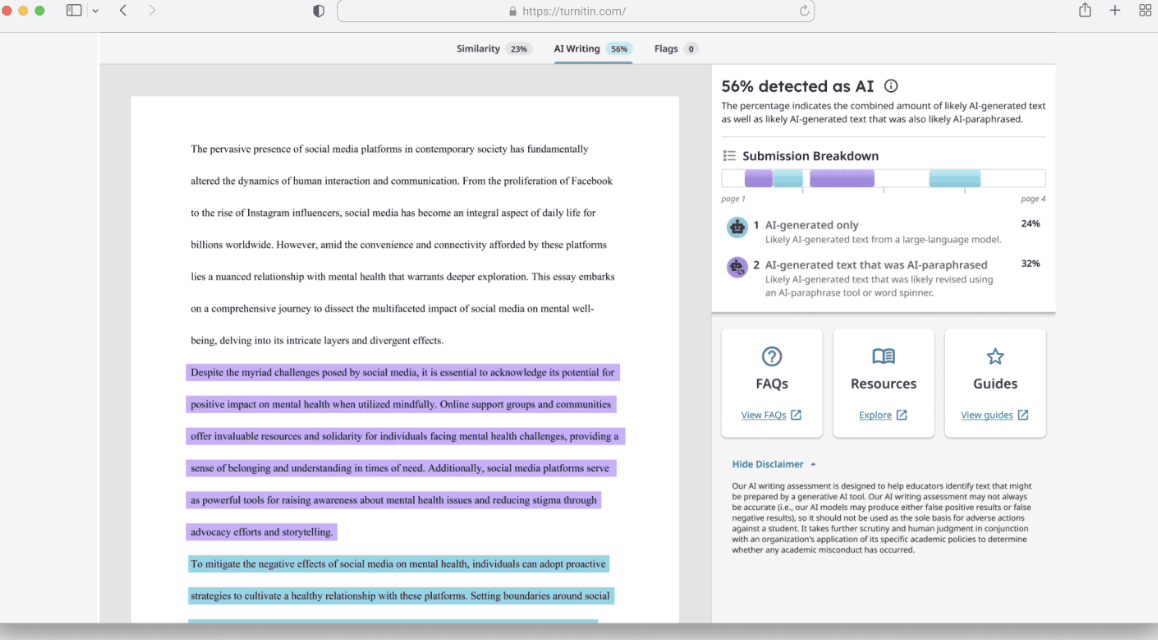
When the same paper was analyzed with JustDone, the result differed by just one percentage point.
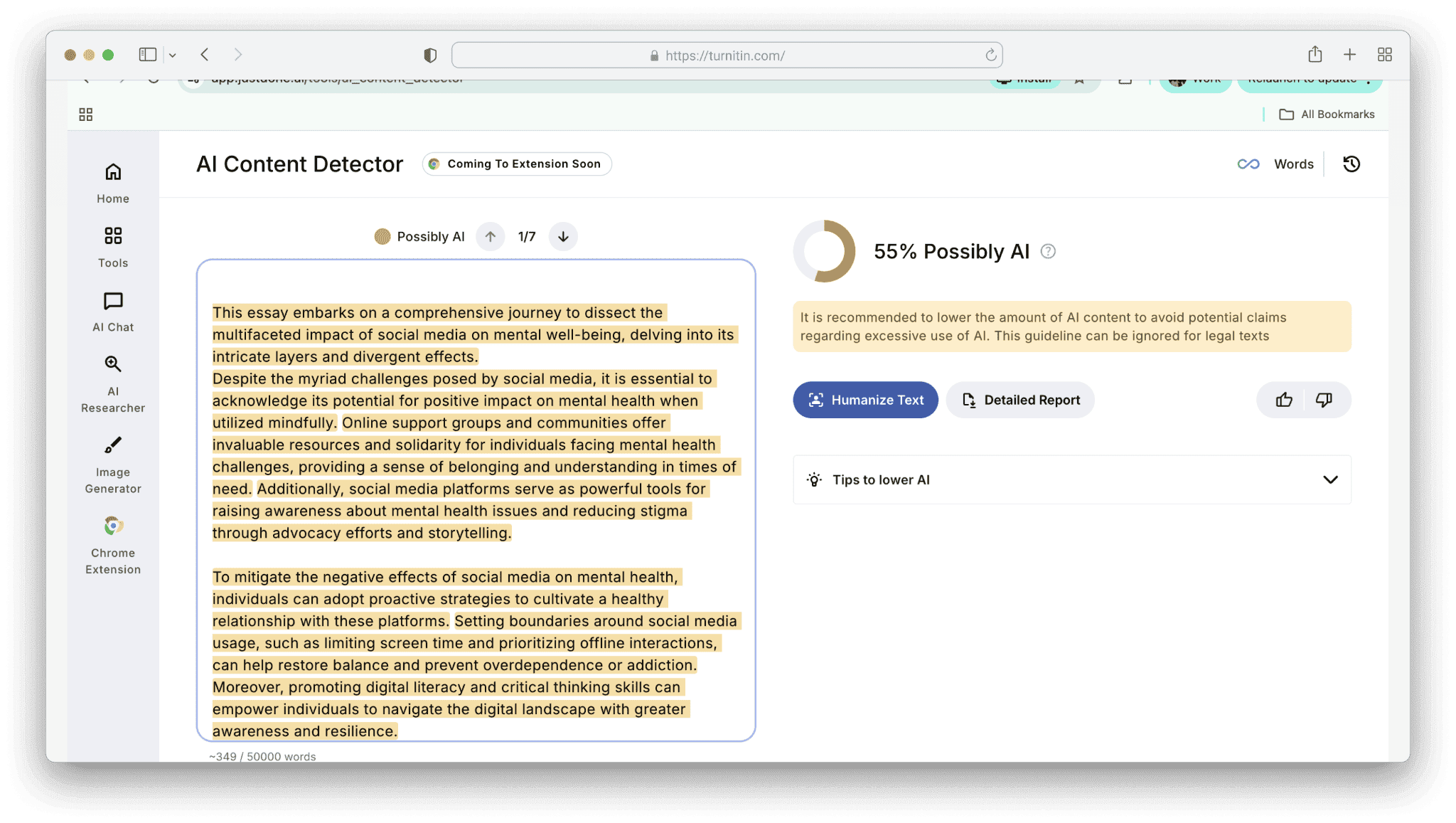
You will see source-linked results at the sentence level in JustDone, so you know what specifically needs to be rewritten or properly cited.
How Rules Differ Across Disciplines
The standards around attribution vary significantly between fields. Violating discipline-specific norms can constitute a violation even when general rules are followed.
Sciences and social sciences
Citation is expected for virtually every factual claim, data point, and methodological decision that came from another source. Reproducing tables or figures without permission and attribution is treated as a serious violation. The norm is comprehensive citation. Basically, if you are unsure whether something needs a source, add one.
Humanities
Close reading of texts is central to humanities scholarship, which means the relationship between your analysis and a source is complex. Using another scholar's interpretation of a text without crediting them is a violation even when you are working with the same primary source independently. This is a disciplinary norm that students new to humanities methods often miss.
Law
Legal writing has different conventions from other academic disciplines. Certain forms of copying, such as reproducing statutory language, citing judicial decisions verbatim, and so on, are standard practice. It does not require quotation marks in many contexts. However, copying another lawyer's brief or a law review article without attribution violates academic integrity standards.
Creative writing
Influence, homage, and imitation are part of creative writing approaches that differ from academic writing. The line between inspiration and misappropriation in creative work is genuinely less defined. However, reproducing another author's specific language, plot structures, or distinctive stylistic choices without acknowledgment can be considered plagiarism even in creative contexts.
Drag
To make sure your work remains original, refer to our detailed advice on how to avoid plagiarism. It includes working with these nontrivial cases too.
Drag
5 Gray Areas You Need to Know
Sometimes, plagiarism is hard to catch. Understanding why is plagiarism a problem even in ambiguous situations helps clarify why the rules exist and how to apply them when the answer is not obvious. These situations can include:
1. Collaborative work and shared ideas
When you work through an idea with a study group, a writing tutor, or a peer reviewer, the line between your thinking and theirs can blur. The standard is that the writing and the ideas in your submission should be your own unless the assignment is about collaboration. If a conversation significantly shaped your argument, acknowledging it, at least informally in a footnote, is the transparent approach that protects you.
2. Ideas absorbed during research
Heavy reading can result in ideas that feel entirely your own by the time you write. You have processed them, synthesized them, and they feel like conclusions you reached yourself. If those ideas came from a source, they still require attribution. This is not a moral failure; it is a reason to keep organized notes that distinguish source material from your own thinking as you research.
3. Translating from another language
If you read a source in another language, paraphrase it in English, and include it in your paper, the original author still requires attribution. The intellectual content belongs to them regardless of the translation. Citing a translated version as if you accessed the primary source directly when you did not is a form of source misrepresentation.
4. Widely repeated claims without a clear origin
Some ideas are cited so widely that their original source is obscure. Finding the original is worth the effort, because citing the original author is more accurate than citing whoever popularized the claim. When the original is genuinely untraceable, you can do the following: acknowledge that the idea is widely discussed in the literature. It is for sure better than presenting it as your own original insight.
5. Using AI tools during the writing process
A student who uses ChatGPT, Claude, Gemini, or other LLMs to brainstorm, polish, or improve sentences differs from the one who submits AI-generated text wholesale. Most institutions are still defining their rules for how to use AI in academic spaces. The safest approach is to check your institution's specific AI policy, disclose any AI assistance where required, and treat AI-generated text the same way you would treat any other source. It should go as something that requires attribution if it appears in your work.
Pick the Guide That Fits Your Situation
Seven deep dives, grouped by what you're trying to do.
Fundamentals
GuideWhy Is Plagiarism Bad? Academic, Ethical, and Professional Reasons ExplainedGuideWhy Is Plagiarism a Violation of Ethics?GuideConsequences of Plagiarism: What You Risk and How to Protect YourselfTypes of plagiarism
GuideTypes of Plagiarism: A Complete Guide for Students and WritersGuideSelf Plagiarism: What It Is, Why It Matters, and How to Stay SafeGuideMosaic Plagiarism: Examples and How to Avoid ItGuideAccidental Plagiarism: What It Is, Why It Happens, and How to Prevent ItAI & Plagiarism
GuideIs Using AI Plagiarism? The Honest AnswerGuideIs Using ChatGPT Plagiarism? The Problem of Academic IntegrityGuideHow to Ensure Your AI-Assisted Essay Meets Academic Integrity StandardsGuideHow to Avoid AI Detection in WritingFrequently Asked Questions
What are the main types of plagiarism?
Direct copying, paraphrasing without citation, patchwork misappropriation, self-plagiarism, accidental omissions, and AI-generated content submitted as original work. Each involves a different form of misrepresentation. A full breakdown of each type with examples is available in the dedicated guide to types of plagiarism.
Is paraphrasing considered plagiarism?
Paraphrasing without a citation is a violation. The idea belongs to the original author regardless of how you expressed it. Paraphrasing requires both genuinely different phrasing and attribution to the original source.
Is using AI or ChatGPT plagiarism?
Submitting AI-generated content as your own original work without disclosure violates most academic integrity policies. A similarity checker confirms text does not match existing sources, but AI-generated content typically does not match any source in a database, so a separate AI detection scan is needed. JustDone includes both in one workflow.
How can I check if my work has plagiarism?
Paste your text into JustDone's plagiarism checker and review the sentence-level results. Every flagged section links directly to the matching source so you can see exactly what overlapped and add the appropriate citation or rewrite before submitting.
What percentage of plagiarism is acceptable?
Most universities consider similarity scores under 15% acceptable, but the number alone does not tell the full story. Properly cited quotes appear as matches and are not a problem. Unattributed sections are. Always review what is flagged rather than focusing only on the overall percentage.
Can you plagiarize yourself?
Yes. Reusing your own previously submitted work without disclosure is self-plagiarism. If you want to build on prior work, disclose it to your instructor and cite the original submission.
What is accidental plagiarism?
Unintentional use of someone else's words or ideas without attribution — typically from missing citations, paraphrasing too closely, or research notes that blurred the line between source material and original thinking. It is treated seriously by most institutions regardless of intent.
How do plagiarism checkers detect copied text?
By breaking your text into fragments and comparing them against large databases. Matches are identified by similarity, not just exact copying. It means paraphrased content also gets flagged. Advanced tools also analyze sentence structure and writing flow to catch overlap that basic checkers miss.
How can students avoid plagiarism?
Cite as you write rather than retroactively. Paraphrase from memory after closing the source. Keep notes that distinguish your own ideas from source material. Check your draft with a plagiarism checker before submitting. Catching issues at draft stage takes minutes to fix rather than a formal integrity process to navigate.
