Key takeaways:
- Plagiarism is a question of academic integrity. It includes improper paraphrasing, missing citations, self-plagiarism, and even AI-generated content used without disclosure.
- The best way to avoid plagiarism is to build good habits from the start: take organized notes, cite sources as you write, and clearly separate your ideas from source material.
- Before submitting any assignment, run a plagiarism check to catch missed citations and similarity issues. Tools like JustDone can help you identify and fix potential problems before they affect your academic work.
Plagiarism is one of the most serious issues in academic writing. However, it is easy to prevent if you know the rules of academic integrity. At its core, academic integrity is the commitment to honesty, trust, and responsibility in all academic work. No matter how plagiarism happens (intentionally or by accident), submitting work that misrepresents who wrote it or where the ideas came from undermines the learning process. Besides, it carries real consequences.
The good news is that with the right habits and tools, you can avoid plagiarism entirely. This guide walks through what works best, from citation practice to using a plagiarism detector as a pre-submission check.
How to Avoid Plagiarism in Academic Writing
Before building habits to avoid plagiarism, it helps to understand what actually counts as plagiarism in academic contexts. Most students associate it with copy-pasting, but the definition is broader:
- Direct copying — reproducing text word-for-word without quotation marks or citation
- Paraphrasing plagiarism — rewording another's ideas without attributing the source
- Mosaic plagiarism — stitching together phrases from multiple sources without attribution
- Self-plagiarism — reusing your own previously submitted work without disclosure
- AI plagiarism — submitting AI-generated content as your own original writing
- Improper citation — acknowledging a source but formatting the citation incorrectly
Research referenced by the International Center for Academic Integrity has found that more than two-thirds of undergraduate students admit to cheating on written assignments or tests at least once. Understanding which behaviors constitute violations is the foundation of genuine prevention.
Tips to Avoid Plagiarism in Your Writing Process
The most effective approach to avoiding plagiarism is building good habits throughout the writing process, not just at the end. Here are the strategies that consistently work.
Start with organized notes
One of the most common causes of accidental plagiarism is poor note-taking. When researchers absorb information from multiple sources without clearly recording what came from where, they can later mistake a source's phrasing for their own. Keep a running document that records each source alongside the ideas and quotations you took from it. When you return to your notes weeks later, you will know immediately what needs attribution.
Understand paraphrasing properly
Paraphrasing is one of the trickiest areas of academic writing. Changing a few words while keeping the same sentence structure is still paraphrasing plagiarism; it is just harder to detect. Effective paraphrasing means fully restructuring the idea in your own words after you have genuinely understood it.
A reliable test: after reading a source passage, close it, wait a few minutes, and write the idea entirely from memory. If you need to reopen the source to write your version, you may be too dependent on its phrasing. When in doubt, a paraphrasing tool can help you rephrase content correctly while preserving the original meaning.
Cite as you write
Do not leave citation for the end. Every time you use an idea, argument, statistic, or direct quote from an external source, note the citation immediately. Retroactively tracking sources after a draft is complete wastes time and increases the risk of missing something. Most word processors allow you to add citations inline as you draft, which makes the final bibliography straightforward to compile.
Use quotation marks consistently
Any text taken verbatim from a source must appear in quotation marks, regardless of length. A single distinctive phrase lifted from a source without quotation marks is still plagiarism, even if the sentence around it is your own. The rule is simple: if it came from somewhere else exactly as written, mark it as such.
Distinguish between your analysis and your sources
Academic writing requires you to do more than summarize sources. Your argument, interpretation, and analysis are your contribution. When you synthesize information from multiple sources, be explicit about which ideas came from external sources and which conclusions are your own. This clarity protects you and strengthens your writing.
How to Prevent Plagiarism: Citation and Source Management
Proper citing is the technical foundation of academic integrity. Even writers who understand the principles of plagiarism sometimes struggle with the mechanics of citation. Here is what matters most.
What Is the Best Way to Avoid Plagiarism Through Citation?
The best way to avoid plagiarism through citation is to apply a consistent rule: cite anything that a reader would need to look up to verify or explore further. This includes:
- Direct quotations from any source
- Specific statistics, data points, or research findings
- Arguments or interpretations from another author
- Ideas that are specific to a particular writer, even when paraphrased
- Images, figures, or tables from external sources
Commonly known facts — dates that appear in every textbook, definitions that are universal across the field — generally do not require citation. If you are unsure whether something qualifies as common knowledge in your discipline, cite it.
How to properly cite sources varies by citation style. APA, MLA, and Chicago each have specific formats for books, journal articles, websites, and other source types. Using a citation generator takes the formatting burden out of the process and reduces errors in bibliographies, particularly for students managing large numbers of sources across a long paper.
Keep a citation document
As you research, maintain a running list of every source you consulted, not just the ones you cited. If a passage you thought was your own turns out to echo a source, having the full list available makes attribution possible. Sources you consulted but did not cite can sometimes be listed as background reading, depending on your institution's requirements.
How to Remove Plagiarism From a Draft Before Submitting
Even careful writers sometimes discover plagiarism issues in their drafts, either through self-review or by running a detection check. Here is how to address it systematically.
Review manually against your sources
Go back to every source you cited and read your writing alongside it. Look specifically for:
- Sentences or phrases that mirror the source too closely, even if words are changed
- Ideas or arguments borrowed without attribution
- Paraphrasing that follows the source's structure sentence by sentence
This manual comparison is most effective when your source list is well-organized and complete. It catches paraphrasing plagiarism that automated tools sometimes miss, because it involves judgment about similarity rather than exact text matching.
Use a plagiarism checker as a verification step
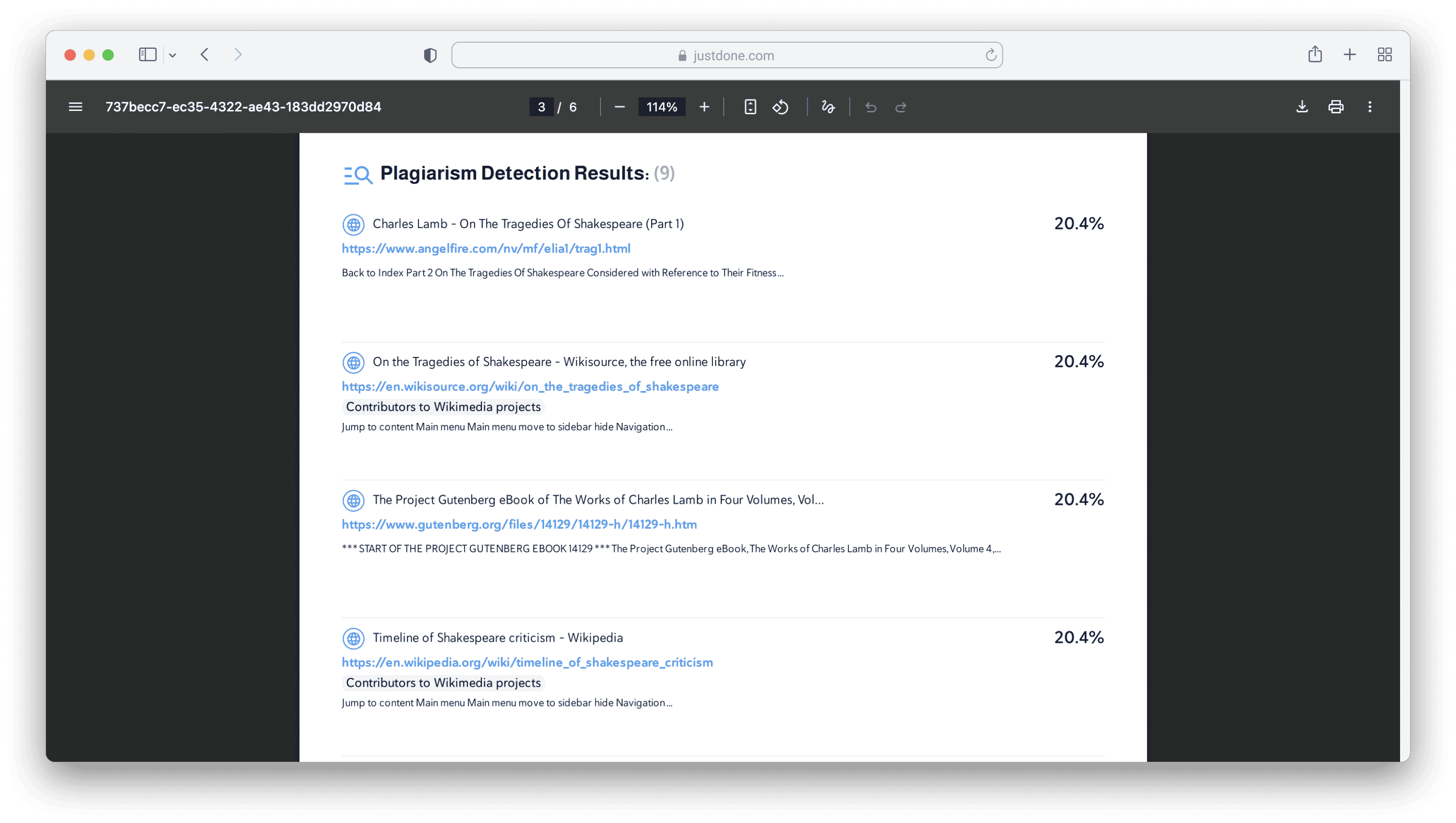
A plagiarism detector scans your work against billions of web pages, open-access academic papers, and previously submitted student work simultaneously. The output is a similarity report showing matched passages and their sources.
When reviewing your report, look at what was flagged rather than focusing only on the overall percentage. Properly cited direct quotes will often appear as matches. That is expected and not a problem. The passages that require attention are highlighted sections without attribution.
JustDone's plagiarism checker is built into a broader writing workflow, which means you can identify a flagged section and revise or add a citation within the same tool.
Here’s how JustDone’s plagiarism detection report looks like:
 Checking early in the drafting process, not just at final submission, gives you more time to address issues without deadline pressure.
Check AI-generated content separately
Traditional plagiarism checkers look for matches against existing sources. AI-generated text typically does not match any specific source in a database, so a clean similarity score does not confirm that AI-generated content is absent. If you have used AI tools at any stage of your writing process, run your draft through an AI detector as a separate step to understand how the content reads from a detection standpoint.
If you do use AI in a way your institution permits, cite it. APA, MLA, and Chicago now all have guidance on citing AI-generated content. Disclosure is not just ethical — it protects you from being misidentified as having submitted content that was not yours.
Building Long-Term Habits to Avoid Plagiarism
The students who consistently avoid plagiarism are not the ones who check most carefully at the end; they are the ones who have built habits that prevent problems from arising in the first place.
The most effective long-term habits are:
- Cite as you write, not after
- Take organized notes that distinguish your own ideas from source material
- Paraphrase from memory, not from the open text
- Use quotation marks for any verbatim text, no matter how short
- Run a plagiarism check before final submission as a standard step
- Disclose any prior work you are building on before reusing it
- Keep draft history in Google Docs or Word as a record of your writing process
These habits do not require significant additional time. They require consistent application, and they protect both your academic record and the integrity of your work.
Frequently Asked Questions
What types of plagiarism exist?
The main categories are direct plagiarism, paraphrasing plagiarism, mosaic plagiarism, self-plagiarism, AI plagiarism, accidental plagiarism, and source-based plagiarism. Each involves a different form of misrepresentation, from copying an entire document to failing to cite a paraphrased idea. Understanding the distinctions matters because each type requires a slightly different prevention strategy.
How much plagiarism is acceptable in academic writing?
Most universities consider a similarity score under 15% reasonable, but this varies significantly by institution and depends on what is driving the score. Properly cited direct quotes often appear as matches in similarity reports, which is expected. The threshold that matters is not the overall percentage but the proportion of unattributed content. Check your institution's specific guidelines before interpreting your similarity report.
Can I check for plagiarism for free?
Yes. Manual comparison against your sources is free and effective for catching paraphrasing issues and verifying citations. For automated checking, tools like JustDone's plagiarism detector offer a trial with access for basic checks. Running both a manual review and an automated scan gives you the most complete picture before submission.
Does paraphrasing always avoid plagiarism?
Not on its own. Paraphrasing without a citation is still plagiarism; the idea originated with another writer regardless of how you expressed it. Effective paraphrasing requires both genuine rewording and attribution to the original source. If the idea, argument, or finding came from somewhere else, that source needs to be credited.
How to avoid plagiarism comes down to one consistent principle: accurately represent where every idea in your work came from. Cite your sources, paraphrase genuinely, check your work before submitting, and use available tools to verify what you may have missed. Academic integrity is not a set of rules to navigate around; it is the foundation of work that is actually worth producing.
