Key takeaways:
- There are more types of plagiarism than most students realize. Complete plagiarism, mosaic plagiarism, paraphrasing plagiarism, self plagiarism, and accidental plagiarism all count as violations, even when you didn't copy intentionally.
- The most common types of plagiarism happen by accident. If you paraphrase without a citation, confuse source material with your own notes, or reuse previous work without disclosure, you will be flagged.
- Running your draft through JustDone's AI plagiarism checker before submission catches sentence-level matches across all common types of plagiarism. This gives you time to fix issues before they reach your professor.
Academic dishonesty takes many forms, and understanding the types of plagiarism is the first step toward avoiding them. For a student working on an essay or a researcher submitting a paper, knowing what constitutes plagiarism matters a lot. Understanding what is plagiarism in its broadest sense is essential before exploring its specific forms.
According to a 2023 study by Turnitin, over 57 million papers showed evidence of potential plagiarism. This confirms that the problem is widespread across all levels of education and publishing.
This guide covers every major category clearly, with practical examples of plagiarism so you can recognize and avoid each one.
Why Knowing Plagiarism Types Matters
Before diving into individual categories, it helps to understand why the distinctions matter. Different plagiarism types carry different consequences and require different prevention strategies. Some are deliberate. Others happen by accident. Some involve entire documents. Others show up in a single sentence. Institutions, journals, and instructors treat each differently, but seriously.
Harvard University notes that plagiarism is using another person's ideas or language without adequate credit, even when the borrowing is limited to a small portion of a paper.
Understanding intentional vs unintentional plagiarism is particularly important for students.
Accidentally paraphrasing too closely is handled differently than deliberately submitting someone else's work. But both can result in academic penalties. The intent affects the severity of the response, not whether a violation occurred.
Types of Plagiarism Explained
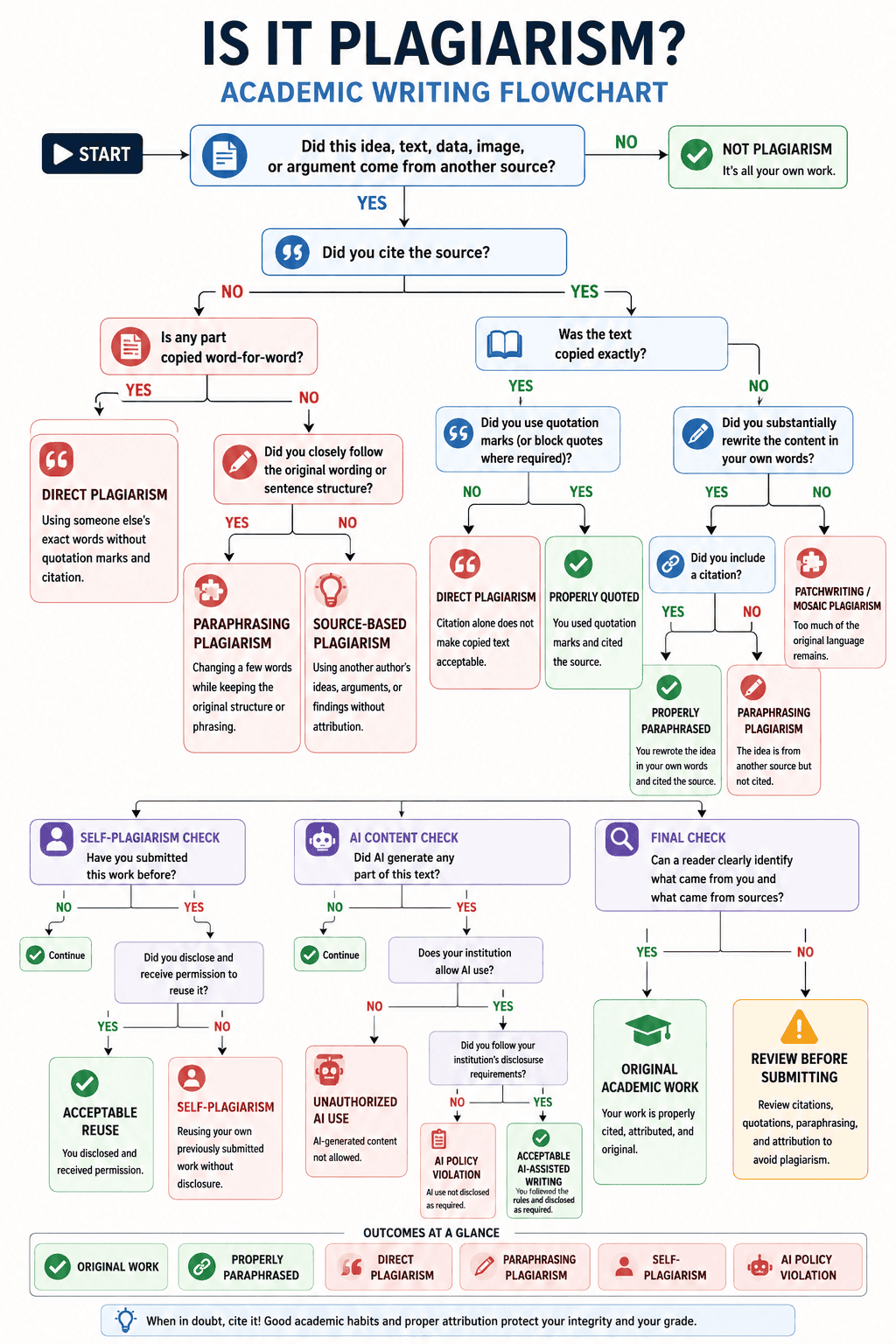
Here is a breakdown of the most important categories, from the most severe to the most commonly misunderstood.
What Is Complete Plagiarism?
Complete plagiarism is the most serious form. It means taking an entire piece of work written by someone else and submitting it as your own without any acknowledgment. This includes purchasing essays from contract cheating services, submitting a classmate's paper, or copying a published article word for word under your own name.
Complete plagiarism is not a gray area. It is a deliberate act of deception and is treated as the most severe form of academic misconduct at virtually every institution. The consequences typically include a failing grade, academic probation, or expulsion.
Direct Plagiarism
Direct plagiarism involves copying a specific section of someone else's work without quotation marks and without citation. Unlike complete plagiarism, it does not involve an entire document. It targets a paragraph, a few sentences, or a passage that is lifted and inserted into a new work as if it were original.
This is one of the common types of plagiarism that plagiarism detection tools catch most reliably, because the text matches existing published sources exactly. Running a draft through an AI plagiarism checker before submission flags these matches at the sentence level.
Mosaic Plagiarism
Mosaic plagiarism — also called patchwork plagiarism — involves taking phrases, sentences, or ideas from one or more sources and weaving them together with minimal changes. The writer might swap a few words for synonyms or rearrange sentence order, but the underlying structure and meaning are borrowed without attribution.
This type is harder to detect by eye because it does not match any single source exactly. Detection tools identify it by analyzing phrase-level similarity across multiple sources simultaneously. According to Harvard's guide on using sources, mosaic plagiarism is one of the most commonly misunderstood forms — many students who engage in it do not realize it crosses the line.
The following are the key characteristics that define mosaic plagiarism:
- Synonyms replace original words without changing meaning
- Sentence order is rearranged but the content is unchanged
- Phrases from multiple sources are combined without citation
- The text reads as original but closely mirrors the source material
Paraphrasing Plagiarism
Paraphrasing plagiarism occurs when a writer restates someone else's idea in their own words but fails to cite the original source. The language is different, but the intellectual content is not. The idea, argument, or finding originated elsewhere, and the reader has no way of knowing that.
This is one of the most common misunderstandings in academic writing. Many students believe that paraphrasing eliminates the need for a citation. It does not. Any time you express an idea that came from another source — regardless of how completely you rewrote it — that source needs to be credited.
Source-Based Plagiarism
Source-based plagiarism involves misrepresenting your sources rather than copying text directly. This includes citing a source you never actually read, fabricating a citation entirely, or misquoting a source in a way that distorts its meaning. It also includes citing a secondary source as if you consulted the primary source directly.
This type matters because it undermines the credibility of the work beyond the plagiarism itself. A reader following your citation to verify a claim will find either no source, the wrong source, or a source that does not support what you claimed. In research publishing, fabricated citations are treated as a form of research fraud.
Self Plagiarism
Self plagiarism is the reuse of your own previously submitted or published work without disclosure. Submitting the same paper to two different courses, reusing large sections of a previous assignment without attribution, or republishing research findings in a new journal without acknowledging the original publication all constitute self-plagiarism.
The most common misconception is that owning the original work makes reuse acceptable. Academic institutions disagree. The purpose of an assignment is to demonstrate current learning and effort. Submitting work that was produced for a different purpose misrepresents that effort, regardless of authorship.
Accidental Plagiarism
Accidental plagiarism is among the most common types of plagiarism in student writing. But it is the most preventable. It occurs when a writer forgets to include a citation, uses a phrase from a source without realizing it, or paraphrases too closely to the original without intending to copy.
The fact that it is unintentional does not make it less of a violation. Most academic integrity policies treat the outcome rather than the intent as the basis for a finding. Intentional vs unintentional plagiarism may affect the severity of the consequence, but both result in a conversation with an academic integrity officer.
Common causes of accidental plagiarism include:
- Taking notes without recording sources and later confusing your own words with quoted material
- Paraphrasing without checking that the rewording is sufficiently different
- Forgetting to add a citation after writing a passage
- Incorrectly assuming that commonly known information does not need attribution
AI-Generated Plagiarism
AI-generated plagiarism is a newer category that is increasingly relevant. It occurs when a student or writer submits AI-generated content as their own original work without disclosure. Because AI models draw from existing published material, the output may reproduce phrases, arguments, or structures from identifiable sources. Sometimes, without the user being aware.
Beyond the detection risk, submitting AI-generated text as your own raises the same fundamental issue as other forms of plagiarism: it misrepresents who produced the work and what effort was involved. Most institutions now address this explicitly in their academic integrity policies.
Examples of Plagiarism in Practice
Seeing examples of plagiarism in concrete scenarios makes the categories easier to apply:
- Direct plagiarism example: A student copies three sentences from a Wikipedia article into their essay without quotation marks or citation.
- Mosaic plagiarism example: A student takes a paragraph from a journal article, replaces several words with synonyms, and includes it in their paper without any citation.
- Paraphrasing plagiarism example: A student reads a study finding that "social media use is associated with higher rates of anxiety in adolescents" and writes "teenagers who use social media tend to experience more anxiety" without citing the study.
- Self plagiarism example: A student submits a paper on climate change that was written for a sociology class to satisfy a political science assignment the following semester.
- Source-based plagiarism example: A student cites a primary source they never read, having found the reference in a secondary source. But he formats the citation as if they consulted the original directly.
Gray Areas: Five Situations Students Are Genuinely Unsure About
Most plagiarism guides cover the obvious cases. Here are five situations where students genuinely do not know where the line is.
1. Using your professor's lecture notes or slides
Lecture slides and verbal explanations are someone else's intellectual work. If you use an idea or specific framing from a lecture in your written work, it needs a citation. Most citation styles have a format for unpublished course materials — use it.
2. Paraphrasing a source you found in translation
You still cite the original author, not the translator. The idea originated with the original writer regardless of what language you read it in. If you cannot verify the translation's accuracy, note in your citation that you consulted a translated version.
3. Reusing a sentence from your own previous draft
Even one sentence from a previous assignment counts as self-plagiarism without disclosure. The fix is simple: tell your instructor. One sentence of transparency converts the issue entirely.
4. Using a classmate's example with their permission
Permission from the original person does not eliminate attribution. If the framing or specific example originated with your classmate, they need to be acknowledged, typically in a footnote or brief in-text note.
5. Facts that seem too common to need a citation
The test is not whether you have seen the fact before. It is whether you know its original source. Population statistics, research findings, and quantitative claims almost always need a citation, even when they feel like common knowledge. If you cannot find the source, do not include the fact.
When you are unsure, run your draft through JustDone's AI plagiarism checker before submitting. Flagging something for review is considerably less stressful than explaining it afterward.
How to Identify and Prevent Plagiarism
Understanding how to prevent plagiarism starts with a consistent verification process before any work is submitted. The most reliable approach combines careful citation practice with a detection tool that catches what manual review misses.
What types of plagiarism exist across the categories above share one common feature: they can all be identified before submission if you check. Running your draft through JustDone's AI plagiarism checker compares your text against published sources and flags potential matches at the sentence level. This will give you time to address any issues before they become academic integrity proceedings.
The practical checklist for avoiding every type covered in this guide:
- Cite every source you consulted, including those you paraphrased
- Use quotation marks for any text taken verbatim from a source
- Check your notes for phrases that may have originated in source material
- Disclose any prior work you are building on before submitting
- Verify every citation against the actual source to avoid source-based errors
- Run your final draft through a plagiarism detection tool before submission
Frequently Asked Questions
What types of plagiarism exist?
The main types of plagiarism are complete plagiarism, direct plagiarism, mosaic plagiarism, paraphrasing plagiarism, self plagiarism, source-based plagiarism, accidental plagiarism, and AI-generated plagiarism. Each involves a different form of misrepresentation, from copying an entire document to failing to cite a paraphrased idea. But all violate the fundamental principle that submitted work must accurately represent who produced it and where the ideas originated.
Is using ChatGPT considered plagiarism?
Not necessarily. Using ChatGPT is not automatically plagiarism, but submitting AI-generated content as your own work may violate your school's academic integrity policies. The key issue is transparency and attribution. Because policies vary, always check your school's guidelines. When in doubt, cite AI-generated content if required and use plagiarism and AI detection tools to review your work before submission.
Wrapping up, understanding the full range of types of plagiarism is not just about avoiding penalties, but about producing work that accurately represents your thinking and a fair academic process. No matter what kind of plagiarism happens – intentional copying or accidental paraphrasing – the tools and habits to prevent it are the same: cite consistently, verify before submitting, and use a detection tool to catch what you might have missed.
