Key takeaways:
- The consequences of plagiarism can range from a failed assignment to suspension, expulsion, or even legal action, depending on the severity of the violation.
- Plagiarism affects more than grades. It can damage your academic record, professional reputation, and future career opportunities.
- The best way to avoid plagiarism is to cite sources correctly, paraphrase carefully, and check your work before submission. Tools like JustDone's plagiarism checker can help you identify potential issues before they become serious consequences.
Most students know that plagiarism is wrong. Fewer understand what the actual outcomes look like in practice. If you are wondering is plagiarism bad enough to warrant real concern or if you have already received a warning and want to understand what comes next, the answer is straightforward. The consequences of plagiarism are serious, and they reach further than most people expect. This guide covers what happens at each level: academic, professional, and legal.
Plagiarism Consequences in Academic Settings
Academic institutions treat plagiarism as a fundamental violation of academic integrity. The response varies by institution and by the severity of the offense, but the general pattern is consistent across most institutions.
First offense
For a first violation, most universities apply one of the following:
- A failing grade on the assignment
- A failing grade for the entire course
- A formal written warning placed on the student's academic record
- Mandatory academic integrity training or counseling
- Required resubmission with a grade penalty
The specific outcome depends on whether the plagiarism was deliberate or accidental, how much of the work was affected, and what the institution's policy says. Even unintentional plagiarism typically results in a formal consequence.
Repeat or serious violations
When plagiarism is deliberate, widespread, or repeated, the response escalates significantly. Common outcomes include:
- Academic probation
- Suspension from the institution for one or more semesters
- Permanent expulsion
- Retroactive removal of grades or credits from affected courses
A plagiarism finding does not stay contained to the course where it occurred. Most institutions record violations in the student's official academic file. That record follows them through transfer applications, graduate school applications, and professional licensing processes.
The Plagiarism Consequences Matrix
To make you understand what kind of plagiarism leads to consequences and take action fast, I’ve gathered everything you need to know in the following table:
Type | High School | Undergraduate | Graduate/Research | Professional |
|---|---|---|---|---|
| Accidental (missing citation) | Warning, resubmit | Grade penalty | Formal review | Correction notice |
| Paraphrase plagiarism | Zero on assignment | Course failure risk | Academic probation | Contract risk |
| Mosaic plagiarism | Suspension risk | Course failure | Probation or dismissal | Job loss risk |
| Complete plagiarism | Expulsion risk | Expulsion | Degree revocation | Legal action |
| Self-plagiarism | Rare consequence | Grade penalty | Publication retraction | Professional sanction |
| AI-generated content | Policy varies | Course failure | Dismissal | Termination risk |
Consequences of Plagiarism for Your Career
Academic consequences for plagiarism are serious. But the professional consequences can be longer-lasting.
Employment and hiring
Background checks for competitive positions increasingly include academic credential verification. A plagiarism finding on an academic record can lead to a job offer being withdrawn, even years after graduation. In fields where credentials are formally verified, such as law, medicine, education, and finance, an integrity violation in your academic history creates a barrier that is difficult to overcome.
Professional reputation
For researchers, journalists, and published authors, plagiarism findings are often made public. As the American College of Sports Medicine confirms, several high-profile cases have resulted in book withdrawals, retracted publications, lost positions, and lasting reputational damage. These are consequences that extend well beyond the original violation. The ethics and plagiarism question in professional contexts is not theoretical. Institutions, employers, and publishers take it seriously because their own credibility is tied to the originality of the work they produce or endorse.
Loss of work and income
Freelancers and content professionals who plagiarize risk losing clients, contracts, and ongoing work. Platforms that manage content creation have plagiarism policies that result in account suspension or permanent removal. A single verified instance of plagiarism can end a professional relationship and damage referrals in a field where reputation is everything.
Legal Consequences of Plagiarism
Beyond academic and career consequences, plagiarism can carry legal weight. This is the category most students are least aware of.
Copyright infringement
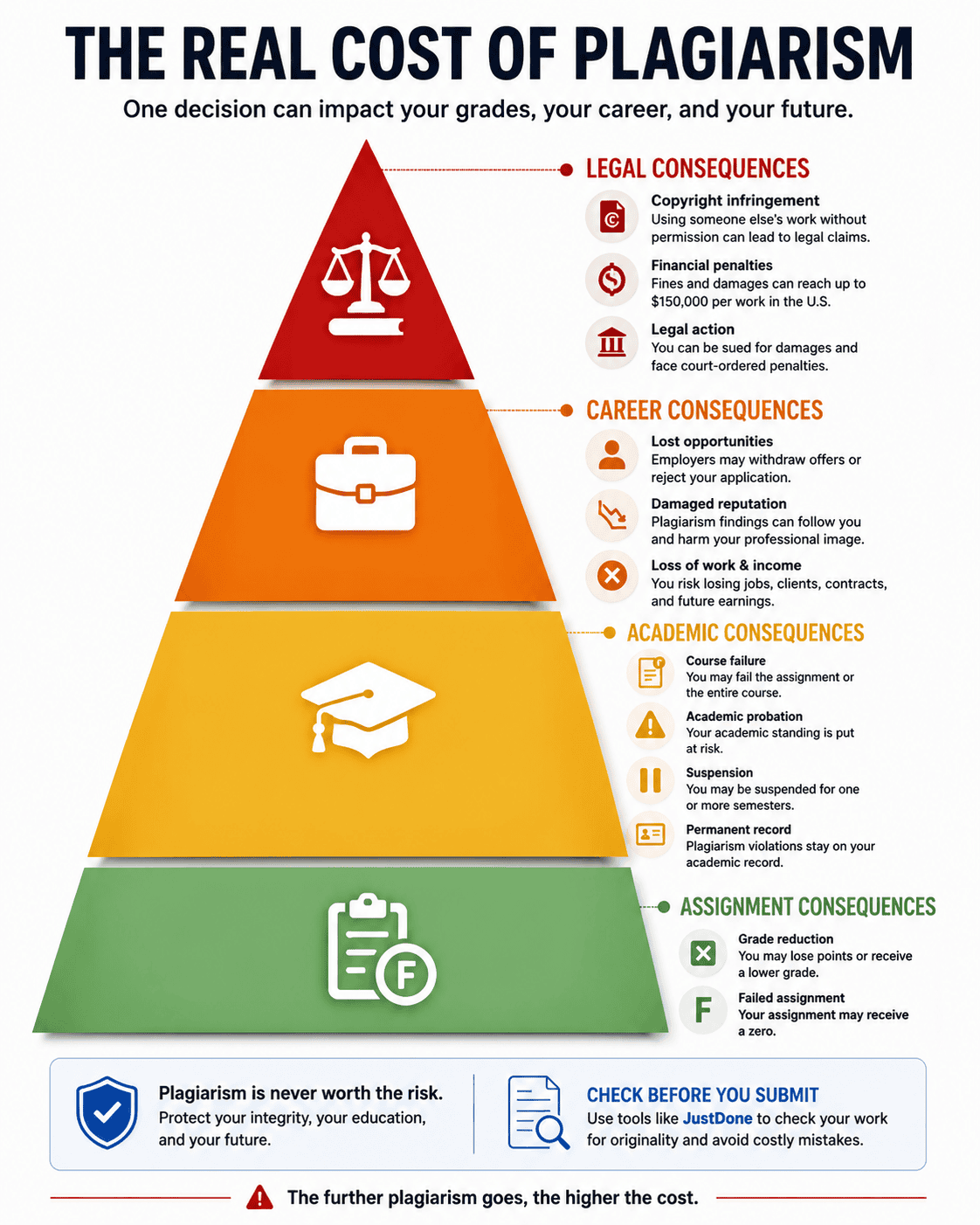
Copyright law protects original written works from the moment they are created. Using substantial portions of a copyrighted work without permission is not just plagiarism. It is copyright infringement, which is a legal violation. Copyright holders can pursue civil action and claim damages. In the United States, statutory damages for copyright infringement can reach up to $150,000 per work in cases involving willful infringement.
Legal action in publishing
Published authors, researchers, and journalists have successfully sued for plagiarism in court. The legal consequences of plagiarism in professional publishing are not limited to reputation. They include financial damages, injunctions requiring the removal of plagiarized content, and in some jurisdictions, criminal liability for fraud where plagiarism was used to obtain financial benefit, such as grant funding or paid publication.
Academic fraud
Submitting plagiarized work for academic credit can constitute fraud in legal terms, particularly when financial benefits such as scholarships, grants, or paid research positions are involved. Several institutions have pursued legal action against students who submitted fraudulent work in these contexts.
Consequences of Plagiarism Specific to AI-Generated Content
A newer category of plagiarism consequence has emerged alongside AI writing tools. Students who submit AI-generated content as their own original work face the same penalties for plagiarism as those who copy from human sources. Most institutions now address this explicitly in their academic integrity policies.
What makes AI plagiarism particularly risky is that AI-generated text does not match existing sources in a traditional plagiarism database. A clean similarity score does not mean the work is original. Institutions now use dedicated AI detection tools alongside the best plagiarism checkers. Running your draft through a GPT checker before submission shows you what those tools will find before your institution does.
Ways to Avoid Plagiarism Before It Becomes a Problem
Understanding plagiarism consequences is useful. Preventing them is better. The most reliable prevention strategies are straightforward and do not require significant extra time.
- Cite as you write. Add citations the moment an external idea enters your draft. Retroactive citation is where ideas get separated from their sources.
- Paraphrase from memory. After reading a source, close it and write the idea from memory. This naturally reduces over-reliance on source phrasing. A paraphraser can help you reword more thoroughly when you are unsure whether your version is far enough from the original.
- Format citations correctly. Citation errors are a common source of accidental misattribution. A citation generator produces accurately formatted references in APA, MLA, and Chicago, which reduces formatting-related errors.
- Check your work before submitting. Using a plagiarism checker as a standard pre-submission step gives you a chance to catch missed citations and close paraphrasing before your instructor does. JustDone's plagiarism checker flags sentence-level matches against published sources and prior submissions, with enough specificity to show exactly which passages need attention.
For a complete breakdown of prevention strategies, see JustDone's guide to ways to avoid plagiarism, designed specifically for students.
Frequently Asked Questions
What are the consequences of plagiarism?
The consequences of plagiarism range from a failing grade on a single assignment to permanent expulsion from an academic institution. Career consequences include job loss, contract termination, and lasting reputational damage. Legal consequences include copyright infringement claims, financial damages, and in cases involving fraud, potential criminal liability.
What happens if you plagiarize in high school?
High school penalties for plagiarism vary by school and district, but typically follow a graduated response. A first offense often results in a zero on the assignment, a parent notification, and a note in the student's disciplinary record. Serious or repeat violations can lead to course failure, suspension, or expulsion. Some high school plagiarism findings appear in records that colleges and universities review during the admissions process. Running work through a plagiarism checker before submitting is the simplest way to catch problems before they reach that stage.
Final Thoughts
The consequences of plagiarism are not abstract. They affect grades, records, careers, and in some cases, legal standing. However, if you act the right way, all of them are preventable. Cite your sources, paraphrase carefully, and verify your work before it goes anywhere. The habits that prevent plagiarism are the same ones that make academic writing stronger overall.
