Key takeaways:
- Changing words is not enough. Mosaic plagiarism happens when sentence structure and ideas are borrowed without citation, even if every word is different. The idea still belongs to its original author.
- Mosaic plagiarism or patchwork plagiarism can happen without realizing it. Weak paraphrasing skills, staying too close to sources, and running out of time are the most common causes. Understanding why it happens is the first step to avoiding it.
- Check your draft before your instructor does. Read your sources, write from memory, cite everything, and run your draft through JustDone's Plagiarism Checker before submission.
Mosaic plagiarism happens when a writer borrows phrases, sentence structures, or ideas from one or more sources, swaps in a few synonyms, and presents the result without proper citation. It is one of the trickier types of plagiarism to catch, because the wording looks new on the surface while the ideas still belong to someone else. It is also called patchwork plagiarism, and it counts as a serious academic integrity violation even when no line is copied word for word.

What Is Mosaic Plagiarism?
Mosaic plagiarism is a form of academic dishonesty where a writer takes phrases, ideas, or sentence structures from one or more sources without citation. Instead of copying text word for word, the writer replaces some words with synonyms or rearranges a sentence while keeping the original meaning and structure intact. The result looks different, but it is still someone else's idea presented as original work.
The name comes from the art form where small tiles form one larger image. In the same way, fragments from different sources are pieced together into what looks like original writing. What makes it tricky is that it rarely feels like cheating: many students believe changing a few words makes an idea their own, but the original still belongs to its author, and credit is always required.
How Mosaic Plagiarism Differs from Other Types of Plagiarism
Plagiarism is not a single behavior. It comes in several forms, each misrepresenting someone else's work in a different way. Knowing the differences helps you see when a line is crossed:
| Type | What happens | Multiple sources | Citation given |
| Direct | Text is copied word for word | No | No |
| Paraphrasing plagiarism | One source is reworded but structure is kept | No | No |
| Mosaic/patchwork | Phrases from several sources are blended and words are swapped | Yes | No |
| Self-plagiarism | Writer reuses their own previously submitted work | No | No |
Direct plagiarism is the most obvious: a source is copied word for word with no attempt to hide it. Paraphrasing plagiarism [internal-link anchor — no URL assigned] is subtler — the writer rephrases the content but stays too close to the original structure and skips the citation.
Patchwork plagiarism goes further. It pulls from several sources, blends the ideas, and swaps words for synonyms so the writing looks original. Because the borrowing runs across a whole piece, it is usually treated as more serious; if you have wondered why is plagiarism unethical, this is part of the answer. Self-plagiarism is different — no outside source is involved, but the writer reuses old work without disclosing it.
One distinction matters: paraphrasing itself is not plagiarism — academic writing favors it over heavy quoting. The problem starts when a paraphrased idea is not cited, or the rewrite is so weak the original structure still shows. That is where it crosses into mosaic plagiarism.
Mosaic Plagiarism Example: How It Looks in Practice
Seeing it in action is the clearest way to understand it. These cases cover academic writing, journalism, and multi-source blending — and the most common setting for mosaic plagiarism is student work.
In Academic Writing
This is the most common setting where mosaic plagiarism occurs. A student reads a source, changes a handful of words, and submits the result without a citation.
Original source (Yibo Zuo, 2026):
“Glycolysis is a central metabolic pathway that converts glucose into pyruvate. Although pyruvate has been well documented to be a key and terminal metabolite of glycolysis with both energetic and biosynthetic roles, its non-metabolic functions remain unexplored.”
Student's version:
“Glycolysis is a fundamental metabolic process that transforms glucose into pyruvate. While pyruvate has been widely recognized as a critical and final product of glycolysis with both energy-related and biosynthetic functions, its non-metabolic roles have not yet been investigated.”
According to JustDone Plagiarism Checker, this abstract is detected 100% plagiarized.
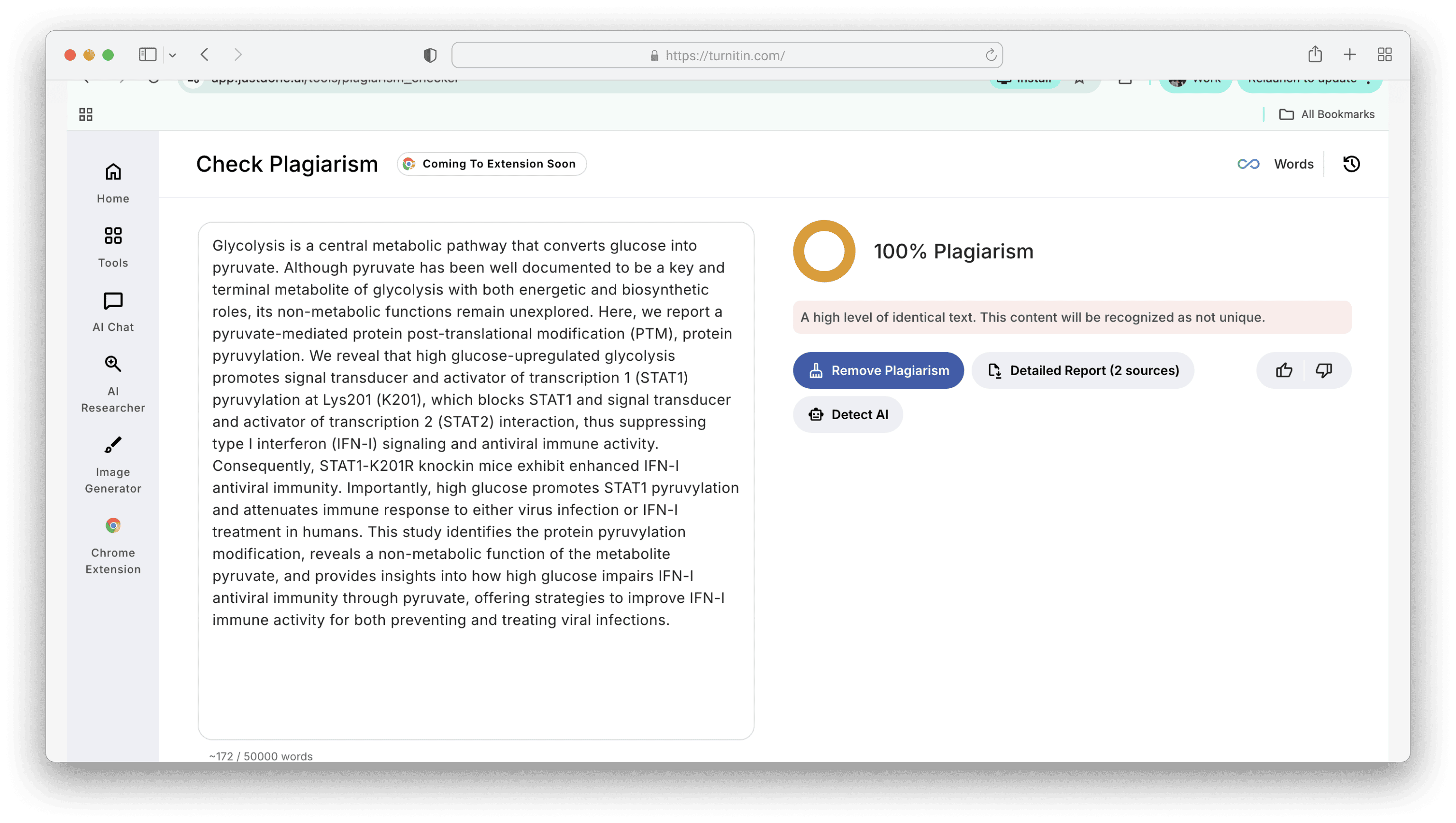
Why it still counts: Despite the synonyms, the sentence structure and order of ideas match the original exactly, and no citation is present.
In Journalism and Content Writing
Mosaic plagiarism is not limited to student essays. It also appears in professional writing, particularly when a journalist or content writer closely follows another outlet's reporting without credit.
Original source:
“The city council passed the new housing ordinance after a heated three-hour debate on Tuesday night.”
Rewritten version:
“After a tense discussion lasting three hours on Tuesday, the city council gave approval to the revised housing law.”
Why it is still plagiarism: The words are different but every detail is preserved. The timing, the outcome, and the sequence of events are all taken directly from the original report. Journalism depends on transparency and source attribution. Rephrasing another reporter's work without crediting them undermines both credibility and professional ethics.
In Multiple Sources
This last case is the clearest patchwork plagiarism scenario. Here is an example of patchwork plagiarism: the writer blends two sources into one paragraph without citing either.
Original source (An Deming, Yang Lihui, 2015):
"Chinese modern folklore has traveled a turbulent path in the hundred years since its inception in the second decade of the twentieth century. During this historical course, the vicissitudes of Chinese folklore studies were shaped by the constant transformation of political, social, and cultural circumstances. Folklore’s changing destiny reflects not only the close interrelation between humanities and social sciences and the state system, political ideology, and social economy, but also the distinctive nature and issues of the discipline itself.”
Student's mosaic version:
“Chinese modern folklore has taken a turbulent journey over the hundred years since it began in the second decade of the twentieth century. Throughout this historical period, the ups and downs of Chinese folklore studies were influenced by the continuous changes in political, social, and cultural conditions. The shifting fate of folklore demonstrates not only the strong connection between humanities and social sciences and the state structure, political ideas, and social economics, but also the unique character and problems of the discipline itself.”
Why it still counts: Every swap is surface-level. The structure and sequence of ideas belong to the original authors, and there is no citation anywhere.
Before you submit, check whether your writing sits too close to your sources. A quick plagiarism check flags sections that mirror existing content, so you can rewrite them and add citations early.
Why Does Mosaic Plagiarism Happen?
Mosaic plagiarism rarely has a single cause. Knowing why it happens is as useful as knowing what it is. The most common reasons are:
- Weak paraphrasing skills. Many think swapping synonyms is enough. Real paraphrasing means understanding a source fully, then rewriting it in a new structure. One study found 84.9% of postgraduate students admitted to unintentional plagiarism from poor academic writing skills.
- Staying too close to the source. When unsure of the topic, a writer mirrors the source because stepping away feels risky.
- Running out of time. A rushed writer patches together source material instead of thinking each idea through.
- Doing it on purpose. Some swap synonyms to lower a similarity score, often with word-spinner tools. Even so, Turnitin catches structural patterns that survive simple synonym swaps.
Non-native English writers face an extra challenge: paraphrasing fluently in a second language is hard, and different citation norms abroad raise the risk even with good intentions.
How to Avoid Mosaic Plagiarism
Avoiding mosaic plagiarism comes down to one habit: engage with your sources instead of leaning on their structure. The key step happens before you write — read the source fully, close it, and write what you understood from memory, which forces you to process the idea rather than mirror the phrasing.
When you start writing, do not rewrite the source sentence word by word. Begin from a blank line and explain the idea as you would to a friend. Then add your own reaction — whether you agree and how it connects to your argument. Our how to avoid plagiarism guide walks through the full routine.
A few practical rules:
- Cite every paraphrased idea, no matter how much you changed the wording.
- Use the citation style your institution requires — APA, MLA, or Chicago. A quick citation guide [internal-link anchor — no URL assigned] helps if you are unsure; JustDone's citation generation can format references for you.
- Keep a running list of sources as you research so nothing gets missed.
- If a sentence still feels too close after rewriting, rewrite it again.
Tools That Help Detect Mosaic Plagiarism
Because the text has already been reworded, this kind of copying is hard to catch by eye. Detection tools make the process more reliable for educators and students. The main options:
- Turnitin — the institutional standard. It compares submissions against a large database and flags paraphrased and structurally similar content.
- Grammarly — mainly a writing assistant, with a built-in checker for quick, surface-level scans.
- Originality.ai — aimed at content creators, useful for both AI-generated text and closely paraphrased material.
- JustDone Plagiarism Checker — it scans drafts before submission and flags sections that mirror sources too closely. It also works as an AI detector, so one scan covers both originality and AI-generated content before you submit to Turnitin.
A quick pre-submission flow:
- Draft your work and paraphrase your sources where needed.
- Run a scan to find sections that are too close to your sources.
- Rewrite the flagged parts, add missing citations, and add your own analysis.
- Run a final check to confirm the issues are resolved.
- Submit to Turnitin with confidence.
No tool is perfect. Both work on probability and pattern recognition: a clean score does not prove originality, and a flag does not prove copying. You still have to fix it with real revision and citation.
Mosaic Plagiarism vs Patchwork Plagiarism
The terms mosaic and patchwork plagiarism describe the same violation and are interchangeable: borrowing phrases and ideas from several sources, making surface-level changes, and presenting the result without citation.
The difference is only in the name. "Mosaic" comes from assembling small tiles into one image; "patchwork" from sewing fabric scraps into one cloth. Academic policies tend to use the first term, while some style guides prefer patchwork plagiarism. Either way, they point to the same problem.
In practice:
- Academic literature and university integrity policies tend to use "mosaic plagiarism" more frequently
- "Patchwork plagiarism" appears as an alternative term in some institutions and style guides
Both terms will be understood in any academic or professional context. If you come across either term in your institution's academic integrity policy, they are pointing to the same problem. Knowing both is useful simply because different educators and institutions have different preferences for which one they use.
Frequently Asked Questions
What is mosaic plagiarism in simple terms?
Mosaic plagiarism is when you take ideas or phrases from other sources, change a few words, and present the result as your own writing without crediting the original author. The wording looks different but the ideas and structure still belong to someone else.
What is mosaic plagiarism vs direct plagiarism?
Direct plagiarism is copying text word for word without any changes or citation. Mosaic plagiarism involves rewording and restructuring the original while keeping its core ideas and sequence intact. Direct plagiarism is easier to detect. Mosaic plagiarism is more subtle because it looks original on the surface but is not.
How can I recognize it in a text?
Look for sentences that follow the same logical order as a known source, forced or unnatural synonyms, writing with no consistent personal voice, and arguments that never go beyond the source. If a passage reads like a lightly edited version of something else, patchwork plagiarism is likely present.
Which tools detect it best?
Turnitin is the institutional standard, and JustDone's Plagiarism Checker is practical for students checking drafts before submission. JustDone also flags AI-generated content in the same scan; Grammarly and Originality.ai are useful extras for web content. JustDone flags sections that mirror existing sources too closely, including mosaic-style paraphrasing, and also detects AI-generated content in the same scan. Grammarly and Originality.ai are useful additional options for web-based content.
Final Summary
Mosaic plagiarism happens when ideas from one or more sources are blended, lightly reworded, and presented without citation. It does not feel like cheating because nothing is copied directly, yet the consequences are the same. The fix is simple: read your sources, write from your own understanding, and cite every idea that is not yours. Changing the words is never enough — the idea, the structure, and the citation all matter, which is why one careful review is the surest way to keep your work clear of mosaic plagiarism.
