Quick answer: Using ChatGPT is not automatically plagiarism. Submitting ChatGPT-generated text as your own original work, without disclosure or attribution, is. The line depends on how you use the tool, what your institution's policy says, and whether you are presenting AI output as something you wrote yourself.
Is using ChatGPT plagiarism? That question comes up in almost every academic writing discussion right now, and the answer is more specific than most people expect. Using ChatGPT to help research, outline, or improve your grammar is not plagiarism. Submitting ChatGPT output as your own original work, without disclosure or attribution, almost always is. The relationship between plagiarism and AI is still being defined by institutions, publishers, and educators. But the core principle has not changed: misrepresenting where your work came from is an integrity violation, whether the source is another human's writing or a language model's output. This guide gives you a clear answer on where the line falls and what to do to stay on the right side of it.
ChatGPT and Plagiarism: What You Actually Need to Know
ChatGPT and plagiarism are connected in two distinct ways that most students mix up. That confusion leads to real consequences.
The first is traditional plagiarism: copying someone else's words without attribution. ChatGPT does not copy verbatim from a single published source. It generates new text from patterns in a large training dataset. Because of this, its output usually does not match any document in a standard plagiarism checker database. A paper written entirely by ChatGPT can return a very low similarity score.
For instance, let’s run a ChatGPT-generated essay through JustDone plagiarism checker. The result is 8% similarity score.
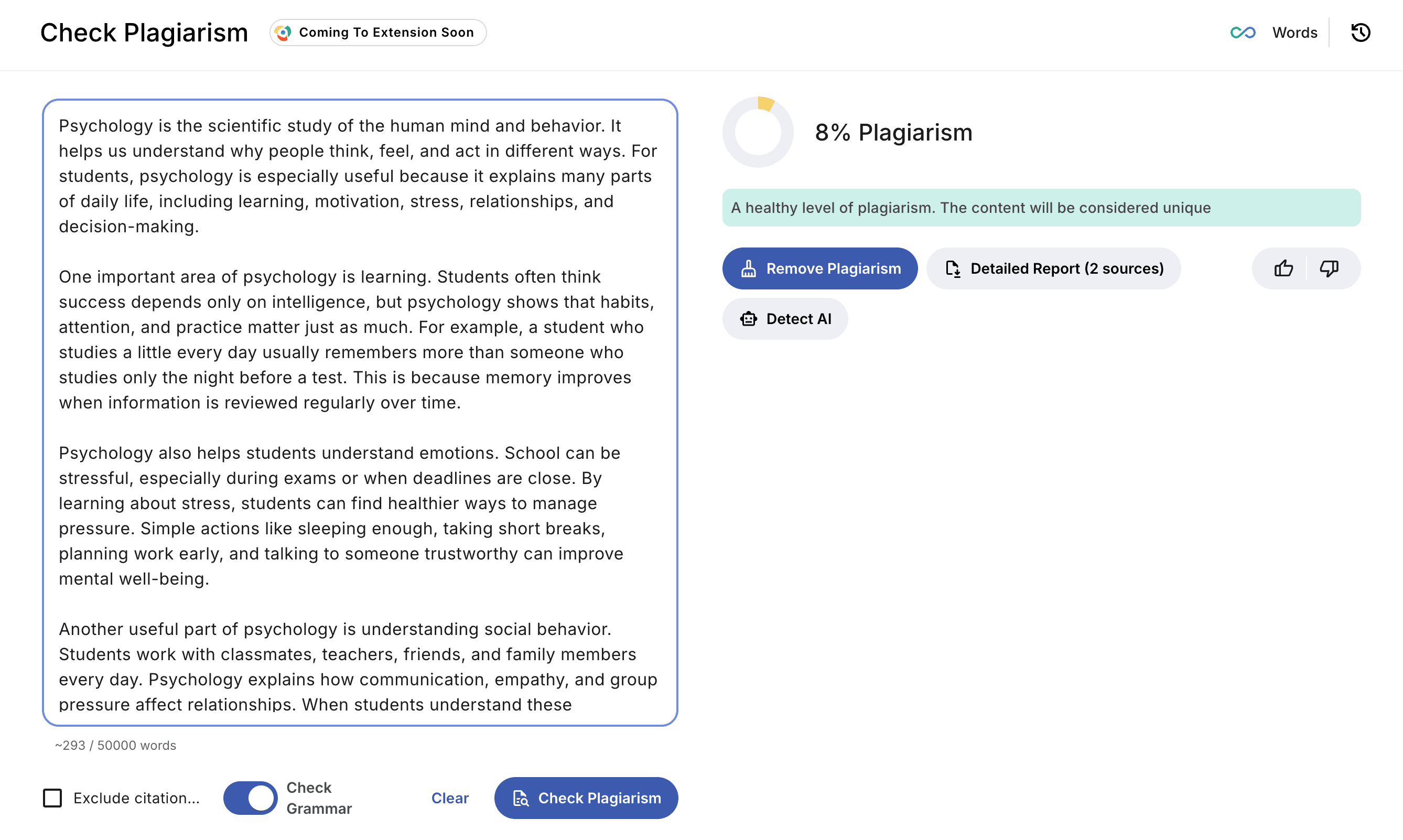
Many students take this as confirmation they are safe. In fact, they are not.
The second issue is academic integrity. When you submit an assignment, the implicit agreement is that the thinking, analysis, and writing reflect your own effort and understanding. Submitting ChatGPT output without disclosure breaks that agreement. Even when the text is technically original and does not match any existing source, it can be flagged as AI-generated.
The same essay with 8% similarity score has 100% AI score when running through JustDone’s AI Detector.
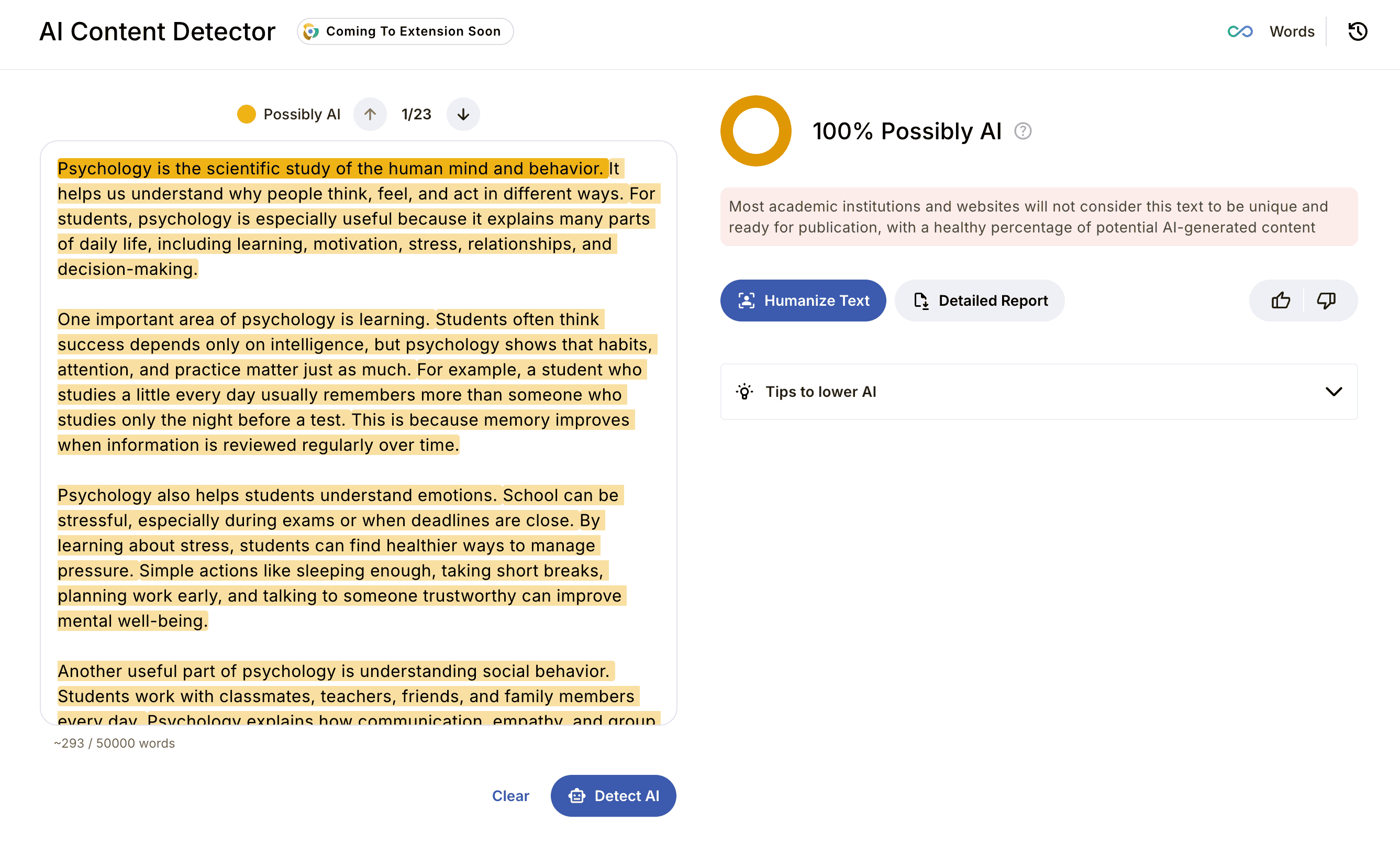
Most institutions now treat undisclosed AI-generated submissions as academic misconduct, with the same range of consequences as conventional plagiarism.
When ChatGPT Plagiarism Happens and When It Does Not
Not every use of ChatGPT creates a problem. The issue is specific to how the output is represented in your submission.
Using ChatGPT is plagiarism if you do the following:
- Submitting a ChatGPT-written essay, report, or assignment as your own work
- Using ChatGPT to write specific sections of a paper without disclosing it
- Plagiarism using ChatGPT to paraphrase a published source, then including that output without citing the original
- Presenting AI-generated analysis or conclusions as your own original thinking
Uses that are not plagiarism:
- Using ChatGPT to brainstorm ideas or sketch an outline before you start writing
- Running your own draft through it for grammar or clarity feedback
- Using it to understand a concept you are researching, then writing your own response from your own understanding
- Disclosing AI assistance where your institution's policy explicitly allows it
Understanding why is plagiarism unethical in the traditional sense helps explain the AI version too. The core issue is the same: presenting work that is not yours as though it is. The source of that work — another student, a published author, or a language model — does not change the fundamental problem.
How Detection Works for AI-Generated Content
Knowing how is plagiarism detected by your institution's tools helps you understand exactly what your submission will be measured against.
Traditional similarity detection compares your text against a database of published sources and previously submitted student papers. Since ChatGPT generates new text rather than copying directly, it typically does not trigger high similarity scores. A clean similarity report means the text does not match known sources. However, it does not mean the submission is honest or original.
AI content detection works on a different set of signals. Turnitin introduced a dedicated AI detection layer in 2023. Tools like JustDone's AI detection scan for statistical patterns: sentence rhythm, word predictability, and structural consistency. These are the signals that separate machine-generated text from natural human writing. No tool is 100% accurate: false positives do occur, particularly for writers who use a formal or highly structured academic style. But institutions are using AI detectors routinely as a standard part of submission review.
This is exactly why ChatGPT and plagiarism in the AI context requires a separate detection approach from traditional similarity tools. Running both checks before you submit gives you the fullest picture of what your professor will find.
Why These Consequences Are Real
The rules around submitting AI-generated work without disclosure exist for reasons worth understanding directly. You need to know them not just to avoid detection.
Your grade is supposed to mean something. A degree or grade signals that you developed specific knowledge and skills. When AI-generated submissions produce that credential, the signal is inaccurate. The people relying on your academic record — employers, graduate programs, professional licensing boards — are making decisions based on information that does not accurately reflect your actual abilities.
Other students are affected too. Those who complete their own work are competing for grades and recognition against submissions that required a fraction of the effort. That is not a fair academic environment, and institutions treat it seriously for exactly that reason.
The consequences around ChatGPT and plagiarism are also more lasting than a single grade penalty. A plagiarism finding can follow you through graduate school applications, professional licensing processes, and employment background checks. The short-term time saved rarely balances against that long-term risk. Using AI as genuine writing support, but not as a substitute for your own thinking, protects you.
What to Do Before You Submit AI-Assisted Work
If ChatGPT was involved at some stage of your writing (for brainstorming, outlining, or editing), these steps reduce your risk before anything goes in.
- Start with your own draft. Your ideas and structure come first. Use ChatGPT to respond to what you have already written, not to produce the writing itself.
- Cite any ChatGPT content that appears in your submission. If AI-generated text appears in your work, attribute it properly. Learn how to cite ChatGPT in APA, MLA, or Chicago. A citation generator with AI source support makes this quick and accurate.
- Check your institution's policy before you write, not after. Rules vary significantly between courses, programs, and schools.
- Run an AI detection check. JustDone's AI humanizer helps you revise AI-flagged sections in your own voice. Then verify the result with a detection scan before submitting.
- Run a plagiarism check alongside it. Both checks together cover the full range of originality risks.
Following these steps means you can avoid plagiarism and use AI tools without putting your academic record at risk.
Frequently Asked Questions
Is ChatGPT plagiarism free?
ChatGPT output is not plagiarism-free in the academic sense. Since it generates new text rather than copying from a single source, it typically does not trigger high similarity scores on traditional detection tools. Many students see a clean plagiarism report and conclude they are safe. That conclusion is wrong. Submitting ChatGPT-generated content without disclosure violates academic integrity policies at most institutions — regardless of what the similarity score shows. A low score means the text does not match known sources in the database. It says nothing about whether the work honestly represents your own thinking and effort. Plagiarism in the AI context is about representation, not just text matching.
Does ChatGPT plagiarize?
ChatGPT usually does not copy text word for word from one source. It creates new text based on patterns in its training data. But that does not make the output automatically original. Sometimes, ChatGPT can produce wording that is very close to existing sources. It can also restate ideas from published research without naming the original author or study. If you use that text in your paper without citing the real source, it can still count as plagiarism. This is true even if ChatGPT wrote the sentence and you did not know where the idea came from.
Can ChatGPT check for plagiarism?
No. ChatGPT is a text generation tool, not a plagiarism detection system. It does not have access to a searchable database of published sources or previously submitted student papers, and it cannot compare your text against existing content to identify matches. For a reliable originality check, use a dedicated tool like JustDone’s plagiarism checker that scans against actual source databases and returns matched results with direct links to the originals.
Is using ChatGPT plagiarism – this question depends entirely on whether you present the output as your own. Understanding that distinction before you submit is the most practical thing you can take from this guide.
