Key takeaways:
- Accidental plagiarism is treated as seriously as intentional plagiarism. Institutions review the work itself, not the intent behind it. This means a missing citation carries the same weight whether you forgot it or never planned to add it.
- Intentional vs unintentional plagiarism differs in consequences, not in outcome. Both versions produce work that misrepresents its origins, and both trigger a formal review. The distinction affects how severe the penalty is, not whether one is applied.
- How to avoid accidental plagiarism comes down to these rules: cite as you write, paraphrase from memory, and run your draft through JustDone's plagiarism checker before submitting.
Plagiarism does not always happen on purpose. Many students who face academic integrity proceedings genuinely did not realize they had done anything wrong. They forgot to add a citation, paraphrased too closely to the original, or mixed up their own notes with source material. This is what accidental plagiarism looks like. And it is far more common than most people think. Understanding the different types of plagiarism, including the unintentional ones, is one of the most practical things you can do to protect your academic record. This guide explains what accidental plagiarism is, where it comes from, and how to stop it from happening in your work.
What Is Accidental Plagiarism?
If you want to know what is accidental plagiarism, here's the simplest explanation. Put simply, it is using someone else's words or ideas without giving proper credit. It happens not because you meant to cheat, but because of a mistake somewhere in your writing process.
Understanding what plagiarism means in a formal academic sense is important here. Institutions judge the work itself, not the writer's intentions. If your submitted paper misrepresents where ideas or words came from, it counts as plagiarism, regardless of whether you intended it.
Accidental plagiarism most often happens to students who:
- Are new to academic writing and unfamiliar with citation rules
- Write in a second language and lean heavily on source phrasing
- Take notes without tracking which words came from sources
- Think that changing a few words is enough to avoid plagiarism
- Leave citations until the end of the writing process
None of these situations involves dishonesty. But all of them produce the same result as deliberate copying: work that does not accurately represent its origins.
Unintentional Plagiarism: Why Intent Does Not Protect You
Unintentional plagiarism and deliberate plagiarism look identical on the page. A missing citation is a missing citation, whether you forgot it or never planned to include it. This is the part most students underestimate.
Intent matters to institutions, but only in how they decide the consequences, not in whether a violation occurred. A student who accidentally plagiarized and a student who did so deliberately will both go through the same formal review process. The accidental offender may face a lighter penalty, but they still face one.
Consequential plagiarism is a useful way to think about this. The concern is not why the content was misrepresented: it is that misrepresentation happened and that readers, instructors, and original authors are all affected by it in the same way.
The takeaway: good intentions are not a safeguard. Careful habits are.
Intentional vs Unintentional Plagiarism: What's Different
Intentional vs unintentional plagiarism is a real and important distinction, but students often rely on it too heavily as a defense. Here is what actually differs between the two:
Intentional Plagiarism | Unintentional Plagiarism | |
| Cause | Deliberate choice to deceive | Mistake, carelessness, or misunderstanding |
| Examples | Buying an essay, copying a classmate | Missing citation, patchwork paraphrasing |
| Detected by | Same tools | Same tools |
| Consequences | Typically more severe | Serious, often with educational component |
| Prevention | Ethical decision | Building better writing habits |
Understanding intentional and unintentional plagiarism as two versions of the same problem, rather than two entirely different things, is more accurate. Both require a formal response from your institution. The difference shows up in severity, not in whether the issue is taken seriously.
Where Accidental Plagiarism Usually Comes From
Most cases of accidental plagiarism come from the same handful of situations. Knowing them makes them easier to avoid.
Messy research notes
When you take notes from multiple sources without recording where each idea came from, you set yourself up for problems later. A phrase you copied verbatim can look like your own writing weeks later when you return to your notes. This is one of the most common causes of accidental plagiarism in longer research papers.
Paraphrasing too close to the original
Mosaic plagiarism is what happens when you take a source's sentence and swap out a few words without changing the structure. It still reads like the original, and it still counts as plagiarism, even with a citation, if the phrasing is close enough to require quotation marks. Many students do not realize this until they are flagged.
Citation errors
An incorrect citation is more than a formatting issue. Citing the wrong source, omitting an in-text citation for a paraphrased idea, or including a source in your bibliography without citing it in the text are all forms of accidental misattribution. The work appears unattributed even when you had every intention of crediting it.
Not knowing what needs a citation
This is especially common in disciplines students are new to. Facts that seem widely known may still require a citation in academic writing. When in doubt, add the source — the cost of an unnecessary citation is zero.
Leaving citations until the end
Many students draft first and add citations later. This means ideas can get separated from their sources. A paraphrase written in good faith ends up in the final document without attribution because the citing step got missed.
How Can You Avoid Unintentional Plagiarism?
Instructors of the University of North Carolina answer clearly on how can you avoid unintentional plagiarism. The answer is habit — specifically, building citation and note-taking habits that make omissions less likely at every stage of writing.
Here are the approaches that work:
- Label your notes clearly. Mark everything you record during research as either a direct quote, a paraphrase, or your own thoughts. Do this at the note-taking stage, not afterward.
- Paraphrase without looking at the source. Read the passage, close the source, then write the idea from memory. This naturally pushes you away from the original phrasing. A paraphrasing tool can help you reword more thoroughly when you are unsure whether your paraphrase is close enough.
- Add citations as you write. Every time an external idea enters your draft, add the citation immediately. Do not save it for a final pass.
- Format citations correctly from the start. Citation format errors are easy to make and often go unnoticed until a reader or detector flags them. An AI citation generator produces accurately formatted references in APA, MLA, and Chicago, which removes a common source of error entirely.
- Review your draft before submitting. Running your paper through a plagiarism checker catches missed citations and close paraphrasing before your instructor sees them. JustDone's checker helps you catch accidental matches at the sentence level — specific enough that you know exactly what to fix.
The Paraphrase Test: Three Versions of the Same Sentence
Paraphrasing is where most accidental plagiarism actually happens. Students reword a source, believe they have done enough, and submit. The problem is usually not laziness. It is not knowing exactly where the line between good paraphrase and not good is.
Here is a sentence from Malcolm Gladwell's Outliers: The Story of Success (Little, Brown and Company, 2008) — one of the most widely read and cited nonfiction books of the past two decades — tested three ways so you can see the difference clearly.
Source: Gladwell, M. (2008). Outliers: The Story of Success. Little, Brown and Company.
Original source sentence:
"In fact, researchers have settled on what they believe is the magic number for true expertise: ten thousand hours."Version 1 — Still plagiarism
"Researchers have actually agreed on what they think is the key number for real expertise: ten thousand hours."This looks like a paraphrase. Every word has been swapped for a near-synonym. But the sentence structure is identical, the ideas appear in the same sequence, and there is no citation. A plagiarism detector will flag this. So will an experienced reader.
Why it fails: Replacing words without restructuring the sentence is the definition of mosaic plagiarism. In fact, it is the most common form of accidental plagiarism and the one students most often do not recognize in their own writing.
Version 2 — Borderline
"According to research Gladwell cites, reaching genuine expertise in a field requires approximately ten thousand hours of practice."This is meaningfully better. The structure has changed, the phrasing is more natural, and the writer has attributed the idea to Gladwell. But it would still benefit from a formal citation. Without one, a reader has no way to locate the original claim or verify it.
Why it is borderline: The rewriting is genuine, but a citation makes it complete. With one, this version is fully acceptable. Without one, it remains technically unattributed.
Version 3 — Genuinely original paraphrase
"The relationship between practice and expertise has been studied extensively. One widely cited conclusion is that mastery in most fields requires a substantial, consistent time investment — Gladwell puts the figure at ten thousand hours, drawing on research across music, sport, and professional skill development (Gladwell, 2008)."JustDone's plagiarism checker reports 0% traces of plagiarism:
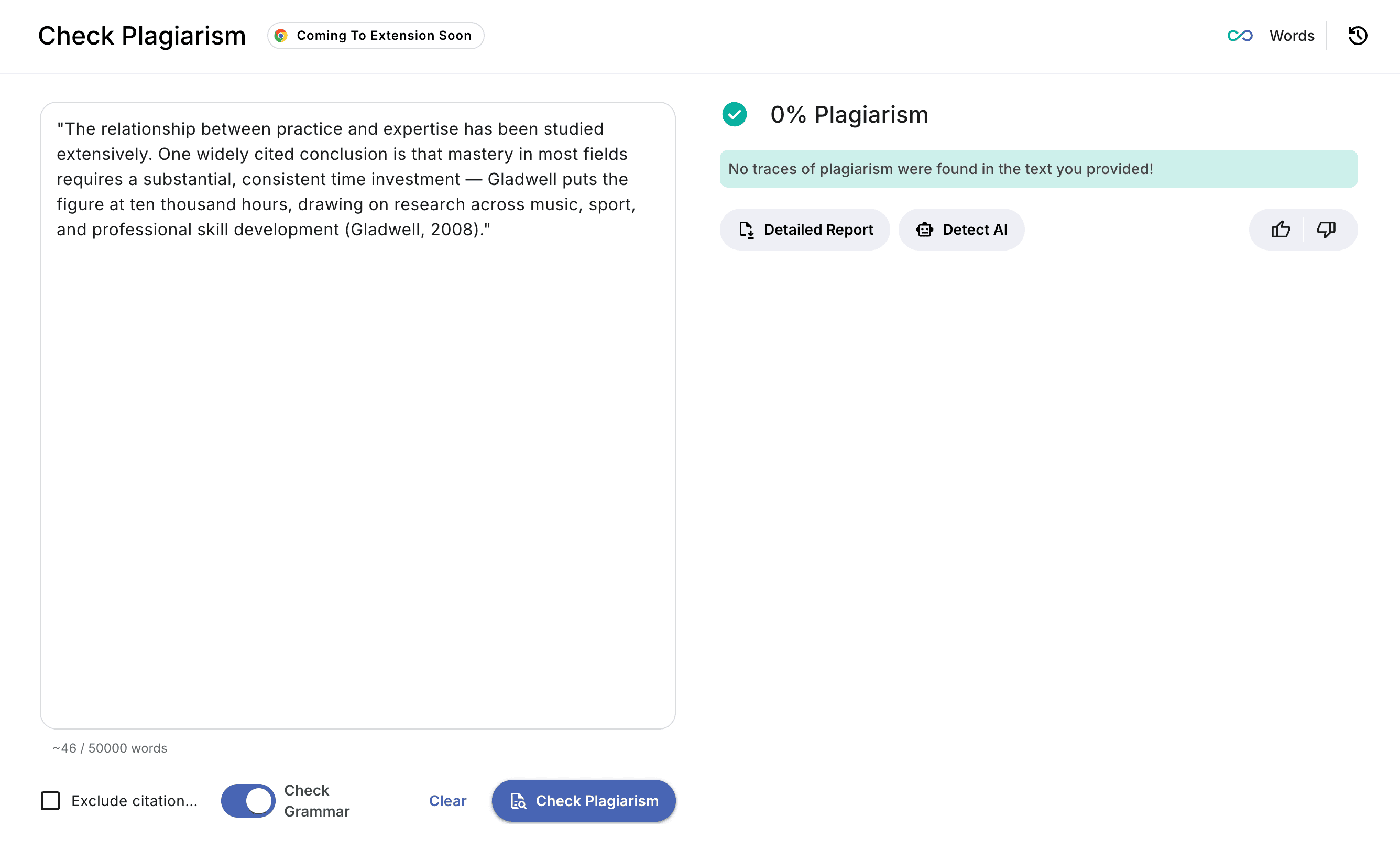 This version restructures the information across two sentences, adds context about where the finding comes from, and includes a proper citation. The sentence structure is entirely new.
Why it works: Different words, different structure, additional context, and a citation. This is what a genuine paraphrase looks like. This will keep it from appearing in your similarity report.
The rule that connects all three:
Changing words is not enough. Changing structure is not enough. Changing both is not enough if you leave out the citation. A genuine paraphrase requires all three: different words, different structure, and attribution to the original source.
When you are unsure whether your version is close enough, close the source, wait a few minutes, and rewrite from memory. If you need to reopen it to write your paraphrase, you are still too dependent on the original phrasing.
How to Avoid Accidental Plagiarism When Using AI Tools
AI writing tools have introduced a new category of accidental plagiarism that is worth understanding specifically.
The output might reproduce phrases you never saw. AI models are trained on published text and sometimes generate content that closely mirrors existing sources. A student using AI assistance may submit content that matches published work without ever knowing the original source existed.
Undisclosed AI use can itself be treated as misrepresentation. Most institutions now require you to declare when AI tools were used in your work. Even if you used AI in a way your course permits, failing to disclose it can be treated as a form of accidental plagiarism — misrepresenting the origins of your content, even unintentionally.
The safeguards are the same as for all accidental plagiarism: attribute any content that did not come from you, run your draft through a detection check before submitting, and read your institution's AI use policy before you start.
Self-Plagiarism Can Also Happen by Accident
One form of accidental plagiarism that students rarely think about is unintentional reuse of their own previous work. Understanding self-plagiarism helps clarify that submitting your own prior work without disclosure is a violation, even when the reuse was not deliberate.
Students who write on similar topics across multiple courses sometimes carry phrases or full sentences from a previous paper into a new one without realizing it. Detection tools flag these matches against prior submissions in the same way they flag matches against external sources.
The fix is straightforward: review your previous papers on related topics before drafting a new assignment, and disclose any intentional building on prior work to your instructor before you submit.
Frequently Asked Questions
What can happen if you plagiarize?
The consequences depend on the institution and whether the plagiarism was accidental or deliberate. For first-time cases of accidental plagiarism, typical responses include a grade reduction on the assignment, a formal warning, and required academic integrity training. Repeated violations or evidence of intent carry more serious outcomes: failing the course, academic probation, suspension, or expulsion. Beyond the immediate academic consequences, a plagiarism finding can affect graduate school applications and professional opportunities in fields where academic credentials are verified.
How to check if you accidentally plagiarized?
The most reliable approach combines two steps. First, manually compare your writing to every source you used, looking specifically for phrases that follow the source too closely or ideas that lack attribution. Second, run your full draft through a plagiarism checker to catch accidental matches that are too subtle for manual review to catch. JustDone's checker flags specific sentences against published sources and previous submissions, showing you exactly where attribution is missing so you can fix it before submitting.
What is the difference between intentional and unintentional plagiarism?
Intentional plagiarism is a deliberate choice: submitting a purchased essay, copying a classmate's work, or knowingly leaving out citations. Unintentional plagiarism results from mistakes: disorganized notes, paraphrasing too close to the source, forgotten citations, or simply not knowing what requires attribution. Both result in submitted work that misrepresents its origins, and both trigger a formal review. The main difference is in how institutions determine consequences: intent affects severity, not whether a violation occurred.
Examples of unintentional plagiarism?
Common examples include: copying a phrase from a source into your notes and including it in your paper without quotation marks; paraphrasing a source by changing individual words but keeping the same sentence structure; including a statistic without citing the study it came from; listing a source in your bibliography but forgetting the in-text citation; and reusing a paragraph from a previous paper on a related topic without disclosing it. Each of these is a form of accidental plagiarism that a detection tool would flag and that an institution would treat as a violation regardless of intent.
To sum up, accidental plagiarism is entirely preventable, but prevention takes consistent habits, not just good intentions. Cite as you write, paraphrase from memory, check your citations carefully, and run your draft through a detection tool before it goes anywhere. Getting these habits right makes academic writing both safer and better.
