Key takeaways:
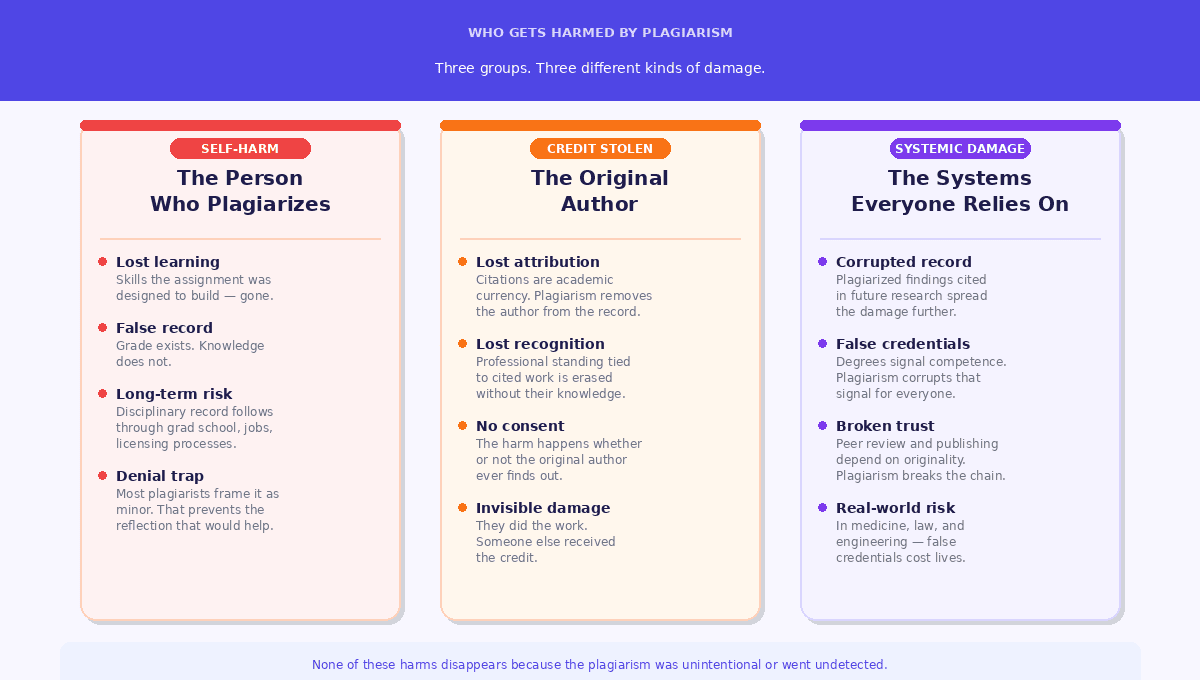
- Plagiarism harms three groups simultaneously: the person who does it, the original author who loses credit, and the systems that depend on originality to function.
- The grade stays on the transcript, but the learning does not. Students who plagiarize in early courses arrive at advanced work without the skills those courses were supposed to build.
- Most plagiarism is caught after submission, but usually it is too late to fix quietly. Running your draft through JustDone's plagiarism checker before you submit takes minutes and catches issues while you still can.
Most people know plagiarism is wrong. Fewer can articulate exactly why, beyond the fact that getting caught carries real consequences of plagiarism. The honest answer goes deeper than grades and penalties. Plagiarism damages the people who do it, the people it is done to, and the systems that academic and professional work depend on. This guide explains each of those dimensions clearly.
Why Is Plagiarism a Problem? The Case Beyond Getting Caught
The most common framing of plagiarism is transactional: you did something wrong, you get punished. But that framing misses the actual harm, and why institutions treat it as seriously as they do.
Plagiarism misrepresents who did the work
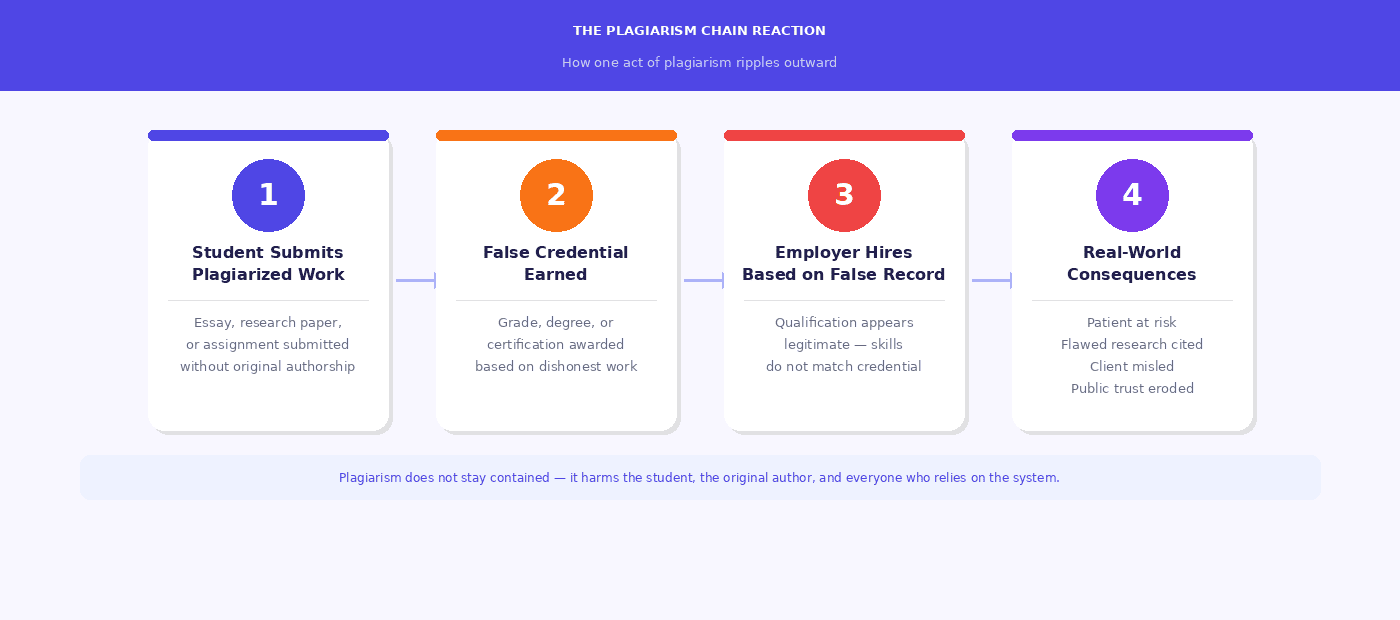
Academic work is designed to demonstrate what you know and what you can do. When you submit someone else's work as your own, you are not just breaking a rule. You are producing a false record of your own capabilities. Grades, degrees, and credentials are meant to signal competence. Plagiarism corrupts that signal. An employer hiring you based on a credential you did not earn is relying on false information. A patient being treated by a doctor who passed exams they did not actually pass is at genuine risk.
This is not a hypothetical concern. A 2015 study published in the journal Accountability in Research found that academic fraud, including plagiarism, in medical education has contributed to practitioners entering professional roles without the skills their credentials implied.
Plagiarism takes something from the original author
When you use someone else's writing, research, or ideas without attribution, you deprive them of something concrete. Academic work depends on citations as a form of currency. A researcher whose work is cited gains recognition, professional standing, and evidence that their contribution mattered. Plagiarism erases that credit. The original author did the work. Someone else receives the benefit.
This is why plagiarism ethics is taken seriously even in cases where the original author is unaware. The harm to attribution happens regardless of whether the author notices.
Plagiarism undermines trust in systems that depend on originality
Academic publishing, peer review, and research credentialing all operate on the assumption that submitted work represents genuine original contribution. When plagiarism enters that system, it distorts the record. A plagiarized finding cited in subsequent research spreads the problem. A review article built on plagiarized summaries misrepresents the state of evidence in a field.
Oxford University's academic integrity guidelines note that plagiarism is a breach of academic integrity and intellectual honesty. The trust that plagiari]sm violates is not abstract; it is what makes academic credentials, peer-reviewed research, and scholarly knowledge worth anything.
Why Plagiarism Harms the Person Who Does It
This is the dimension most plagiarism discussions skip. Beyond the risk of punishment, plagiarism causes real damage to the person committing it.
You do not learn what the assignment was designed to teach
Every assignment exists for a reason. Writing an essay teaches you to construct an argument. Conducting research teaches you to evaluate sources. Summarizing literature teaches you to synthesize complex information. When you plagiarize, you bypass the process and keep none of the skill. The grade exists in your record. The learning does not exist in your head.
This compounds over time. Students who plagiarize in early courses arrive at advanced work without the skills those courses were supposed to build. The grade is on the transcript. But the knowledge is not in their head.
Denial makes the damage worse
Research on academic dishonesty, including a widely cited analysis in Psyche, has found that many people who plagiarize are genuinely in denial about what they did. They frame it as minor, situational, or provoked by circumstance. This denial prevents the reflection that would actually be useful. Understanding why something was wrong and what led to it is far more valuable than simply being caught and punished.
A detected violation follows you
A plagiarism finding on an academic record is not erased when the course ends. It appears in disciplinary records that are reviewed during graduate school applications, professional licensing processes, and sometimes employment background checks. The decision made at 2 a.m. to copy a passage without attribution can resurface years later in a context that matters far more.
Plagiarism in Research and Professional Contexts
The consequences of plagiarism scale with context. In research and professional publishing, the stakes are higher, and the damage is more visible.
According to the Office of Research Integrity, plagiarism in research publishing can distort the scientific record, create false impressions that findings are more widely supported than they are, and deprive original authors of credit for work they produced. Several high-profile academic plagiarism cases in recent years have resulted in retracted publications, lost institutional positions, and lasting reputational damage. This affects not just the individuals involved but also their co-authors and institutions.
In journalism, plagiarism has ended careers that took decades to build. In creative fields, it has resulted in lawsuits and public disputes over attribution that damage professional relationships permanently. The pattern across all professional contexts is the same: the short-term benefit of using someone else's work is structurally outweighed by the long-term risk.
Three Things to Check Before You Submit Any Paper
Here are three questions to ask yourself to make sure your work is original:
1. Are all your sources cited?
Paste your draft into JustDone's plagiarism checker. Every sentence that matches a published source gets flagged with a link to the original. If it is flagged and uncited, add the citation now — not after your professor flags it.
2. Is your paraphrasing close enough to the source?
JustDone shows your text next to the matched source. If they look too similar, rewrite the passage directly in the editor. One click, same page.
3. Did anything from your research notes end up uncredited?
Notes taken verbatim from sources are one of the most common causes of accidental plagiarism. The checker catches these matches even when you did not realize they came from somewhere else.
Running this check takes less time than re-reading your paper. It is the single most practical thing you can do between finishing a draft and hitting submit.
Why Citation Is the Practical Solution
The reason plagiarism is preventable is that the alternative, proper attribution, is straightforward. A citation tells the reader where an idea came from. It gives credit to the original author. It supports the reader's ability to verify and explore the source. And it protects you from any claim that you misrepresented the work as your own.
Most accidental plagiarism, the kind that happens not from dishonesty but from disorganized notes, rushed drafting, or misunderstanding of attribution rules, is preventable with two habits: citing as you write rather than at the end, and checking your work before submitting.
To avoid plagiarism consistently, use a plagiarism check before any important submission. JustDone's plagiarism checker compares your text against published sources and flags sentence-level matches, giving you specific information about what needs a citation or a rewrite, rather than a number you have to interpret on your own.
Frequently Asked Questions
Why plagiarism is wrong?
Plagiarism is wrong for three connected reasons. It misrepresents who produced the work, depriving the writer of an accurate record of their own learning and capabilities. It takes credit and recognition from the original author without their knowledge or consent. And it damages the integrity of systems, academic, professional, and scientific, that depend on the assumption that submitted work genuinely represents the contributor's own thinking. None of these harms disappears because the plagiarism was unintentional or went undetected.
Is plagiarism always intentional?
No. A significant proportion of plagiarism cases involve students who did not realize they had crossed a line through imprecise paraphrasing, missing citations, or notes that blurred the boundary between a source's words and their own. Unintentional plagiarism still produces the same outcome as deliberate copying: work that misrepresents its origins. Most institutions treat both seriously, with intent affecting the severity of consequences rather than whether a violation occurred.
Does plagiarism only matter in academic settings?
No. Plagiarism carries consequences in professional publishing, journalism, creative work, and research. In professional contexts, the outcomes include retractions, legal action for copyright infringement, contract termination, and lasting reputational damage. In research, plagiarism that enters the published record can distort scientific knowledge in ways that affect future work in the field.
So, why is plagiarism bad? Because it harms the people it takes from, the systems it corrupts, and ultimately the person who commits it. The grade or the shortcut gained in the moment is structurally outweighed by what is lost in learning, in trust, and in the record that follows you forward. The practical protection is consistent: cite your sources, check your work, and submit something that genuinely represents your own thinking.
