Key takeaways:
- Yes, Turnitin detects AI, but it's a probability, not proof. Turnitin scans AI writing patterns, not copied text. The score is advisory; instructors decide consequences.
- Humanizers like JustDone AI Humanizer reduce signals, not risk entirely. Automated rewriting may not fool Turnitin if core statistical patterns remain. Manual revision is still required.
- Human input is the only reliable safeguard. Writing your own analysis, adding personal examples, and maintaining a consistent voice across submissions is what genuinely lowers AI detection risk.
Turnitin can detect AI-generated writing using machine learning models that analyze statistical and linguistic patterns in text. It provides a probability score indicating how much of a document appears AI-generated. The result is not absolute and requires instructor review.
Turnitin does not automatically fail students. AI detection is advisory and interpreted by educators according to institutional policy.
What Turnitin’s AI Detection Actually Does
Turnitin’s AI detection system does not search for copied ChatGPT responses. It does not compare essays against a database of AI answers. Instead, it evaluates whether writing patterns statistically resemble machine-generated text.
The system analyzes:
- Predictability of word sequences
- Consistency of tone
- Sentence length variation
- Structural uniformity
- Distribution of vocabulary
It then assigns a percentage indicating the likelihood that the content was generated by AI. Here's what the Turnitin AI similarity report looks like with 56% AI score and highlighted sections:
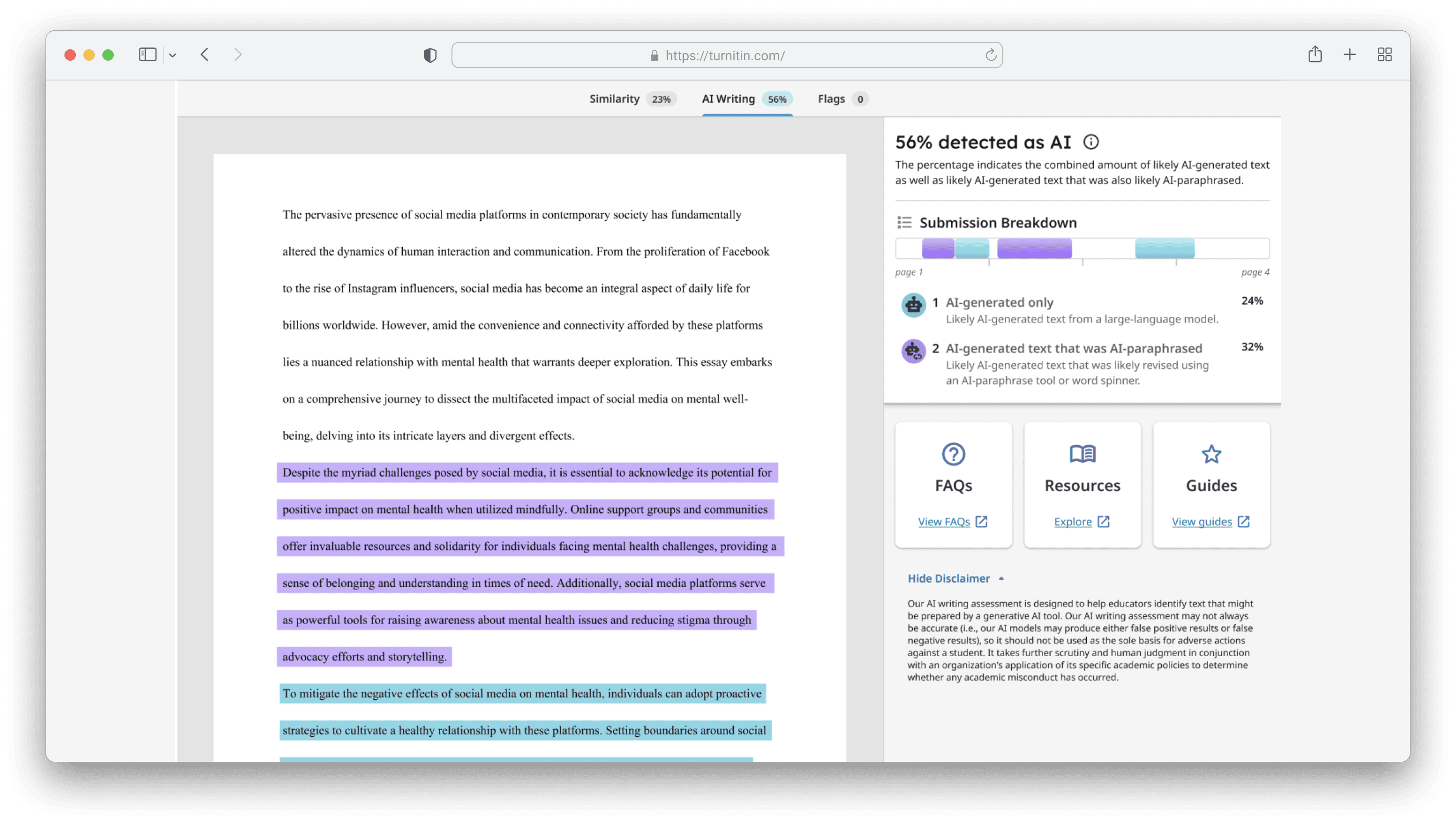
The report proves that Turnitin detects both AI-generated text and AI-paraphrased text.
How Does Turnitin Detect AI? Technical Process Explained
To understand how does turnitin detect ai, it is important to separate myth from mechanism.
Turnitin uses trained machine learning classifiers. These classifiers are trained on two main datasets:
- Human-written academic content
- AI-generated text samples
The model learns statistical differences between these categories.
Step 1: Token Probability Analysis
The system evaluates how predictable each word is within its sentence context. AI-generated text often follows highly probable word sequences.
Human writing tends to show:
- Greater unpredictability
- Irregular phrasing
- Natural variation
This statistical measure is often referred to as perplexity.
Lower perplexity typically indicates more predictable text, which may signal AI generation.
Step 2: Structural Pattern Evaluation
Turnitin evaluates sentence rhythm and paragraph structure. AI writing frequently demonstrates:
- Even sentence lengths
- Consistent grammar patterns
- Balanced paragraph formatting
- Uniform complexity
Human writing usually includes more variation. This variation is sometimes described as burstiness, meaning the degree of change in sentence structure and length.
Step 3: Classification and Scoring
After analysis, Turnitin’s model produces:
- An AI detection percentage
- Highlighted segments
- A confidence level
The score reflects probability, not proof. For example, 10% AI likelihood suggests minimal AI indicators. 60% AI likelihood suggests stronger AI-like patterns. Instructors make the final interpretation.
What Does Turnitin Use to Detect AI
When asking what does turnitin use to detect ai, the answer involves multiple technical components.
1. Machine Learning Classifiers
Turnitin’s detection engine relies on supervised learning models trained to classify text as likely human or AI-generated.
These models evaluate complex linguistic signals rather than checking for copied material.
2. Linguistic Signal Analysis
The system examines:
- Perplexity (word predictability)
- Burstiness (sentence variation)
- Vocabulary distribution
- Syntactic consistency
- Stylistic uniformity
AI-generated text typically produces smoother statistical distributions.
3. Ongoing Model Updates
Turnitin continuously updates its models to adapt to newer AI systems.
As AI writing models evolve, detection systems adjust their training data to maintain classification accuracy.
JustDone AI Detector as Turnitin Alternative
While Turnitin focuses on detecting AI-generated content, students benefit from tools that help them understand and manage their own writing process before submission. JustDone is one such platform that serves as a practical alternative resource for students working with AI-assisted writing.
JustDone is an AI-powered writing platform that includes both AI detection and AI humanization features. For students, it functions less as a Turnitin replacement and more as a writing support tool that helps bridge the gap between AI drafts and submission-ready work. AI detection accuracy is similar to Turnitin. It shows almost the same percentage of AI as Turnitin does above:
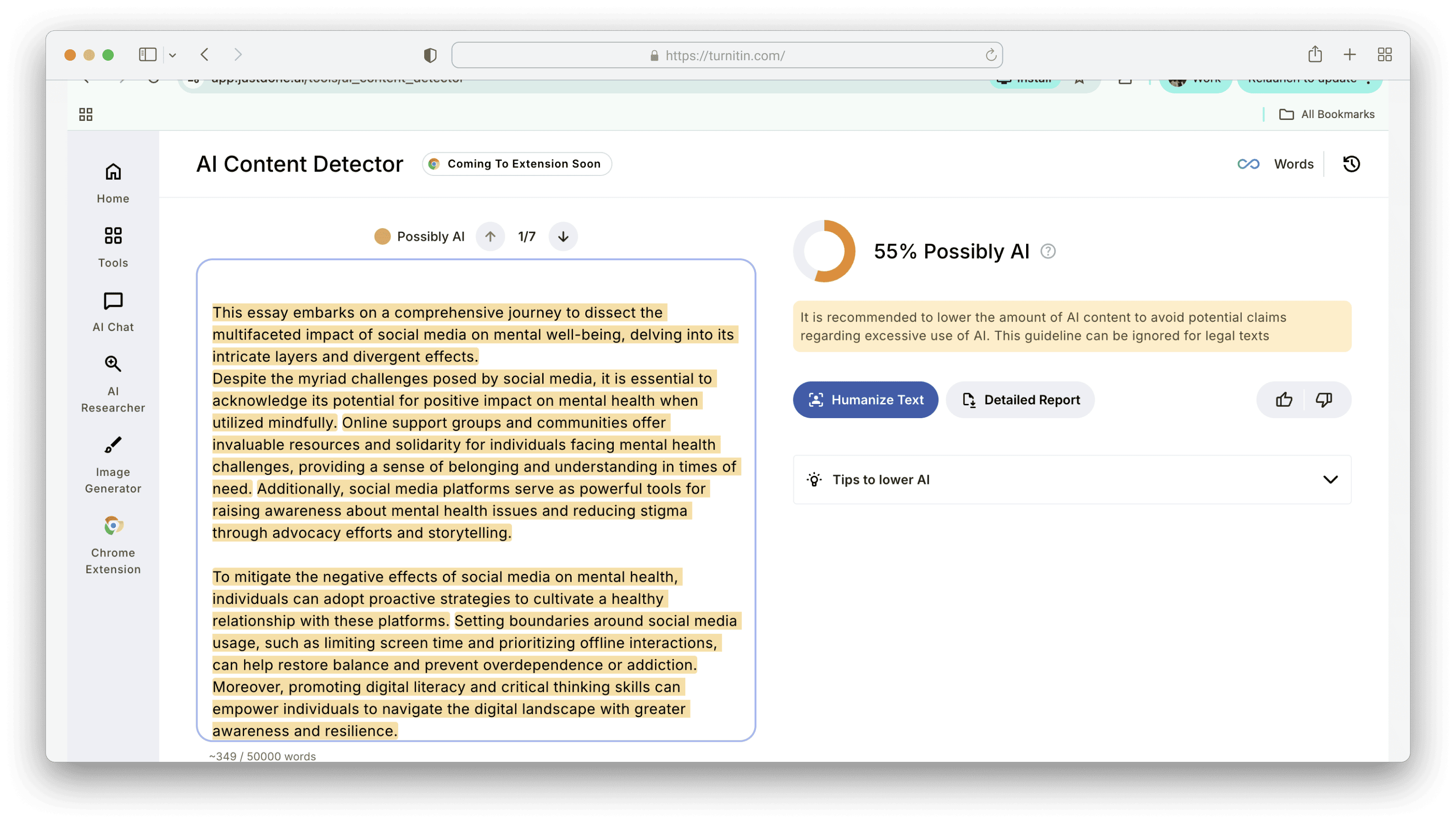
Key features relevant to students include:
- AI Humanizer — rewrites AI-generated text to introduce greater linguistic variation, adjusted sentence structure, and a more natural tone
- AI Content Detector — allows students to scan their own writing and estimate how much of it reads as AI-generated before submitting to Turnitin
- Writing templates — supports drafting essays, summaries, and academic content with guided structure
- Paraphrasing and rewriting tools — helps students rework sections of text to better reflect their own voice
I recommend using JustDone like this: generate a draft or outline using an AI tool, run it through JustDone's detector to identify high-risk sections, apply the humanizer or manually rewrite flagged passages, and then revise the final version with personal analysis and citations before submission.
Does Turnitin Detect Humanize AI Tools
This question refers to AI rewriting or humanizing tools that modify AI-generated text and help lower AI score. AI Humanizers like JustDone's typically replace synonyms, rebuild the structure of sentences, break or merge sentences, adjust grammar patterns, and change tone slightly. However, many of these tools do not fundamentally change the underlying statistical structure of the text. If core AI signals remain, Turnitin’s detection model may still identify AI-like patterns.
Detection Risk Factors After Humanization
Turnitin may still flag text if:
- Entire sections remain structurally uniform
- No original reasoning is added
- Argument depth is shallow
- Writing style differs from prior submissions
There is no verified method that guarantees bypassing AI detection through automated rewriting alone.
AI Detection Accuracy and Limitations
Turnitin AI detection is not 100% accurate. In fact, there is no 100% accurate AI checking tool. Turnitin may produce false positives and false negatives.
A false positive occurs when human writing is flagged as AI-generated. This may happen when:
- Writing is highly structured
- Academic tone is consistently formal
- Essays follow formulaic templates
- Non-native English writers may also produce writing that appears statistically consistent.
False negatives may happen when AI-generated content is not detected. This is more likely when:
- The student heavily edits the AI draft
- Only partial AI assistance is used
- Personal analysis and unique examples are included
As a result, AI detection models operate on probability thresholds and cannot guarantee perfect classification.
AI Detection vs Plagiarism Detection
AI detection and plagiarism detection are not the same and demonstrate different rocesses.
Plagiarism detection compares text against databases, identifies matching sources, and produces similarity percentages.
AI detection analyzes statistical language patterns and estimates probability of machine generation. It does not depend on matching external content
AI-generated text can be original yet still flagged as AI-generated. These systems operate independently within Turnitin.
What Happens If AI Is Flagged
If Turnitin flags AI-generated content, first of all, the instructor reviews the AI score.
They evaluate highlighted text segments and may compare the writing to previous submissions. The next steps will depend on your institutional academic integrity policies. Turnitin itself does not issue automatic penalties. So, outcomes vary by institution.
When detection risk increases:
- Entire essays are generated by AI
- Writing lacks personal insight
- Arguments are generic
- Structure is overly uniform
- Writing style differs from previous work
Detection probability decreases when:
- AI is used only for brainstorming
- Students write the main content themselves
- Personal examples and citations are added
- Critical reasoning is present
Apparently, hybrid writing is the best choice. Writing with strong human input significantly reduces risk to be detected.
F.A.Q.
Does Turnitin detect AI-generated essays?
Yes. Turnitin analyzes linguistic patterns and assigns a probability score indicating potential AI generation.
How does turnitin detect AI in student submissions?
It uses machine learning classifiers to analyze word predictability, sentence structure, and statistical writing patterns.
What does Turnitin use to detect AI specifically?
Machine learning models trained on human and AI-generated texts combined with linguistic signal analysis such as perplexity and burstiness.
Does Turnitin detect humanize AI rewriting tools?
It may detect them if the underlying AI structural patterns remain statistically consistent.
Is Turnitin AI detection definitive proof?
No. It provides probability-based estimates that require instructor interpretation.
Is AI detection the same as plagiarism detection?
No. AI detection analyzes writing style patterns, while plagiarism detection checks for copied text.
Final Summary
Turnitin can detect AI-generated writing using machine learning classifiers trained to recognize statistical differences between human and AI-produced text. The system evaluates predictability, structural consistency, and linguistic patterns, then assigns a probability score. It does not provide absolute certainty and does not automatically penalize students. AI humanizer tools may not fully remove detectable signals if underlying structural patterns remain intact.
