Key takeaways:
- Process evidence beats counter-scores. Google Docs version history, numbered drafts, and research screenshots are what institutions actually accept as proof. An AI detector report alone — even a favorable one — is rarely sufficient on its own.
- AI detectors produce false positives at meaningful rates. Turnitin's sentence-level false positive rate is around 4%. Formal writing styles, non-native English, and heavily edited clean drafts all increase the risk of a false flag.
- A high AI score is a signal, not a verdict. Most academic integrity policies treat detector results as a starting point for investigation. Your job is to shift the conversation from a score to the documented story of how you wrote.
If your assignment was flagged by an AI detector and you didn't use AI, you can prove your innocence. However, the evidence that works isn't another detector score. It's documentation of your writing process: version history, drafts, research notes, and a timeline showing how your work was built.
The Problem: Why False Positives Happen
A 2025 BestColleges report found that 60% of online college students now use AI tools in some form, which means institutions are actively on alert. AI detectors have been deployed widely and fast, but their accuracy hasn't kept pace with their adoption.
These tools don't read your essay the way a professor does. They analyze statistical patterns: how predictable your word choices are (perplexity), how much your sentence lengths vary (burstiness), and how closely your phrasing resembles known AI output. Polished, structured, academically rigorous writing — exactly what you're supposed to produce — can score high on those same metrics.
Who gets flagged most often:
- Students who write in formal or structured academic styles
- Non-native English speakers who write carefully and avoid colloquial phrasing
- Writers of short-form assignments where there's less text to analyze
- Anyone who edits heavily and produces a very clean final draft
This is why proof of authorship has to come from your process — not from running the same text through a different AI detector and hoping for a better number.
What to Do If Falsely Accused of AI Cheating
Here are several steps that can help you prove you didn't use AI when had been writing your assignment.
Step 1: Stay Calm and Get the Full Picture
When you receive the accusation, your first move is to gather information — not to argue.
Ask your instructor or academic integrity office for:
- A written explanation of the accusation
- The specific tool or report that flagged your work
- Which sections or sentences were identified as problematic
- The exact policy you're alleged to have violated
Understanding the specifics matters. If the accusation is based on a single paragraph flagged at 80% AI, your response will look very different than if the entire document scored high. Get the details in writing before you respond to anything.
Step 2: Gather Your Process Evidence
This is the most important step. Institutions don't just want a counter-score — they want to see how the work was created. Here's what counts as strong evidence.
Version History (Your Most Powerful Asset)
If you wrote in Google Docs, open File → Version History → See version history. You'll find a complete timestamped record of every edit: paragraphs added, sentences deleted, sections rearranged.
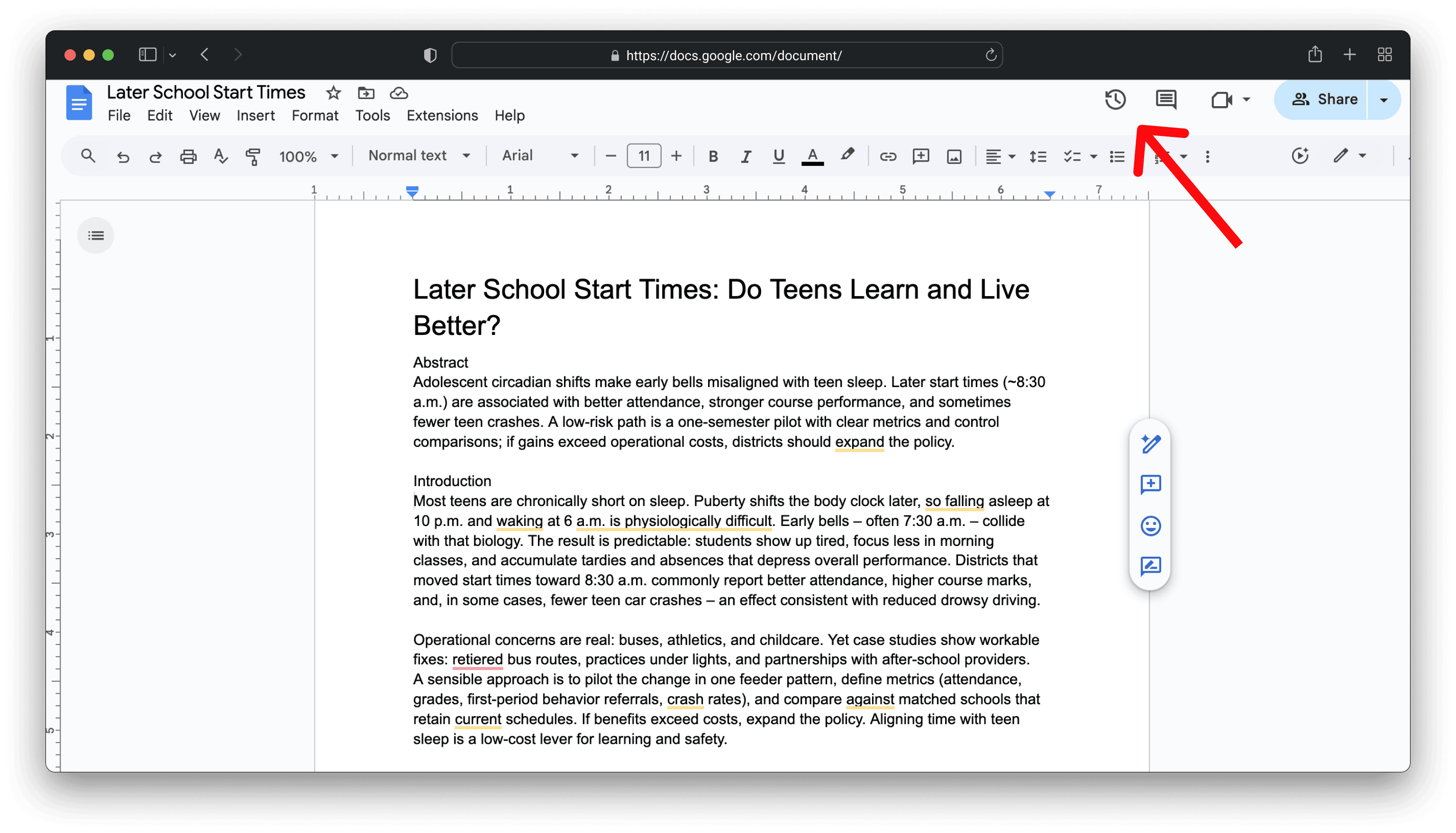 A document that was built from an outline over several days, with visible corrections and rewrites, is essentially impossible to fake.
Microsoft Word 365 has a similar feature under File → History. Notion also saves revision history.
If you worked across multiple computers, emailing draft files to yourself creates time-stamped records through your inbox.
Pro tip: The UNE Advocacy & Welfare guide recommends a simple habit — every time you finish a writing session, use "Save As" and number your drafts sequentially (essay_v1, essay_v2, etc.). This takes 10 seconds and can save your academic career.
Research Trailc
AI doesn't Google things the way you do. Show your research process:
- Screenshots of your browser history from the research phase
- Downloaded or annotated PDFs of your sources
- Notes (typed or handwritten — photograph handwritten notes before discarding them)
- Reference manager exports if you use tools like EndNote or Zotero
Human researchers backtrack, revisit sources, and make judgment calls about what's relevant. That messy trail is actually evidence in your favor.
Handwritten Materials
Photos of notebook pages, margin annotations on printed articles, or handwritten outlines demonstrate analog thinking that no AI workflow produces. Take these photos before you throw anything away.
Personal Voice and Prior Work
If your writing style across previous assignments, emails to professors, or any published work shows consistent vocabulary, rhythm, and argument structure — that continuity is evidence of human authorship. AI writing tends to be tonal consistent and generic; human writing has quirks and patterns that persist across documents.
Step 3: Run Your Essay Through JustDone's AI Detector
Before you respond to anyone, check your own work. JustDone's AI Detector compares your text against multiple AI models simultaneously, giving you a clear breakdown of which sentences are flagging and why, not just a single binary score.
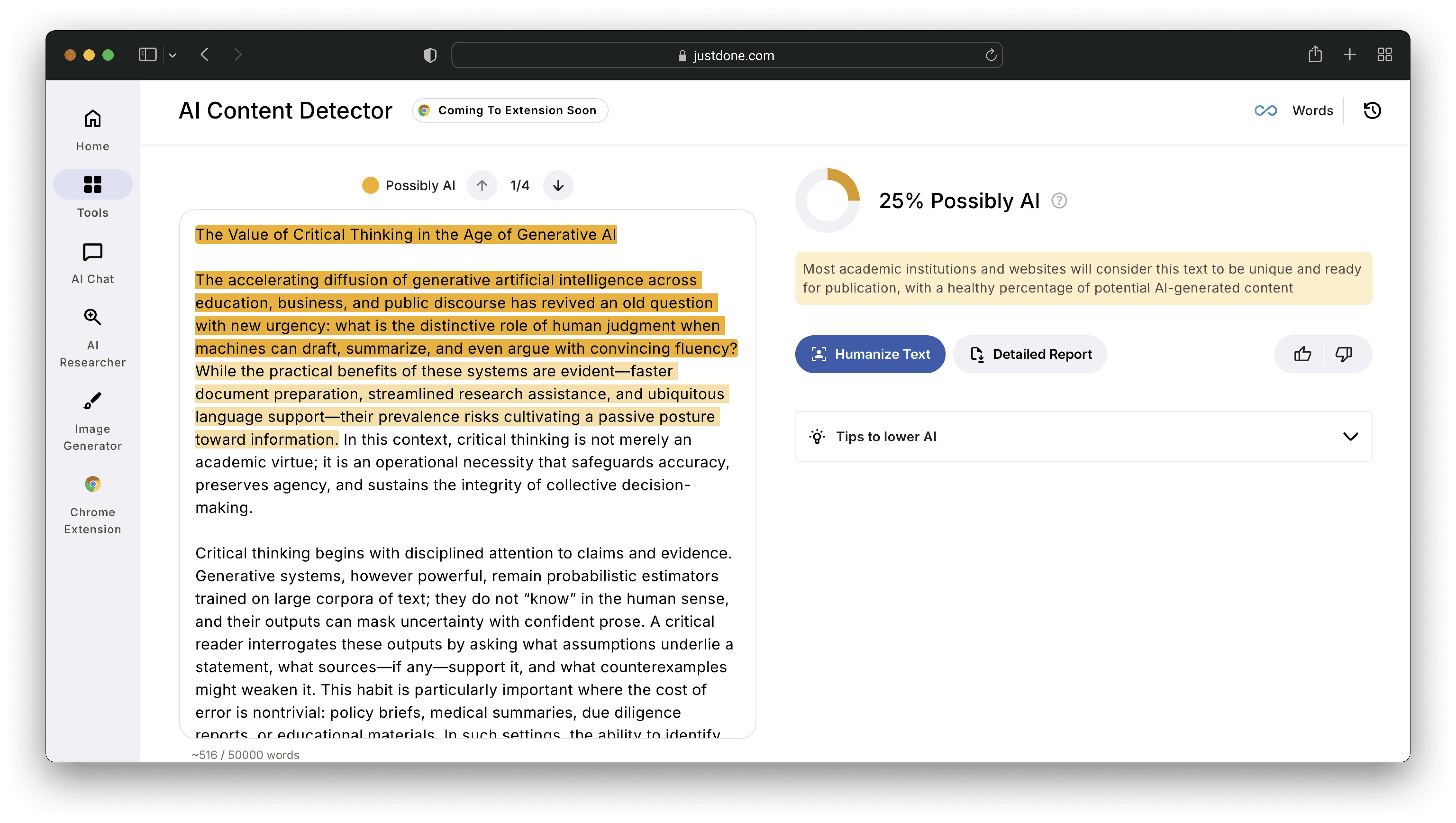
This serves two purposes:
- You understand exactly what's triggering the concern, which makes your response much more targeted
- You have an independent verification report to attach to your appeal
If the report shows your work as predominantly human, include it with your process evidence when you reach out to your instructor. Concrete documentation speaks louder than explanations.
Step 4: Use AI Humanizers, But With Caution
You may see advice to run your text through an AI humanizer before resubmitting or during an appeal. Be careful here.
Humanizers can help you understand which phrases read as formulaic, and rephrasing your own work in a more natural voice is legitimate. However, aggressively rewriting text specifically to bypass a detector carries real risks:
- Over-polished or uniformly paraphrased text can actually increase suspicion in some detectors
- If you're already under investigation, it creates a second thing to explain
- At some institutions, attempting to conceal AI-generated content is a separate violation — more serious than the original accusation
If you use JustDone's Humanizer, use it as a writing improvement tool to humanize AI text, not as a bypass mechanism. Transparency always beats concealment.
Step 5: Communicate With Your Instructor Professionally
Reach out calmly and in writing. Many instructors don't fully understand how unreliable AI detectors can be — especially for students who write carefully. Your tone should be cooperative, not defensive.
A solid opening message:
“I understand my paper was flagged for potential AI use, and I want to address this directly. I wrote this assignment myself and have documentation of my writing process — including version history, research notes, and draft files — that I'd like to share. Could you tell me which sections were flagged and how I can best submit this supporting evidence for your review?”
Attach a few screenshots of your version history in the first message if you have them. Seeing concrete evidence of a multi-day writing process often resolves the situation before it escalates further.
Step 6: Escalate If Needed
If your instructor declines to reconsider after reviewing your evidence, you have the right to appeal to your institution's academic integrity office. Most universities have formal appeal processes specifically for situations like this.
Here's a template you can adapt:
Subject: Request for Review – False AI Detection Finding
Dear [Professor's Name / Academic Integrity Officer],
I am writing regarding the AI use finding on my assignment for [Course Name, Section]. I want to be clear: I wrote this paper independently, without the use of any AI writing tools.
I have attached the following supporting documentation:
Google Docs version history showing [X] drafts written over [X] days
Screenshots of my research and browser history
Early outline and notes
A verification report from JustDone's AI Detector showing my text is predominantly human-written
I respectfully request a formal review of this finding and an opportunity to present this evidence in person if helpful.
Thank you for your time.
Sincerely,
[Your Name]
[Student ID]
[Course and Section]
Keep copies of every communication. If the appeal process involves a hearing, treat it like a presentation: organize your evidence chronologically, practice walking through your writing process out loud, and bring a support person if your institution permits it.
Step 7: Know Your Institution's Policy
Academic AI policies vary significantly across universities — and many are still being written or revised. Look up your institution's specific stance before framing your appeal. Some universities, like Duke, explicitly state that students can defend themselves by presenting drafts, notes, and documentation of independent work.
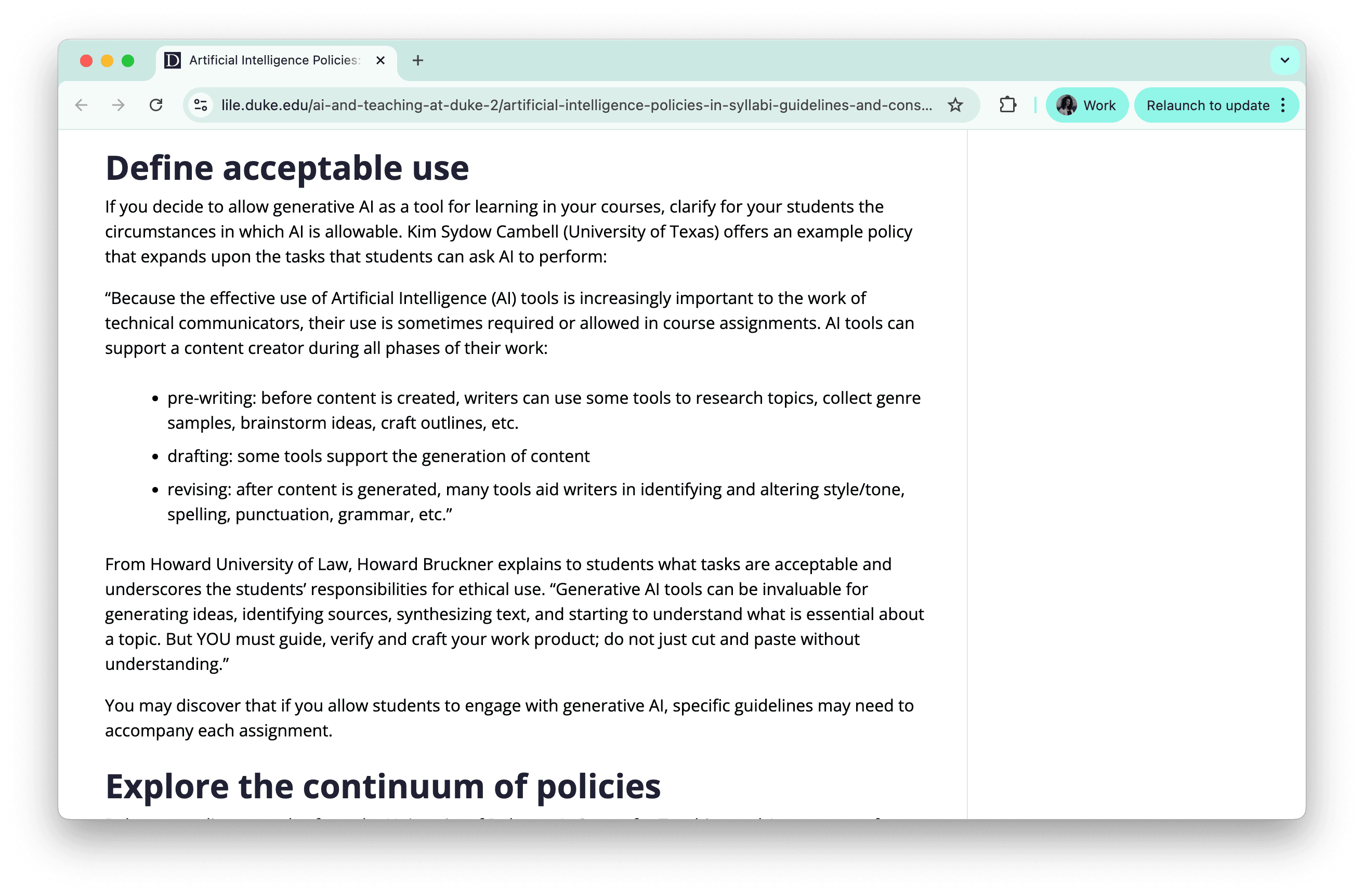 Others, like UNE, provide formal guidance documents for students navigating false accusations.
If your school doesn't have a clear policy yet, referencing the practices of established universities in your appeal gives your case more credibility. Saying "Institution X follows this process for these situations" is a stronger frame than just asserting you're innocent.
How to Prevent False Accusations Going Forward
Once the current situation is resolved, a few habits will protect you permanently:
Write in platforms that auto-save history. Google Docs and Microsoft Word 365 do this automatically. Make it your default writing environment for any assessed work.
- Number your drafts. Save a new copy at the end of each session. This takes seconds and creates a clear timeline.
- Keep your research trail messy and visible. Don't clean up your browser history or delete annotated PDFs until after your grade is final. The messier your research trail, the more human it looks.
- Scan before you submit. Run your essay through JustDone's AI Detector before submission. If specific sentences flag, you can revise them in your own voice before anyone else sees the score.
- Cite lived experience. Personal observations, classroom context, and experience-based examples are things AI genuinely can't replicate. Integrate them where relevant.
Consequences of False Accusations to Be Aware Of
False accusations can be stressful, but it's worth understanding what's actually at stake if the process doesn't go in your favor — and why the appeal steps above matter.
| Severity | Typical outcome |
|---|---|
| Minor | Zero on the assignment, written warning, or mandatory integrity workshop |
| Moderate | Failing grade on the course, academic probation, or restricted privileges |
| Major | Suspension from specific courses, loss of scholarships, formal disciplinary record |
| Severe | Multi-term suspension, ineligibility for re-enrolment, loss of degree candidacy |
Even a false accusation can leave emotional and reputational marks while the process plays out. Document everything. Respond in writing. Keep copies.
Frequently Asked Questions
Can I prove 100% that I didn't use AI?
Not with certainty, and it's worth being honest about that. No tool can certify a piece of writing as definitively human-authored — AI detectors analyze statistical patterns, not authorship. What you can do is provide overwhelming process evidence that makes human authorship the only reasonable conclusion. Institutions increasingly understand this distinction.
How to argue you didn't use AI?
Walk your instructor through your writing process chronologically: show when you started, how the draft evolved, where you struggled and revised, and what sources you consulted along the way. Concretely, that means presenting your version history (Google Docs or Word), your research notes and browser history, any handwritten materials, and an independent verification report from JustDone's AI Detector.
How do professors detect AI writing?
Some professors use intuition — they know your writing style and notice when something feels off. Others run work through tools like Turnitin, GPTZero, or similar detectors. Responsible instructors treat detector scores as a conversation starter, not a final verdict.
Does JustDone's AI Detector help with appeals?
Yes. Because JustDone checks your text against multiple models and provides sentence-level breakdowns, you get a more detailed and defensible report than a single-source score. Including that report alongside your version history and notes gives your appeal a concrete, verifiable foundation.
Is it okay to use JustDone's Humanizer on my essay?
Only if you use it as a genuine writing tool — to improve clarity and natural flow — and not as a way to bypass detection. If you're already under investigation, any aggressive paraphrasing creates additional risk. When in doubt, don't.
What if I write formally and just naturally sound like AI?
This is genuinely unfair, and it's a known problem with current detection technology — particularly for non-native speakers and students trained in rigorous academic writing. Your best protection is proactive documentation: build your version history, keep your research trail, and run your essays through JustDone before submission so you know what to expect.
Conclusion
Being falsely accused doesn't mean you're guilty. It means AI detection is still imperfect, and academia is still catching up. The students who navigate this best are the ones who document their process habitually — not because they expect trouble, but because it takes almost no effort and creates ironclad protection. Start that habit now, and this guide will hopefully never need to apply to you again.
