Key Takeaways
- Every website citation uses the same six details: author, date, page title, site name, URL, and sometimes an access date. Only the order and formatting change by style.
- APA puts the date right after the author and italicizes the page title. MLA puts the title in quotation marks and the date near the end. Chicago puts the details in footnotes or uses an author-date format.
- If there is no author, start with the page title. If there is no date, write “n.d.” in APA, or add an access date in MLA and Chicago.
Knowing how to cite a website saves you from lost points, picky feedback, and accidental plagiarism. Web pages are among the most common sources in student papers, yet every style treats them a little differently. APA puts the date right after the author, MLA wraps the page title in quotation marks, and Chicago moves the details into footnotes.
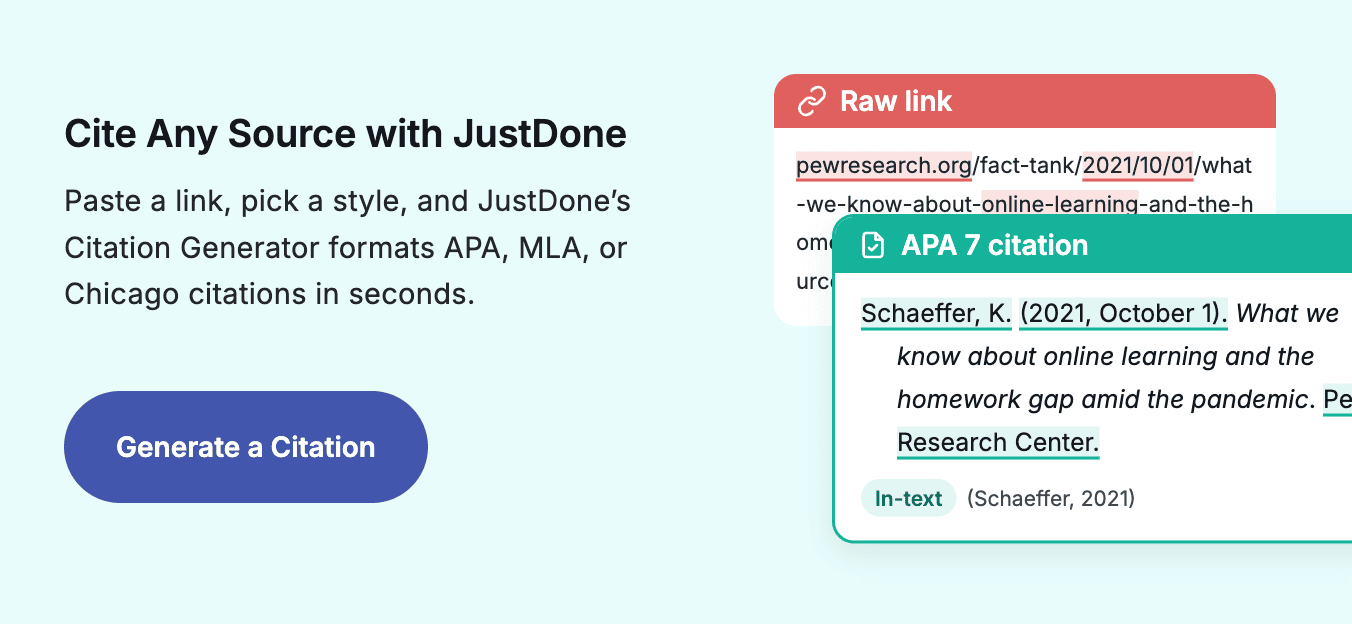
This guide walks through all three styles with real examples, so you can copy the pattern and swap in your own source. You will also see what to do when a page has no author, no date, or content that keeps changing. If you would rather skip the formatting, a website citation generator can do it for you. Paste a URL into the JustDone citation generator and get APA, MLA, or Chicago in one click.
Here is the short version before we start going further.
Style | Reference format | In-text citation |
| APA 7 | Author, A. (Year, Month Day). Title of page. Site Name. URL | (Author, Year) |
| MLA 9 | Last, First. "Title of Page." Site Name, Day Mon. Year, URL. | (Author) |
| Chicago 18 | Last, First. "Title of Page." Site Name. Month Day, Year. URL. | Footnote or (Author Year) |
 What You Need to Cite a Website
Before you open any style guide, collect the details. Learning how to cite a website is mostly about finding six pieces of information, and every style uses the same set in a different order. Purdue OWL recommends gathering them while you research, since pages change and links break.
- Author. A person or an organization. Look near the headline, at the bottom of the page, or on the "About" page.
- Date. The publication date or the "last updated" date for that page. A copyright year in the footer usually covers the whole site, so do not use it.
- Page title. The headline of the specific page you used, not the name of the site.
- Site name. For example, Pew Research Center or BBC News.
- URL. Copy it straight from the address bar. Remove tracking strings that start with a question mark.
- Access date. The day you viewed the page. You only need it in some cases, which we cover below.
Screenshot the page or save it as a PDF if you plan to write later. If the content disappears, you will still have proof of what you cited.
How to Cite a Website APA Style (7th Edition)
APA style is the default in psychology, education, nursing, and most social sciences. An APA website citation follows the author-date pattern, so the date sits right after the name. The APA Style webpage guide uses one template for news sites, government pages, and organization pages alike.
APA Citation Website Format and Example
Here is the basic template:
Author, A. A. (Year, Month Day). Title of the page in sentence case. Site Name. URL
And here is a real APA website citation for an article on the Pew Research Center site:
Schaeffer, K. (2021, October 1). What we know about online learning and the homework gap amid the pandemic. Pew Research Center. https://www.pewresearch.org/fact-tank/2021/10/01/what-we-know-about-online-learning-and-the-homework-gap-amid-the-pandemic/
Keep these rules in mind for every APA 7 website citation:
- Use initials instead of first names.
- Put the page title in italics and sentence case. Capitalize only the first word, proper nouns, and the first word after a colon.
- Leave the site name in plain text.
- If the author and the site name are the same, drop the site name.
- End with the URL and do not add a period after it.
APA In-Text Citation for a Website
APA uses the author's last name and the year. A parenthetical citation looks like (Schaeffer, 2021). A narrative citation works the name into your sentence: Schaeffer (2021) found that many students lacked home internet. Web pages rarely have page numbers, so for a direct quote add a paragraph number instead, such as (Schaeffer, 2021, para. 4).
Website With No Author or an Organization as Author
When no person is named, the organization behind the page usually becomes the author. A government fact sheet is a good example:
National Center for Complementary and Integrative Health. (2025, April). Turmeric: Usefulness and safety. U.S. Department of Health and Human Services, National Institutes of Health. https://www.nccih.nih.gov/health/turmeric
If you truly cannot find any author, here is how to cite a website with no author in APA. Move the page title into the author position, then add the date, site name, and URL. In the text, use a shortened italic title, such as (Turmeric, 2025). Our guide to the in-text citation with no author covers more edge cases.
Website With No Date or Changing Content
Write (n.d.) when a page shows no publication or update date. Ignore "last reviewed" dates, because APA treats a review as different from a real update. For pages built to change, like live dashboards, add a retrieval date:
U.S. Census Bureau. (n.d.). U.S. and world population clock. U.S. Department of Commerce. Retrieved October 21, 2026, from https://www.census.gov/popclock/
Not sure how to cite a website APA style for an unusual page? Paste the URL into the JustDone APA citation generator and check every field it fills in. A tool does most of the work, but your final APA 7 website citation should always match the page itself.
How to Cite a Website MLA Style (9th Edition)
MLA is the go-to style for English, literature, and other humanities classes. Instead of a date-first pattern, an MLA website citation is built from "core elements" that always appear in the same order. Your Works Cited list holds the full entry, and the in-text citation points back to it.
MLA Format and Example
Here is the template:
Last Name, First Name. "Title of the Page." Name of the Website, Day Month Year, URL.
The same Pew article from the APA section looks like this as an MLA website citation:
Schaeffer, Katherine. "What We Know about Online Learning and the Homework Gap amid the Pandemic." Pew Research Center, 1 Oct. 2021, www.pewresearch.org/fact-tank/2021/10/01/what-we-know-about-online-learning-and-the-homework-gap-amid-the-pandemic/.
Notice the differences from APA. MLA uses the author's full first name, title case for the page title, quotation marks instead of italics, and abbreviated months. Drop "https://" from the URL, as Purdue OWL's MLA guide explains, unless you are citing a DOI.
MLA In-Text Citation Website Format
The MLA in-text citation website rule is short: the author's last name in parentheses, such as (Schaeffer). Web pages have no page numbers, so you leave them out. You can also name the author in your sentence and skip the parentheses entirely: Schaeffer notes that the homework gap widened during remote learning.
No Author, No Date, and Access Dates
Many web pages list an organization rather than a person. MLA handles this a little differently from APA. If the organization and the website share a name, skip the author and start with the title. Here is how to cite a website with no author MLA style:
- Start the entry with the page title in quotation marks.
- Add the website name in italics.
- Add the date, then the URL.
- In the text, use a shortened title in quotation marks, such as ("Turmeric").
"Turmeric: Usefulness and Safety." National Center for Complementary and Integrative Health, Apr. 2025, www.nccih.nih.gov/health/turmeric.
MLA has no "n.d." option. If a page shows no date, leave the date out and add an access date at the end instead: Accessed 21 Oct. 2026. Access dates are optional for dated pages, but they help when content may change.
The rules for how to cite a website with no author differ slightly in each style, so double-check which one your instructor wants. If you would rather not count commas, the JustDone MLA citation generator builds the entry from a URL. It is also the fastest answer to how to cite a website MLA style when you have a long Works Cited list. Just review each MLA website citation before you submit.
How to Cite a Website in Chicago Style
Chicago style is common in history, art history, and some business courses. The current edition is the 18th, released in 2024, and its website rules barely changed from the 17th. Chicago offers two systems, so ask your instructor which one to use before you start.
Notes and Bibliography
Most humanities papers use notes. You place a superscript number in your sentence and give the source in a footnote at the bottom of the page. If you have never formatted one, our guide to footnotes walks through the setup in Word and Google Docs.
The first note gives the full details:
- Katherine Schaeffer, "What We Know about Online Learning and the Homework Gap amid the Pandemic," Pew Research Center, October 1, 2021, https://www.pewresearch.org/fact-tank/2021/10/01/what-we-know-about-online-learning-and-the-homework-gap-amid-the-pandemic/.
Later notes for the same page can be shortened to the last name and a short title: Schaeffer, "Online Learning."
The bibliography entry flips the name and swaps commas for periods:
Schaeffer, Katherine. "What We Know about Online Learning and the Homework Gap amid the Pandemic." Pew Research Center, October 1, 2021. https://www.pewresearch.org/fact-tank/2021/10/01/what-we-know-about-online-learning-and-the-homework-gap-amid-the-pandemic/.
Author-Date
The author-date system works more like APA. The year moves up after the name, and the in-text citation reads (Schaeffer 2021) with no comma.
Schaeffer, Katherine. 2021. "What We Know about Online Learning and the Homework Gap amid the Pandemic." Pew Research Center, October 1, 2021. https://www.pewresearch.org/fact-tank/2021/10/01/what-we-know-about-online-learning-and-the-homework-gap-amid-the-pandemic/.
If a page has no date, add an access date instead, such as "accessed October 21, 2026." The Chicago Manual of Style citation guide also notes that a simple mention in your text is often enough for informal web content. For full notes on a long paper, the JustDone Chicago citation generator saves a lot of retyping.
How to Cite a Website in Text
The reference list gets most of the attention, but the in-text part is what your reader sees on every page. If you only need a quick answer on how to cite a website in text, this table puts all three styles side by side.
Situation | APA 7 | MLA 9 | Chicago author-date |
| One author | (Schaeffer, 2021) | (Schaeffer) | (Schaeffer 2021) |
| Two authors | (Lee & Park, 2024) | (Lee and Park) | (Lee and Park 2024) |
| Organization as author | (World Health Organization, 2024) | (World Health Organization) | (World Health Organization 2024) |
| No author | (Shortened Title, 2024) | ("Shortened Title") | ("Shortened Title" 2024) |
| No date | (Schaeffer, n.d.) | (Schaeffer) | (Schaeffer, n.d.) |
| Direct quote | (Schaeffer, 2021, para. 4) | (Schaeffer) | (Schaeffer 2021) |
Every in-text citation for website sources must match the first word of its full entry. If your reference list starts with a title, your in-text citation starts with that same title. That one rule fixes most mismatches. Also remember that every in-text citation for website content needs a matching full entry at the end of the paper.
Special Cases
Not every page fits the standard template. Here is how to cite a website in a few common edge cases:
- A whole website. If you mention a site in general, such as "the CDC website has resources for parents," APA lets you give the name and URL in the text with no reference entry.
- An online news article. Treat it like a webpage, but use the news outlet as the site name. Print newspapers such as The New York Times follow the newspaper format instead.
- A video or a document. These have their own rules. See our guides on how to cite a YouTube video and how to cite a PDF.
- Wikipedia. You can cite it with an access date, but many instructors prefer that you cite the sources it links to instead.
Common Mistakes When Citing Websites
Small slips cost points because instructors check citations quickly and consistently. Watch for these:
- Citing the homepage instead of the exact page you used.
- Using the copyright year in the footer as the publication date.
- Writing "Anonymous" when no author is listed.
- Mixing styles, like italic titles in MLA or full first names in APA.
- Forgetting the in-text citation for a paraphrase.
For more fixes, read our list of common errors in in-text citations. A careful last check of each APA website citation or Works Cited entry takes five minutes and can save you easy points.
Cite a Website Automatically With JustDone
Formatting by hand makes sense for one or two sources. With fifteen, a website citation generator saves real time and catches small slips like a missing period. JustDone works in three steps:
- Paste the page URL into the citation generator.
- Pick APA, MLA, Chicago, or another style.
- Review the fields, then copy the reference and the in-text citation into your paper.
When your draft is done, run it through the JustDone plagiarism checker. It flags passages that match a source but have no citation, so you can fix them before your instructor sees them.
FAQ
Do I need an access date when citing a website?
Only sometimes. APA asks for a retrieval date when page content is designed to change. MLA and Chicago recommend an access date when a page has no publication date.
Can I use the URL alone as a citation?
No. A bare link does not tell readers who wrote the page or when. Every style asks for at least a title, a site name, and a date or access date.
How do I cite a website with two or more authors?
In APA, list up to 20 authors in the reference and use "&" before the last one. In MLA, list two authors in full, or the first author plus "et al." for three or more.
Which date should I use if a page shows several?
Use the publication or "last updated" date for that specific page. Skip "last reviewed" dates and copyright years in the footer.
Is there a faster way to learn how to cite a website?
Practice with one source in all three styles, using the examples above as templates. After two or three papers, the patterns become automatic.
Final Thoughts
Every style asks for the same core facts: who wrote the page, when, what it is called, and where to find it. Get those details right, follow the order your style requires, and keep in-text citations consistent with your reference list. Bookmark this guide, and come back whenever you need a quick reminder of how to cite a website.
