Key takeaways:
- Outline first, draft faster. Spend 15 minutes planning your thesis, paragraph purposes, and evidence slots, and your essay becomes a simple fill-in process instead of constant rewriting.
- Build the outline inside your thesis. Use a thesis like “This paper argues X because of A, B, and C” so your body paragraphs are already decided before you start writing.
- Use AI as a framework, not a shortcut. Generate a starter outline with JustDone AI chat, then refine it by checking logic gaps, missing evidence, and repetitive points before drafting.
An academic outline is a short plan that shows what you will argue, how you will prove it, and what order your points will appear in. When students skip outlining, the draft usually takes longer because they keep rearranging paragraphs while writing. When students outline first, the draft becomes a straightforward fill-in process: you already know what each paragraph is for and what evidence it needs.
This article gives you a practical 15-minute outlining routine you can use for essays and many research papers. You will also get an easy outline template you can copy into your document, plus a quick way to generate a starter outline with the AI chat.

How to Write an Outline in 15 Minutes
Set a timer for 15 minutes. The goal is not elegance. The goal is a structure you can draft from immediately.
Step 1: Turn the prompt into one clear task
Start by rewriting the assignment prompt in your own words. Then write one sentence that states what you must deliver. For example: “Argue whether online learning should remain an option for first-year students, using at least three academic sources and one counterargument.”
This step prevents a common outline problem: students outline something interesting, but not exactly what the prompt asks.
Step 2: Write a thesis that already contains your plan
A useful thesis is not just a topic. It is a claim plus the reasons that will become your body paragraphs. Keep it direct. If the prompt is argumentative, your thesis should take a position.
Here is a simple model that works in many cases:
“This paper argues that X because of reason 1, reason 2, and reason 3.”
Those three reasons become your three body paragraphs. You are building the outline inside the thesis, so you do not have to invent structure later.
Step 3: Create your paragraph spine
Now write the purpose of each paragraph as a single line. Do not write full sentences yet. You are deciding what each paragraph contributes to the thesis.
If you have three body paragraphs, the spine can look like this:
- Paragraph 1 proves the thesis through one key angle.
- Paragraph 2 proves the thesis through a second angle.
- Paragraph 3 proves the thesis through a third angle.
If your assignment expects a counterargument, add a counterargument paragraph after your main points. That paragraph should show you understand another view and can respond to it logically.
Step 4: Add evidence slots, not full research
Under each paragraph, add two evidence placeholders and one analysis note. Evidence placeholders can be a study, a statistic, a definition, a case example, or a credible quote you plan to cite. The analysis note explains what the evidence proves and why it matters.
This is the step many students skip. They list evidence, but they do not plan the meaning. Planning a one-line analysis now makes the later draft much easier.
Step 5: Sketch the introduction and conclusion
For the introduction, you only need three parts: brief background, the focus of the paper, and the thesis. For the conclusion, plan to restate the thesis in new words, summarize the main points, and end with one implication or recommendation.
Once the timer ends, stop. You have enough to draft.
How to outline a research paper fast
If you are writing a research paper with sections, outlining is still the same skill. The difference is that your headings are usually fixed. Many research papers follow an IMRAD-style structure: introduction, methods, results, and discussion. Even if your class uses different labels, the logic is similar: explain what you studied and why, show how you did it, present what you found, then interpret it.
A fast way to outline a research paper introduction is to plan it as a sequence of functions. Start with background context, explain why the topic matters, describe what is already known, identify the gap, and end with your research aim or thesis. That structure is why introduction outlines are so useful: you are not guessing what to write next, you are filling in expected parts.
Use JustDone AI chat to generate an outline
If you want a quick outline draft, the JustDone AI chat can create a structured starting point in seconds. The key is to treat the result as a framework you edit, not something you copy blindly.
Here is a prompt that works well for most student essays:
Create an academic essay outline on the topic: [paste topic].
Assignment type: argumentative.
Word count: [paste number].
Requirements: [number] body paragraphs, include one counterargument paragraph, and include evidence placeholders for each paragraph.
Output: thesis, paragraph-by-paragraph plan, and a short list of what evidence I should look for.
For instance, let's write an outline for a thesis in macroeconomics about Economic Growth and Productivity: What Explains Long-Term Differences Across Countries. I used JustDone AI chat and the prompt above.
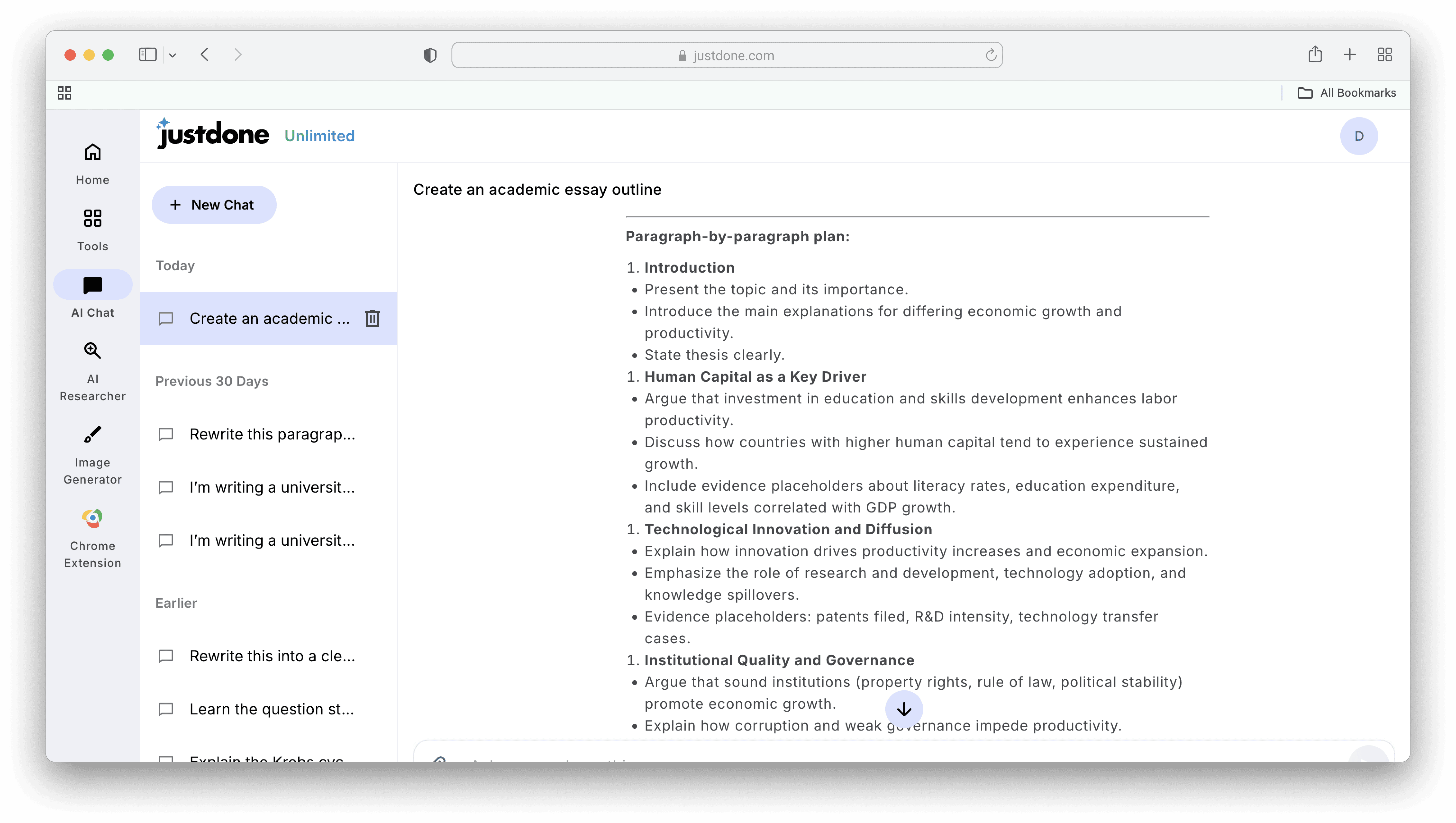
After it generates an outline, refine it with a second prompt:
Check this outline for weak logic, missing evidence, and repetitive points. Suggest a stronger thesis and improve the paragraph order.
First, JustDone explains what gaps the outline actually has and what should be improved.
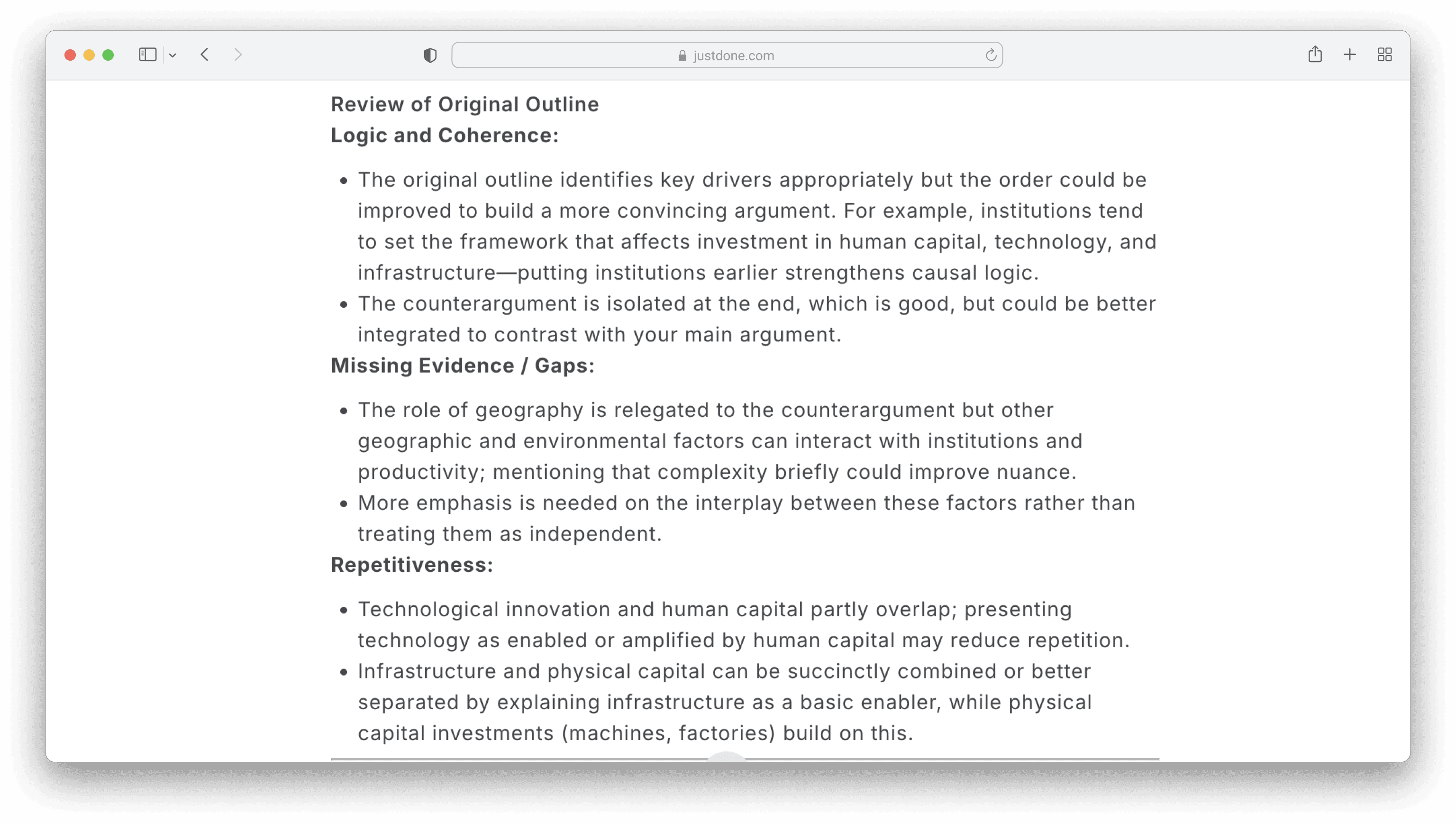 Then, AI chat builds a new, stronger version of the outline.
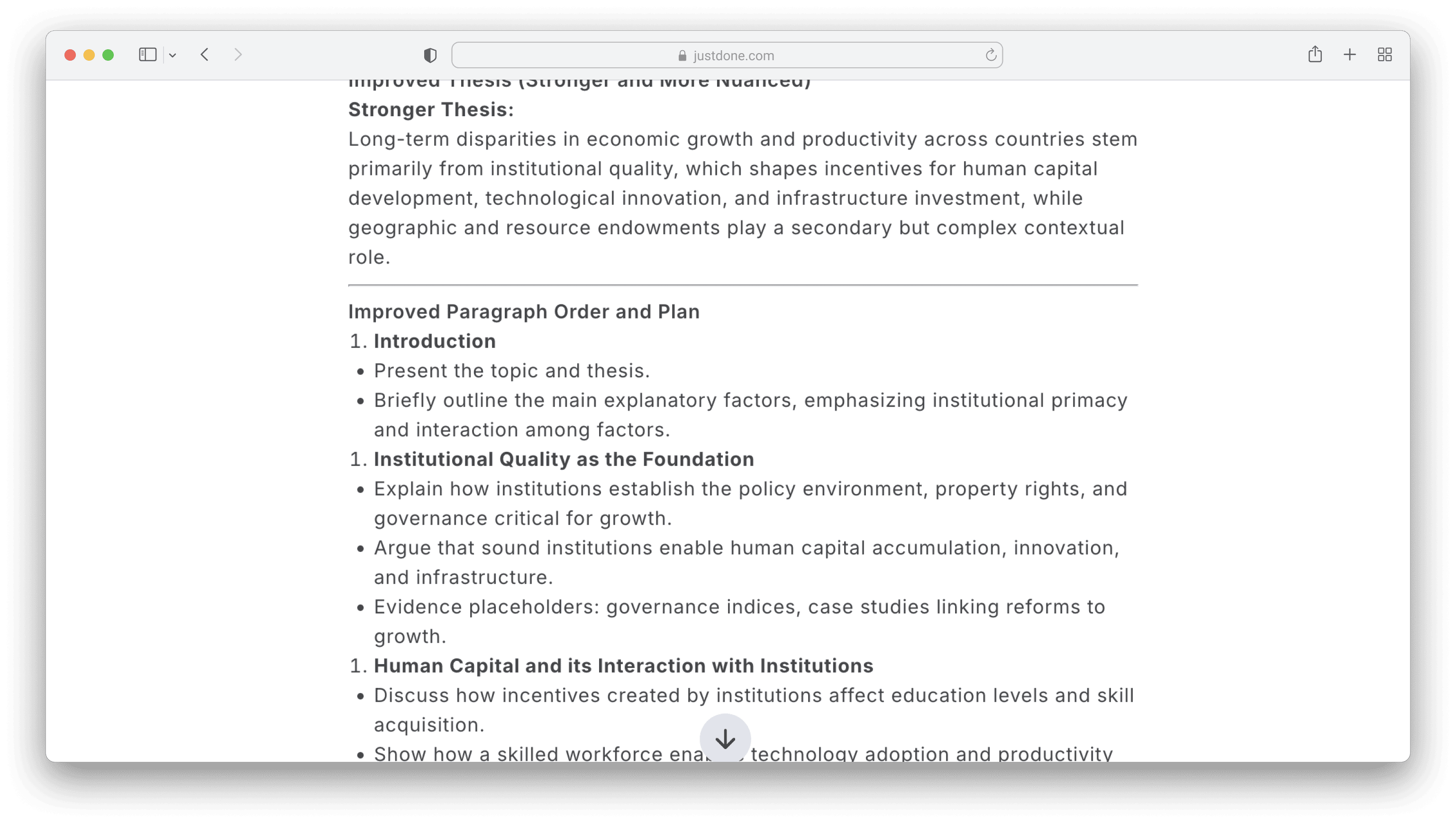 This two-step approach is fast and keeps you in control of your ideas and structure.
Copy-ready academic outline template
Paste this template into your document and fill it in. It is designed to be fast and readable, with space for evidence and analysis, so you do not forget the most important part.
Title:
Write a specific title that matches your claim.

Introduction
Background: What does the reader need to know in two to three sentences
Focus: What question or problem does the essay answer
Thesis: Your claim plus your main reasons

Body paragraph 1
Main point: What this paragraph proves
Evidence to include: One study or credible source, one example or statistic
Analysis: What the evidence shows and how it supports the thesis
Transition: One sentence that sets up the next paragraph

Body paragraph 2
Main point: What this paragraph proves
Evidence to include: One study or credible source, one example or statistic
Analysis: What the evidence shows and how it supports the thesis
Transition: Link to the next point

Body paragraph 3
Main point: What this paragraph proves
Evidence to include: One study or credible source, one example or statistic
Analysis: What the evidence shows and how it supports the thesis
Transition: Set up the counterargument or conclusion

Counterargument paragraph
Opposing view: What someone might disagree with
Why it seems reasonable: The strongest version of their point
Rebuttal: Why your position still stands
Evidence to include: One source or real example that supports your rebuttal
Analysis: What the rebuttal proves about your thesis

Conclusion
Restate thesis in new words
Summarize your main points in one sentence each
Closing implication: What the reader should conclude, do, or consider next

References
List the sources you plan to use
What an academic outline does for your essay
An outline is not extra work. It is a shortcut that moves decision-making to the beginning of the process, when it is fastest. A good outline helps you keep a logical progression, avoid tangents, and notice weak spots before you write 1,000 words around them. It also makes your writing clearer because each paragraph has a single purpose.
Read more about how to write an outline in 5 simple steps. If your assignment has a strict structure, outlining helps you match it. Many writing centers teach a similar pattern: an introduction with context and a thesis, body paragraphs that each make one main point supported by evidence and analysis, and a conclusion that ties everything together without adding new evidence. This predictable structure is exactly what makes outlining so effective for academic writing.
The outline formats students actually use
Most students only need one of two outline styles.
A topic outline is the fastest. You write short phrases for each paragraph and list the evidence you plan to use. It is ideal when you have limited time and want a clear roadmap.
An alphanumeric outline is more formal. It uses a hierarchy such as I, A, 1, a. It is useful when your instructor expects a traditional outline or when your paper has multiple layers of subpoints.
You do not need to pick a perfect format. You need a clear structure. If your outline shows the thesis, the main points, and the evidence you will use, it is doing its job.
Common outline problems and how to fix them quickly
If your outline feels vague, your main points are probably too broad. Rewrite each body paragraph label as a claim you can prove, not a topic. “Social media” is a topic. “Social media increases comparison-based pressure among teens” is a claim.
If your outline lists evidence but still feels weak, you likely missed analysis. Add one line under each evidence item that explains what it proves. This is the difference between collecting sources and building an argument.
If your outline repeats itself, check your topic sentences. Each paragraph should answer a different part of the prompt. If two paragraphs could swap places without changing meaning, they are probably doing the same job.
Final checklist before outline drafting
You are ready to draft when your outline contains a clear thesis, distinct paragraph purposes, evidence placeholders, and at least one sentence of planned analysis per paragraph. If you also know your word target per section and you track it with the JustDone Word Counter, drafting becomes much faster and cleaner.
