Key Takeaways:
- ZeroGPT is fast and free, but inconsistency is a real problem. Across three test scenarios, ZeroGPT returned results that ranged from accurate to significantly off.
- Non-English content is ZeroGPT's biggest weakness. Spanish-language test returned 61.2% AI, which is notably lower than what JustDone returned on the same text (100%).
- A score without sentence-level context isn't enough. ZeroGPT gives you a percentage. It doesn't explain within the Basic plan which sentences drove the score or why.
ZeroGPT is one of the most widely used free AI detectors, with a clean interface and no sign-up required. In our testing, it performed inconsistently, correctly identifying human academic text but significantly underestimating AI score on Spanish-language content and mixed texts. Verdict: the tool works as a quick first check but falls short for academic use, multilingual content, and anything that requires sentence-level precision.
What Is ZeroGPT?
ZeroGPT is a free AI content detector that analyzes text to estimate whether it was written by a human or generated by an AI model like ChatGPT, GPT-4, Claude, or Gemini. It was one of the earliest tools to enter the AI detection space and has built a large user base largely because it requires no account and offers immediate results at no cost.
The tool is available at zerogpt.com and supports text input up to 15,000 characters on the free plan, with a paid upgrade for higher limits. It returns an overall AI probability percentage and highlights sections it considers likely AI-generated.
ZeroGPT has expanded its feature set over time to include a plagiarism checker, paraphraser, summarizer, grammar checker, and AI image detector. Now it is positioning itself as a broader writing tool rather than a single-purpose detector. Despite this, AI detection remains the product it's best known for.
How ZeroGPT AI Detector Works
ZeroGPT states that it uses a technology called DeepAnalyse™ to identify AI-generated content. The tool is trained on a large dataset of human and AI texts and uses pattern recognition to flag content that resembles AI output.
According to ZeroGPT's own documentation, it claims to achieve over 98% accuracy. This is a headline figure that requires context. Accuracy rates in AI detection depend heavily on the type of text, the language, how much the text has been edited, and which AI model generated it. Independent reviews and our own testing suggest the real-world accuracy is more variable than this number implies.
AI Detection Testing Methodology
To evaluate ZeroGPT's real-world performance, we ran three different texts through the tool and compared the results with JustDone's AI checker on the same inputs.
Test 1: Academic English text (human-written). I used a passage from a published academic advisory on generative AI and mental health. The text is totally human-written, formal, and structured. This is exactly the kind of text that triggers false positives on many AI detectors because of its consistent tone and technical precision.
Test 2: AI-generated Spanish academic text. I used a fully AI-generated essay in Spanish on the topic of artificial intelligence in higher education. It is completed with abstract, methodology section, conclusions, and references.
Test 3: Mixed human and AI text (English). I used a passage that combined original human writing with AI-generated sections. It is the kind of mixed output that reflects how many students actually work with AI tools.
Test Results: ZeroGPT vs. JustDone
Let’s compare ZeroGPT AI detection results with the outputs by JustDone.
Test 1 — Human-Written Academic English Text
ZeroGPT result: 16.9% AI GPT — "Your Text is Human Written"
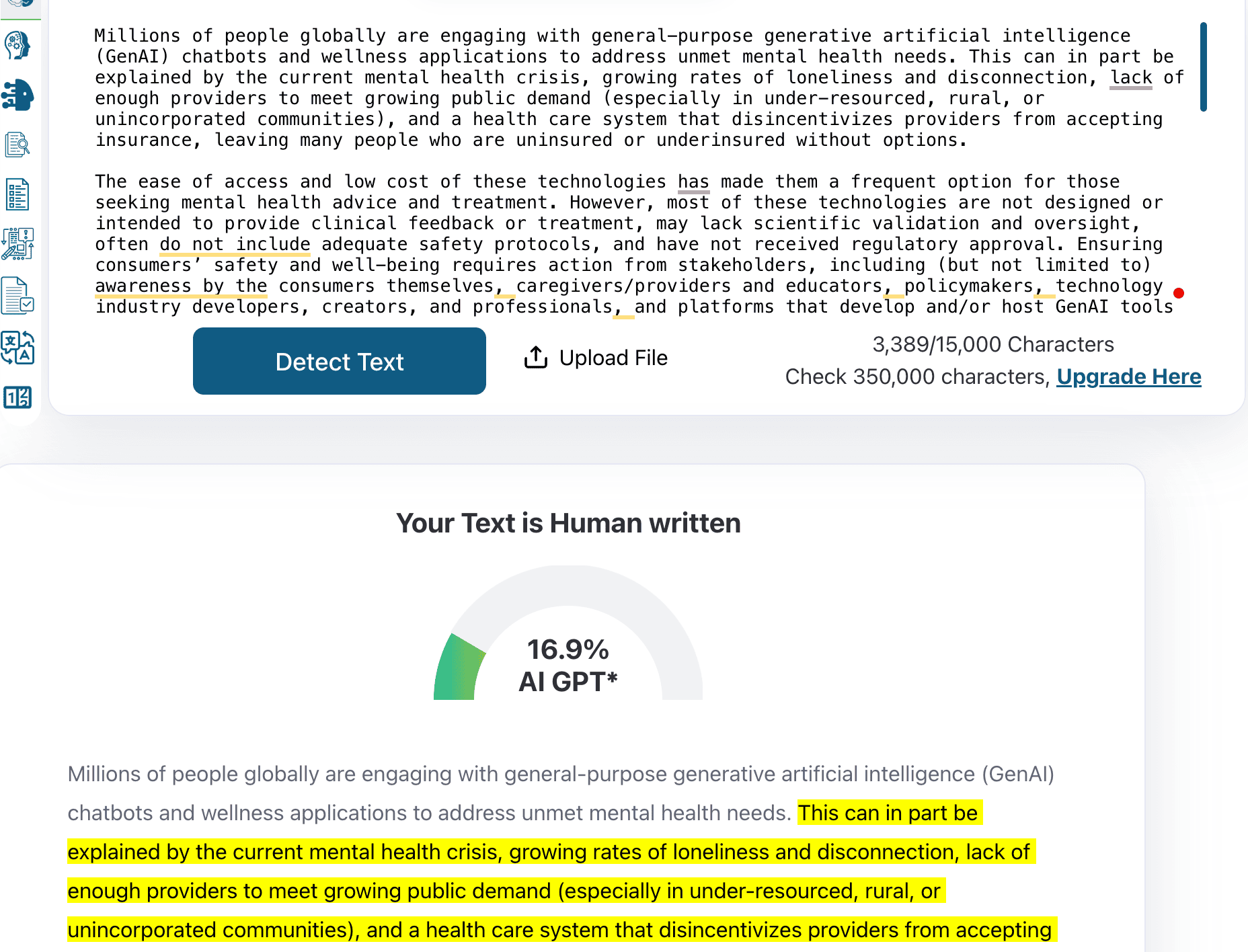
ZeroGPT correctly classified this text as human-written. The 16.9% score is elevated given that the text is entirely human, but the overall verdict was accurate. Some sections were highlighted as potentially AI-generated, reflecting the challenge that formal academic language poses for any detector.
JustDone result: 0% AI — "Most academic institutions and websites will consider this text to be fully human, unique and ready for publication"
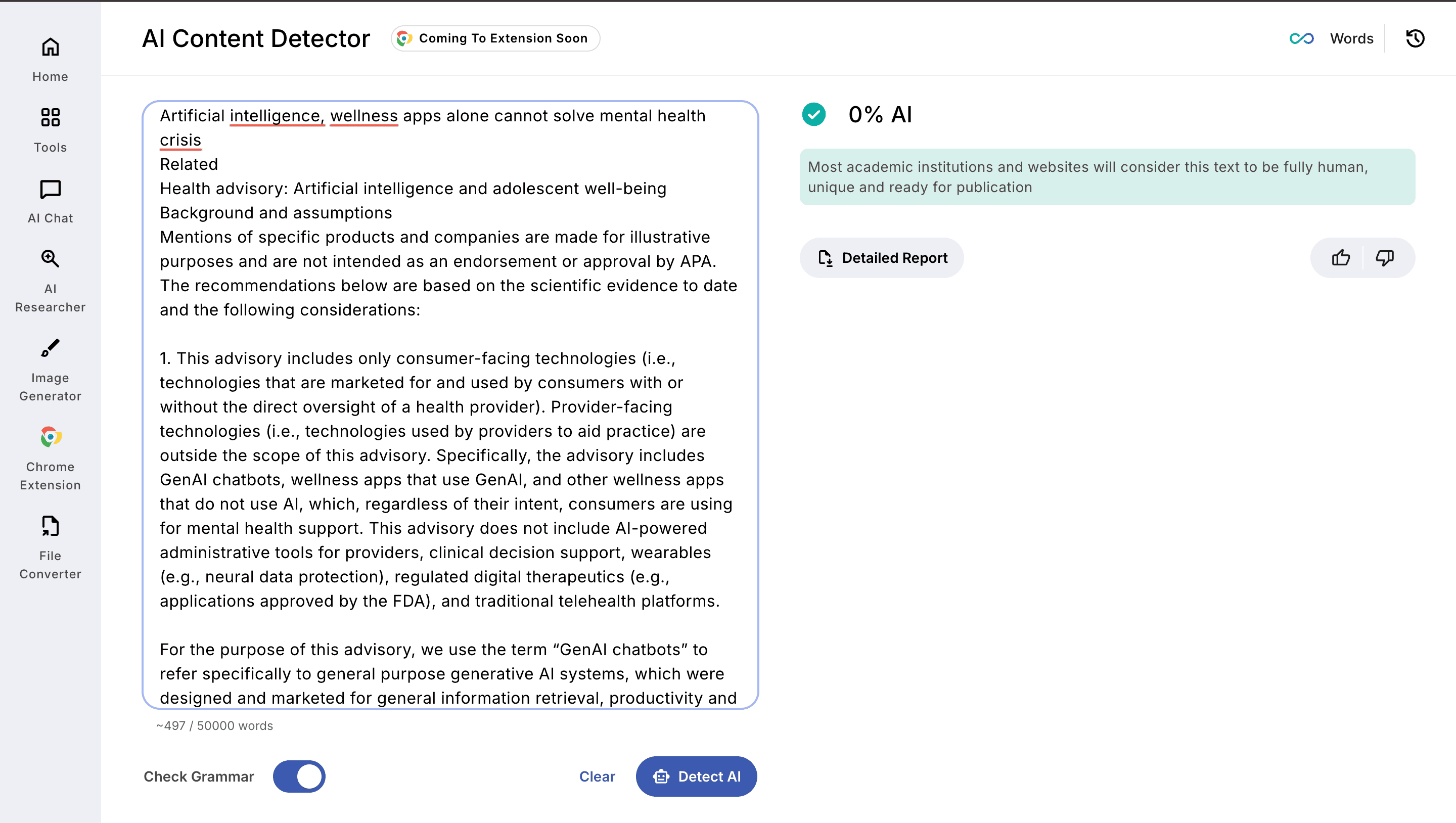
JustDone returned a clean 0% score on the same text. The result is more precise — the text is human and JustDone reflected that accurately with no ambiguity.
Verdict on Test 1: Both tools got the classification right. JustDone gave a cleaner, more confident result. ZeroGPT's 16.9% score could create unnecessary concern for a student submitting genuinely original work.
Test 2 — Fully AI-Generated Spanish Academic Text
ZeroGPT result: 61.2% AI GPT — "Most of Your Text is AI/GPT Generated"
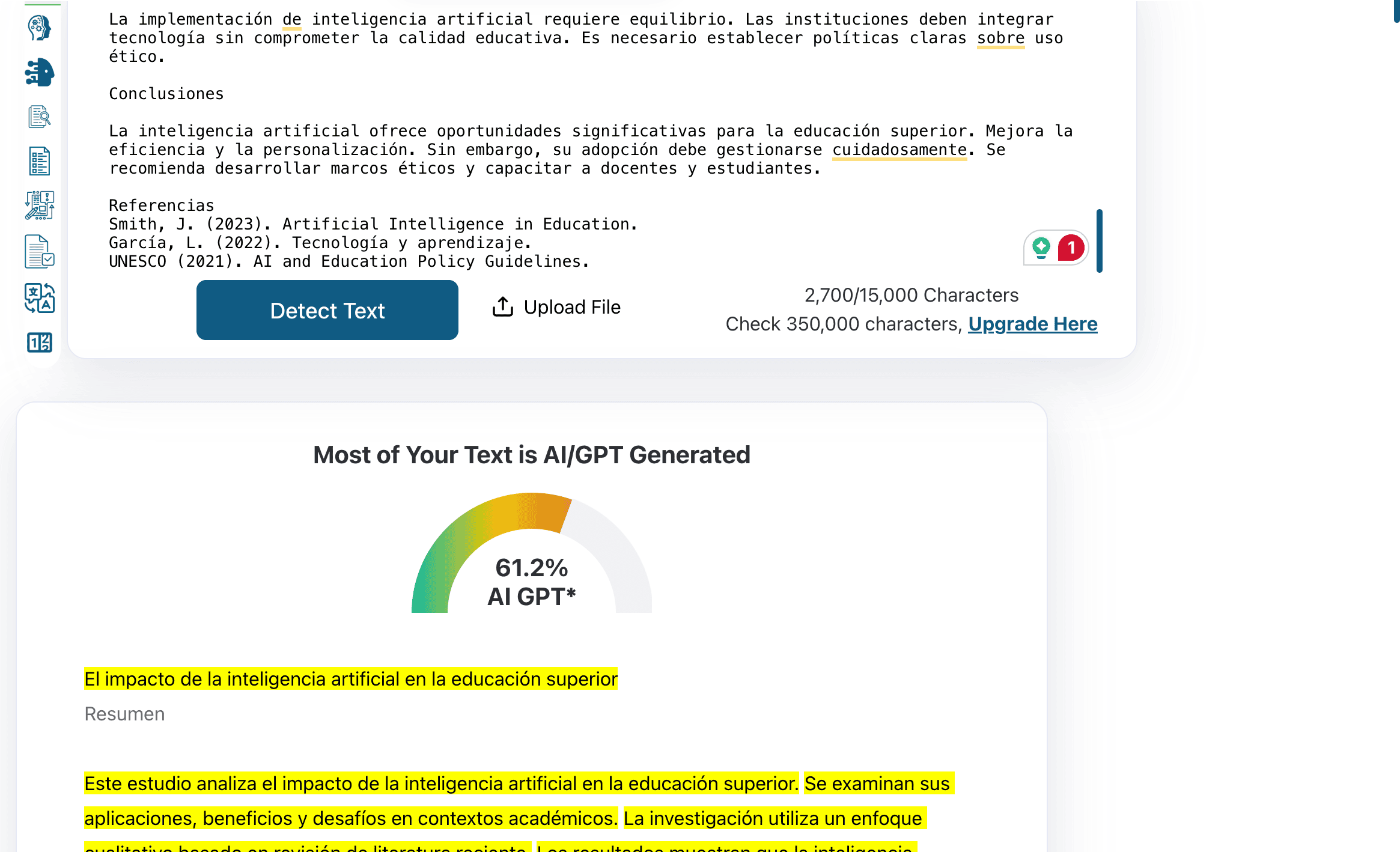
ZeroGPT flagged this as mostly AI-generated, which is technically correct — but 61.2% significantly understates how AI-generated the text actually was. The text was entirely written by an AI model with no human editing. A score of 61% suggests the tool has meaningful limitations when analyzing Spanish-language content.
JustDone result: 100% Possibly AI — all text highlighted
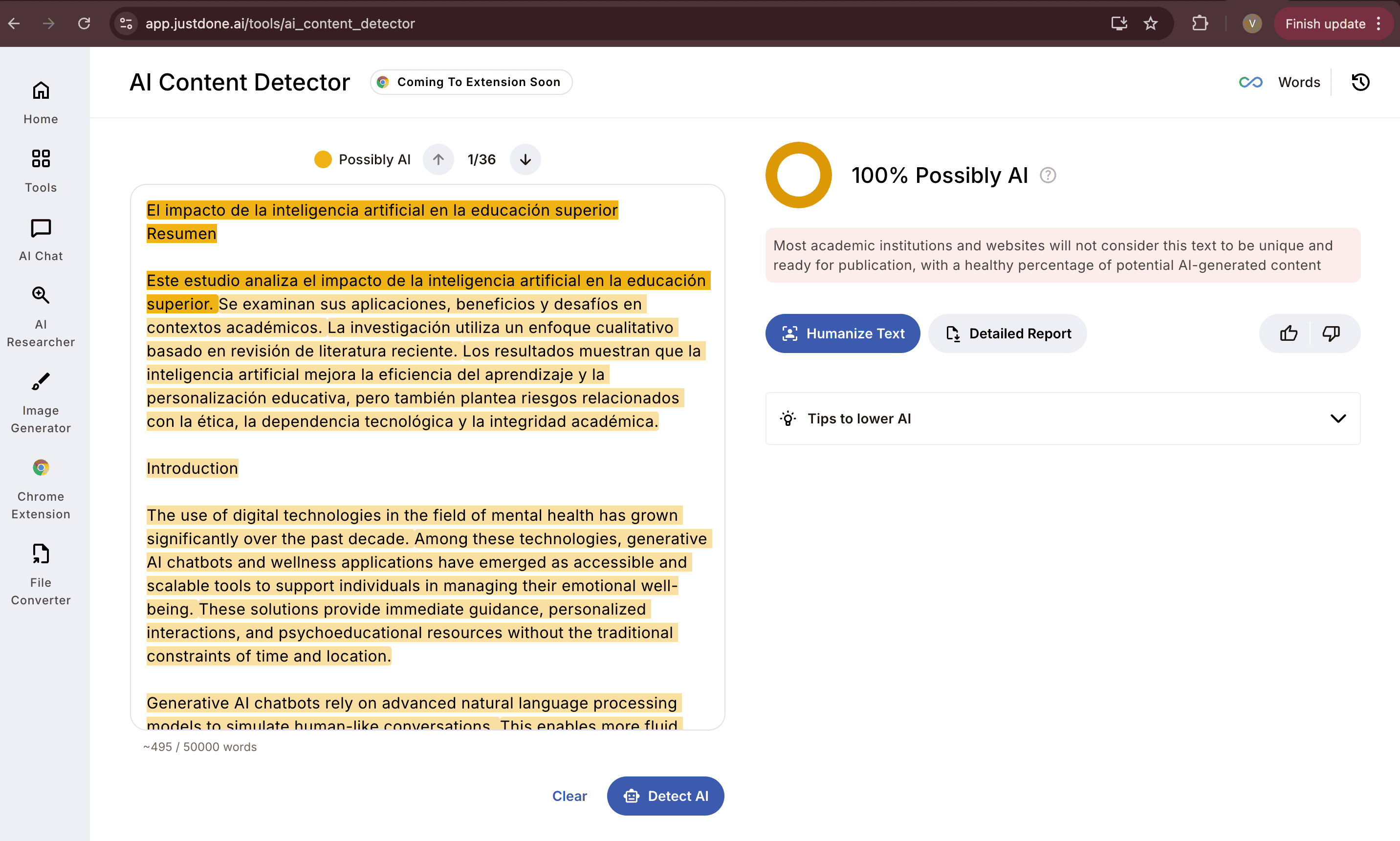 JustDone returned 100% AI probability on the same text. Every sentence was highlighted, reflecting the reality that the text was entirely AI-generated. The result is consistent with what the text actually is.
Verdict on Test 2: This is ZeroGPT's most significant failure in our testing. A 61% score on fully AI-generated Spanish text means ZeroGPT would pass a substantial portion of AI content as acceptable in a non-English academic context. JustDone detected it with full confidence.
Test 3 — Mixed Human and AI Text (English)
ZeroGPT result: 39.9% AI GPT — "Your Text is Likely Human Written, may include parts generated by AI/GPT"
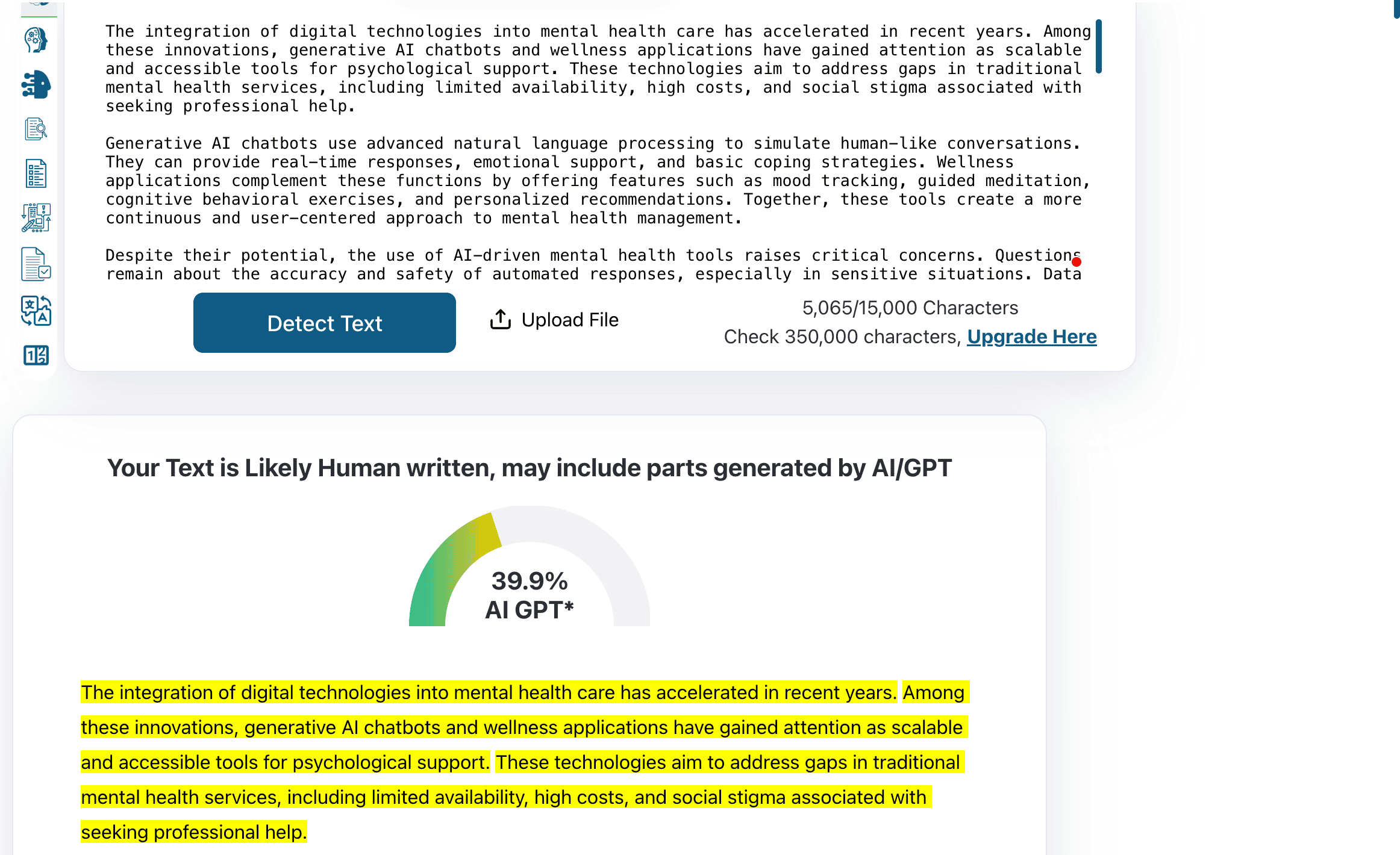
ZeroGPT correctly identified this as mixed content and gave a moderate AI probability score. The highlighted sections covered the first paragraph and several subsequent sections, though some AI-generated portions were not flagged.
JustDone result: 33% Possibly AI — sentence-level highlights with navigation between flagged sections
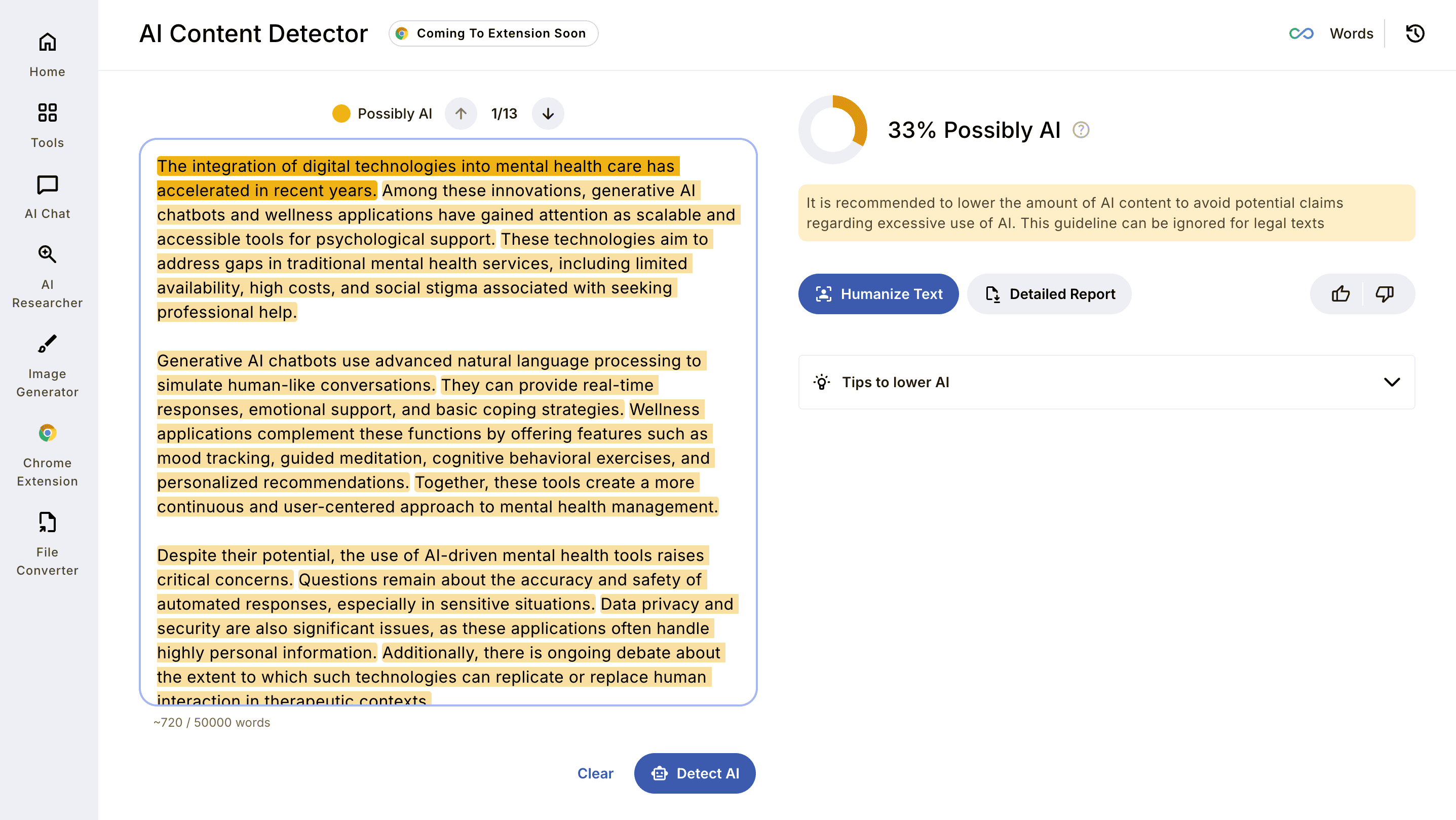
JustDone returned 33% AI probability on the same text, with a sentence-by-sentence breakdown allowing navigation between the 13 flagged sections. The result included a recommendation to lower the AI content percentage and a "Humanize Text" button for immediate action.
Verdict on Test 3: Both tools returned similar overall scores on the mixed text, though the approach differs meaningfully. JustDone provides numbered navigation through flagged sentences and direct access to the Humanizer. ZeroGPT returns a highlighted text without a structured path to fixing what was found.
ZeroGPT Features Overview
AI Detector is the core product. Returns a percentage score and highlighted text. Free up to 15,000 characters per scan. No account required for basic use.
Plagiarism checker is added as a secondary feature. Checks text against web sources for similar content. Not as robust as dedicated plagiarism tools.
AI Paraphraser and Summarizer are writing assistance tools built around the detection engine. Functional for basic use, but not the primary reason most users visit the tool.
Grammar Checker makes a standard grammar and spelling check. Comparable to most free grammar tools.
AI Image Detector detects images generated by AI tools such as Midjourney, DALL-E, and Stable Diffusion. An increasingly relevant feature as AI image generation becomes more common.
Also, ZeroGPT provides other functions like Summariser, Email Writer, and more. The tool states that it supports multiple languages. Our testing on Spanish text suggests that multilingual accuracy is significantly lower than English accuracy. That’s a gap the tool does not clearly communicate to users.
What ZeroGPT Does Well
First is that it’s no account required. You can paste text and get a result in seconds without creating an account. This frictionless experience is one of the main reasons ZeroGPT has attracted a large user base.
Second is a clean, simple interface. The tool is easy to use with no learning curve. The highlighted output is visually clear, and the percentage result is immediately understandable.
It’s free for reasonable word counts. In fact, the 15,000-character limit covers most student essays and a significant portion of professional content. The free tier is genuinely usable for occasional checking.
English-language accuracy is acceptable. On English text, ZeroGPT performs reasonably well for a free tool. The false positive rate on formal academic writing is higher than ideal but manageable.
ZeroGPT Limitations
Here are the most noticeable limitations of the tool:
- Non-English accuracy is unreliable. This is the most significant limitation our testing revealed. The 61.2% score on fully AI-generated Spanish text is a material failure. Students submitting work in Spanish, Portuguese, Italian, Korean, Vietnamese, or any other language cannot rely on ZeroGPT for accurate AI detection results.
- No sentence-level explanation. ZeroGPT highlights text but doesn't provide structured navigation between flagged sections or explain why specific sentences were flagged. For someone who needs to fix their text — not just read a percentage — this is a usability gap.
- No built-in resolution tools. Once ZeroGPT tells you something is AI-generated, you're on your own to fix it. There's no humanizer, no rewriting tool, and no direct path from the detection result to an actionable next step.
- Inconsistent scoring A 61.2% score on fully AI-generated text and a 16.9% score on genuinely human-written text suggest that ZeroGPT's calibration is inconsistent. Both results are on the wrong end of the spectrum — the AI text should be higher and the human text should be lower.
- No scan history within Basic plan. Results aren't saved, which makes it difficult to compare drafts, track changes, or share evidence with a third party.
ZeroGPT Pricing
ZeroGPT operates on a freemium model. The free tier provides access to the AI detector with a 15,000 character limit per scan. Paid plans increase the character limit to 350,000 and unlock additional features. Specific pricing details are displayed on the ZeroGPT website and are subject to change.
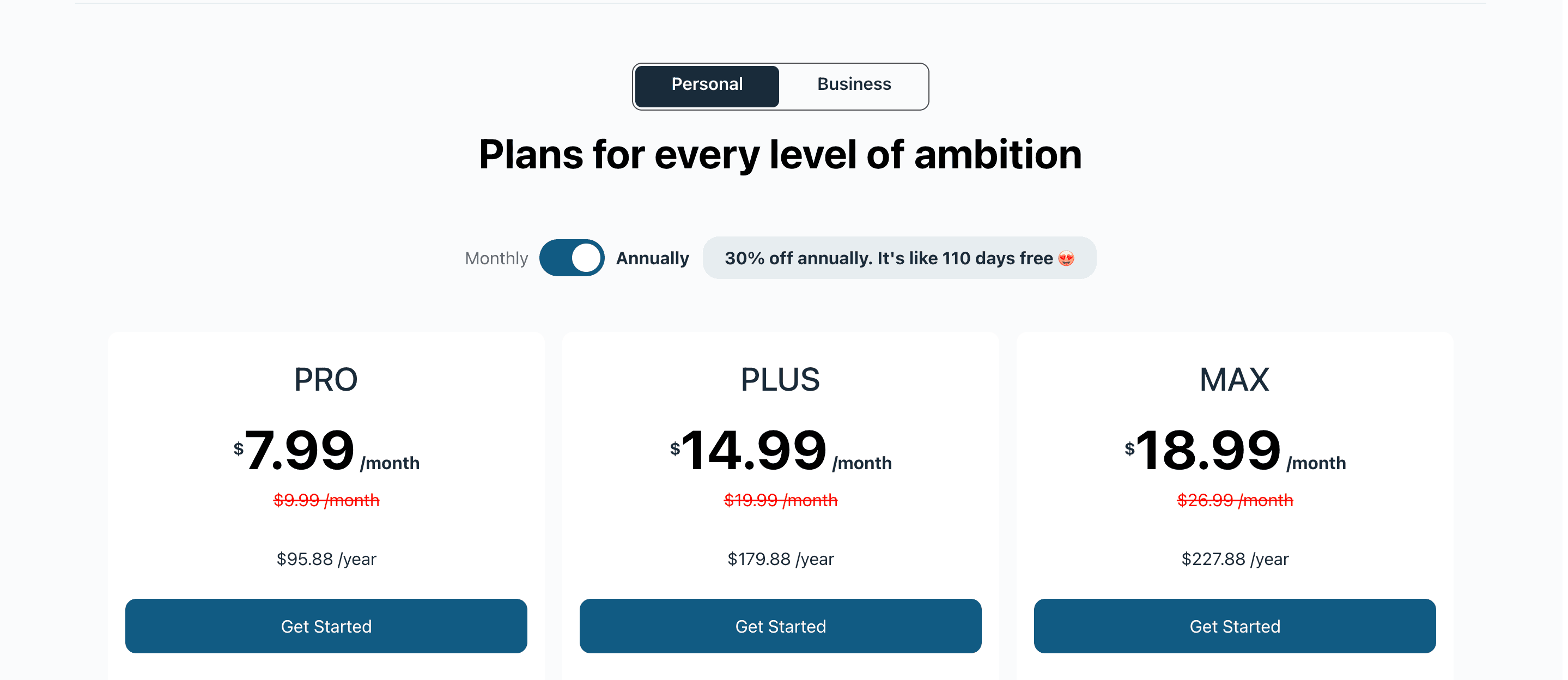
The free tier is sufficient for single-document occasional use. For anyone running regular checks on longer documents, the paid tier becomes necessary.
ZeroGPT vs. Other AI Detectors
Among the best-known and efficient AI detection alternatives, I compared the following options:
ZeroGPT vs. JustDone
JustDone takes a different approach to what AI detection is for. Rather than just returning a score, JustDone shows which specific sentences were flagged, provides numbered navigation between them, and offers a built-in AI Humanizer to rewrite flagged sections without leaving the platform.
In our testing, JustDone outperformed ZeroGPT on both the Spanish-language test (100% vs 61.2% on fully AI-generated text) and gave a cleaner result on human-written academic text (0% vs 16.9%). The sentence-level breakdown and direct integration with humanizing tools means you're not left with a number and no path forward.
For students who need to check work before submission and fix what's flagged — all in one place — that difference is practical and meaningful.
ZeroGPT vs. GPTZero
Both tools are free-tier accessible and English-focused. GPTZero's Advanced Scan is generally considered more accurate on English content. ZeroGPT has a simpler interface. Neither performs reliably on non-English content.
ZeroGPT vs. Turnitin
Turnitin is the institutional standard for plagiarism and AI detection in universities, but it's only available through academic institutions — students cannot access it directly. ZeroGPT is accessible to anyone but is not a substitute for institutional tools.
ZeroGPT vs. Originality.ai
Originality.ai is a more accurate tool aimed at professional content teams and publishers. More expensive and more reliable. Not designed primarily for students.
Who Should Use ZeroGPT?
Casual users who need a quick, free check on English-language text will find ZeroGPT functional. It's fast, requires no account, and gives an immediate result.
Students writing in English can use it as a first-pass check, with the understanding that the result is a signal rather than a definitive verdict — and that formal academic writing may trigger elevated scores even when human-written.
Anyone writing in a language other than English should approach ZeroGPT results with significant caution. Our testing showed a 38.8 percentage point gap between ZeroGPT and JustDone on the same Spanish-language AI-generated text.
Professional content teams needing reliable, consistent detection across languages and document types will find ZeroGPT insufficient as a primary tool.
F.A.Q.
Is ZeroGPT accurate?
ZeroGPT claims over 98% accuracy, but independent testing including our own suggests real-world accuracy is considerably lower — particularly for non-English content and mixed human-AI text. On English content it performs adequately for a free tool. On Spanish content in our test it returned 61.2% for fully AI-generated text.
Does ZeroGPT work in other languages?
ZeroGPT states multilingual support, but accuracy on non-English content is significantly lower than on English. Our Spanish-language test produced a result that substantially underestimated the AI probability. Use results on non-English text with extra caution.
Is ZeroGPT free?
Yes, the core AI detection tool is free with a 15,000 character limit per scan. A paid plan extends this to 350,000 characters and unlocks additional features.
Can ZeroGPT detect ChatGPT?
ZeroGPT is trained to detect output from ChatGPT, GPT-4, Claude, Gemini, and other major AI writing models. Detection accuracy varies depending on how much the text has been edited after generation and what language it's written in.
Does ZeroGPT give false positives?
Yes. Our test on human-written academic English returned a 16.9% AI score. Formal, structured academic writing is a known source of false positives across most AI detectors, and ZeroGPT is no exception.
What is the difference between ZeroGPT and GPTZero?
Despite similar names, ZeroGPT and GPTZero are separate tools built by different teams. GPTZero was developed by Princeton student Edward Tian. ZeroGPT is a separate product. Both offer AI detection but use different models and return different results on the same text.
The Bottom Line about ZeroGPT AI Detection
ZeroGPT is a legitimate free tool that works well enough for quick, casual checks on English-language text. The interface is clean, the barrier to entry is zero, and for simple use cases it does what it promises.
The limitations matter though. Non-English accuracy is unreliable, the scoring is inconsistent across text types, and the tool gives you a result without a clear path to acting on it. For students who write in Spanish, Portuguese, or any other language — or who need to understand and fix what was flagged, not just read a number — ZeroGPT's free tier leaves a meaningful gap.
Use ZeroGPT if you need a fast, no-account check on English text and understand that the result is indicative rather than definitive.
Consider alternatives if you're writing in a non-English language, need sentence-level explanations, or want tools to fix flagged content in the same workflow rather than starting over somewhere else.
