Key takeaways:
- AI detectors analyze writing patterns, including perplexity and burstiness, to estimate whether content was written by a human or an AI tool.
- No detector is 100% accurate: false positives and false negatives are real risks that can unfairly penalize genuine human writers.
- The best approach is to use AI detectors as one part of a broader content authenticity strategy, never as a sole verdict.
So, how do AI detectors work? At the core, AI content detectors analyze text to estimate whether it was written by a human or an AI tool like ChatGPT or Gemini. They measure signals such as perplexity (how predictable the writing is), burstiness (how much sentence length and structure varies), and increasingly, a wider set of linguistic and stylistic fingerprints that go beyond those two metrics alone.
This guide breaks down how AI detection works, compares the best options on the market, and covers their key limitations, including false positives, false negatives, and the challenge of keeping up with fast-evolving AI models.
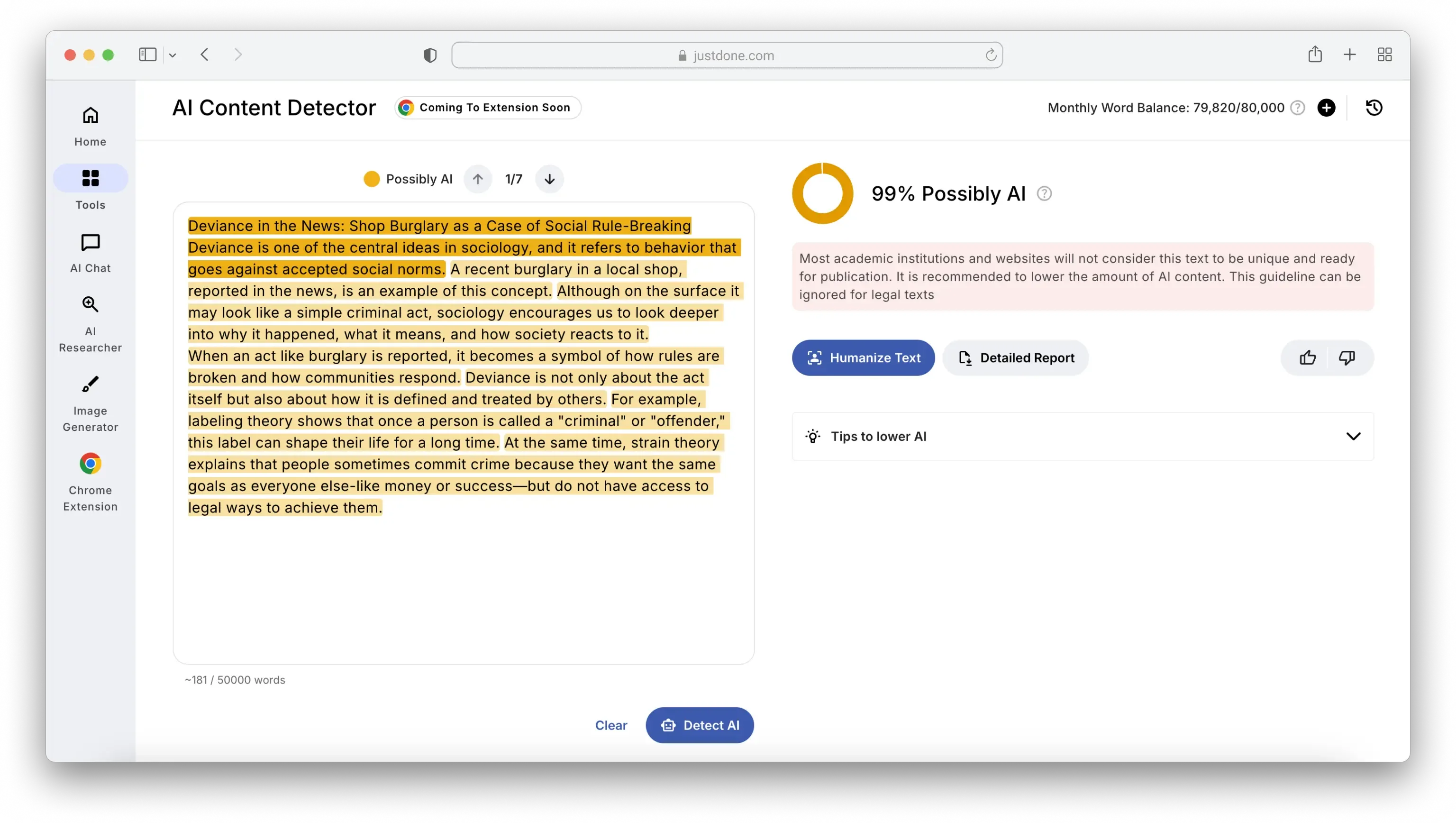
Want to check your content right now? Try JustDone AI Detector and get a sentence-level breakdown of what reads as AI-generated, then fix it with confidence.
What Are AI Detectors?
AI content detectors are tools that estimate the probability that a piece of writing was created by a generative AI system, such as ChatGPT, Gemini, or Claude, rather than by a human.
They don't read text the way a teacher or editor would. Instead, they scan for statistical and linguistic fingerprints: patterns in word choice, sentence structure, predictability, and rhythm that tend to differ between human and machine-generated writing.
AI-generated content is becoming more common online, and AI checkers have become increasingly important for educators, publishers, recruiters, and content teams trying to verify authenticity.
How AI Detection Works
To understand how AI detection works, it helps to know the technologies behind it, largely the same foundational technologies that power generative AI models themselves.
Machine learning allows detectors to recognize patterns across massive datasets without being explicitly programmed with rules. The more examples a detector trains on, texts labeled "human-written" or "AI-generated", the better it becomes at telling them apart.
Natural language processing (NLP) helps detectors analyze not just individual words but the relationships between them: syntax, context, semantic meaning, and sentence structure. AI can produce grammatically correct sentences, but it tends to struggle with subtlety and the depth that comes naturally to experienced human writers.
Classifiers are machine learning models trained on large, pre-labeled datasets to sort text into categories like "AI-written" and "human-written," based on features like sentence length distribution, vocabulary diversity, and structural regularity. Some advanced tools add intermediate categories, distinguishing "AI-generated," "AI-generated and AI-refined," and "human-written and AI-refined," for a richer picture of how content was likely produced.
Embeddings are numerical representations of words and phrases that let computers process language mathematically, mapping words into vectors that capture meaning and context. This lets detectors compare a new piece of writing against the patterns they learned from training data.
Detection Signals: Patterns, Tells, and Accuracy
What Do AI Detectors Look For?
Detectors are trained to notice specific tells that show up again and again in machine-generated text. Research from AI detection labs has pointed to a wider set of stylistic and structural signals beyond perplexity and burstiness alone:
- Predictable word choice. Words like "delve," "tapestry," "moreover," and "it's important to note" appear far more often in AI output than in typical human writing, a byproduct of the data models are trained on.
- Uniform sentence and paragraph length. AI text tends toward evenly sized paragraphs and sentences that hover around the same length.
- Formulaic structure. A neat introduction, a list-like body, and a conclusion that starts with "overall" and repeats the thesis rather than adding anything new.
- Vague or generic claims. AI systems are tuned to stay safely on-topic, often avoiding specific personal details or strong opinions.
- Lack of natural variation. Human writing includes small imperfections, sentence fragments used for effect, and tone shifts that don't follow a predictable pattern.
What Makes AI Writing Detectable?
The signals above are what makes AI writing detectable in the first place: repetitive rhythm, generic phrasing, and an absence of the small imperfections that mark human drafting. Understanding this helps you edit with intention instead of guessing. If you know a detector watches for uniform sentence length and stock transition words, you can vary your pacing and add concrete specifics before you ever run a check.
Perplexity: The Predictability Score
Perplexity measures how predictable a piece of text is, or how "surprised" a language model would be by the word choices and sentence structures it encounters.
Low perplexity means highly predictable text, exactly what you'd expect to come next. This is characteristic of AI-generated writing, which optimizes for coherence and readability. High perplexity means unpredictable writing: unexpected word choices, unusual metaphors, or unconventional structures, more typical of human writing.
| Example Sentence | Perplexity Level | Why |
|---|---|---|
| The sky is blue. | Low | Extremely common and predictable. |
| The sky outside was a soft shade of silver before the storm. | Medium-low | Less predictable but still natural and clear. |
| The sky is remembering the rain we never had. | Medium | Poetic and metaphorical — more human-feeling. |
| I would love a bowl of grasshoppers jumping. | High | Grammatically odd and highly unexpected. |
Perplexity alone isn't a reliable signal on its own. Formal, technical, or procedural writing naturally produces low-perplexity text, which is one reason older detectors flagged formal human writing as AI-generated, and why modern tools now combine perplexity with several other signals.
Burstiness: The Rhythm of Human Writing
Burstiness measures variation in sentence length and structural complexity. Human writing naturally has high burstiness: short punchy sentences mixed with longer, complex ones, shifts in register, rhythm broken for emphasis. AI writing tends toward low burstiness: consistently medium-length sentences with an almost metronomic regularity that feels smooth but lifeless.
| Sample Paragraph | Burstiness | Explanation |
| I woke up late. The sky outside was a mix of orange and gray, a sign of the storm approaching. Groggily, I made my way to the kitchen, grabbing a cup of coffee to shake off the sleepiness. It was going to be a long day, I could already tell. | High | Sentence lengths vary. Uses adverbs, present participles, and varied rhythm. |
| I woke up late in the morning. The sky outside was a mix of orange and gray. I made my way to the kitchen. I grabbed a cup of coffee. I could tell it would be a long day. | Low | Sentences are consistently short and simple. Monotonous structure throughout. |
Perplexity and burstiness work together. High burstiness tends to raise perplexity too, since sudden shifts in sentence length make the next word harder to predict. Research from AI detection labs has shown that perplexity and burstiness alone aren't enough for reliable detection, since some genuine human writing, technical manuals, legal text, and non-native English writing, can score low on both. That's why leading tools layer these two metrics with classifiers trained on much larger, more diverse datasets.
The Detection Process Step by Step
Here's what happens behind the scenes when you paste text into an AI detector like JustDone's:
- Input. You paste your text and hit “check.”
- Tokenization. The detector breaks your writing into tokens, small units of language it can analyze computationally.
- Feature analysis. The system examines sentence length distribution, vocabulary frequency, structural patterns, perplexity, burstiness, and semantic coherence.
- Embedding comparison. Your text is converted into vectors and compared against patterns learned from training data.
- Classification. The classifier places your text on the spectrum between "AI-generated" and “human-written.”
- Scoring. You receive a probability estimate, not a definitive verdict.
Want to try it yourself? Run your content through JustDone's AI detector for a sentence-level breakdown of what reads as AI-generated and actionable guidance on sounding more authentically human.
AI Detectors vs. Plagiarism Checkers
These tools are often confused, but they serve different purposes.
| AI Detector | Plagiarism Checker | |
|---|---|---|
| What it detects | Whether text was likely written by AI | Whether text matches existing published sources |
| Output | Probability score (e.g. "73% AI-generated") | Similarity percentage with source matches |
| Reliability | Probabilistic, can produce false positives/negatives | Match-based, generally more precise for exact overlaps |
| Best for | Checking if writing feels machine-generated | Confirming originality and correct citation |
Plagiarism checker can sometimes flag AI-generated content as plagiarism, because generative models draw on training sources without citing them. This is why pairing an AI checker for teachers with a plagiarism checker gives a more complete picture before submitting academic or client work.
How Accurate Are AI Detectors?
Accuracy varies significantly across tools, and no detector is perfect. Here's how the leading AI detectors colleges use compare:
| Tool | Reported Accuracy | Notes |
| JustDone | 94% | Explains why sections are flagged and allows humanization in one click |
| Turnitin | 86% | A golden college standard for Plagiarism checking |
| GPTZero | 95,7% | Well-known free and paid detector; performs reliably on clear AI content but can vary based on text type and editing |
| Copyleaks | 99% | Marketed as very high accuracy with low false positives (nearly 0.2%) |
| Originality.ai | 95-99% | Some independent tests show very high accuracy on standard AI text. |
Several factors affect how reliable any detector will be:
- Text length: Short passages offer fewer patterns to analyze. Longer texts give detectors more signal to work with.
- AI model sophistication: Newer AI systems produce increasingly human-like text, making them harder to detect.
- Human editing: AI-generated content that has been substantially revised by a human becomes much harder to identify.
- Writing style: Creative, unconventional, or highly technical writing can confuse detectors trained on more standard prose.
- Language: Most detectors are trained primarily on English-language data and may perform less reliably on other languages.
Is JustDone AI Detector Accurate?
JustDone's AI Detector reports roughly 94% accuracy in internal testing, with a sentence-level breakdown rather than a single blunt score. It shows which sentences read as machine-generated, flags the reasoning (repetitive structure, overly polished phrasing, uniform rhythm), and lets you send flagged sections straight to the humanizer for a rewrite. For creators, students, and editors who need a working tool rather than a courtroom verdict, that combination of transparency and next steps is what makes the accuracy figure useful day to day.
Limitations: Why AI Detectors Aren’t Perfect
These tools help identify AI-assisted work, but false positives can unfairly penalize students or writers.
False Positives
A false positive occurs when a detector flags human-written content as AI-generated. Common causes include formal or highly structured writing styles, technical or procedural content with naturally low burstiness, and writers whose style is particularly clean or polished. Non-native English speakers face this risk disproportionately, since their patterns may differ from a detector's training data.
This isn't a theoretical risk. A Stanford research team tested seven widely used AI detectors on TOEFL essays written by non-native English speakers and found the tools misclassified more than 61% of that writing as AI-generated, compared to almost no false positives on essays by native speakers of similar quality.
Read the full Stanford paper on GPT detector bias for the complete methodology.
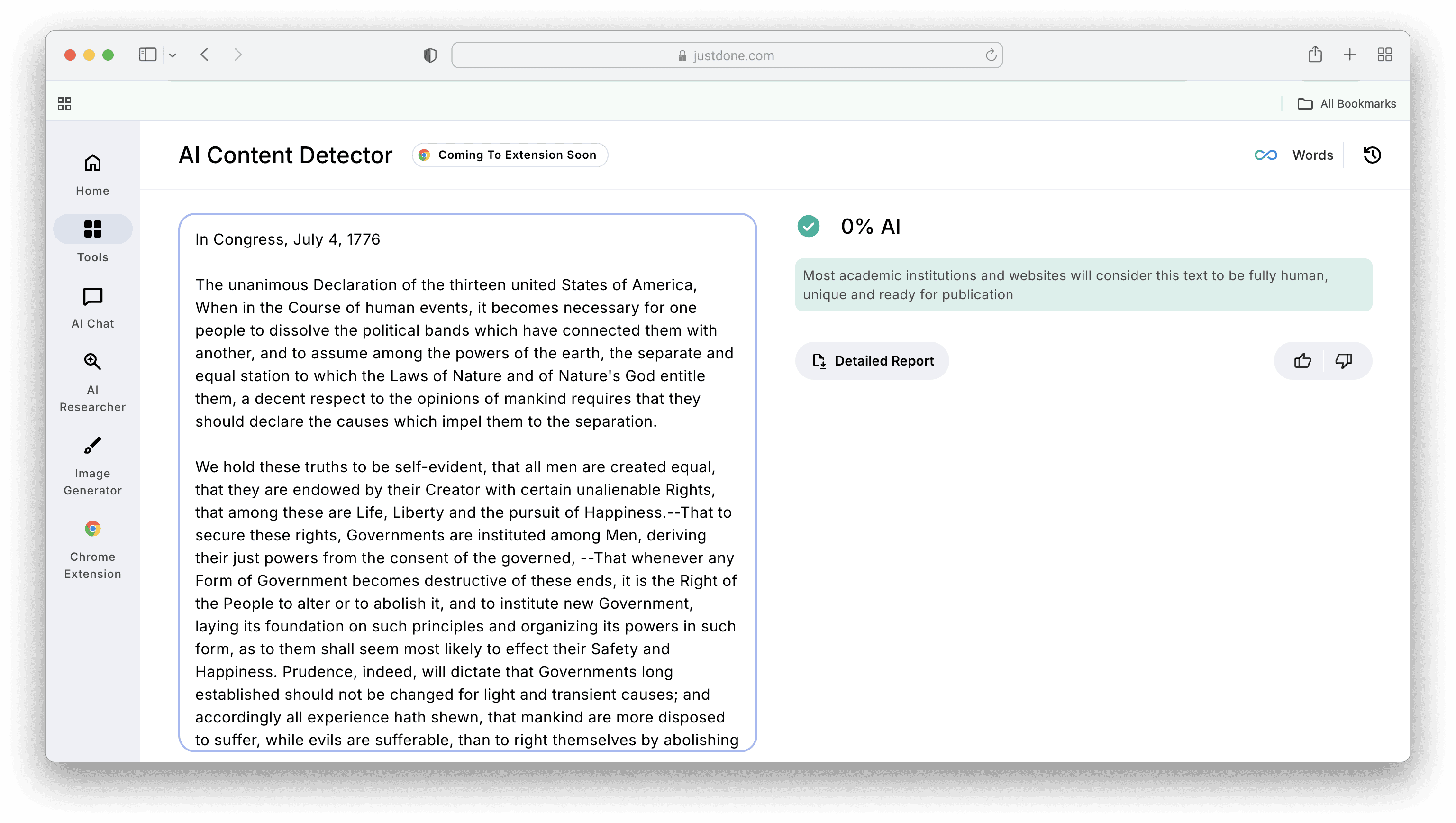
Historical documents show the same problem. The Declaration of Independence, written entirely by human hands in 1776, has been flagged as AI-generated by some detectors, simply because its formal, structured prose resembles machine output. Advanced checkers now handle this better: JustDone AI Detector correctly scores the Declaration at 0% AI probability.
Historical documents are a striking example of how problematic false positives can be. The Declaration of Independence, written entirely by human hands in 1776, has been flagged as AI-generated by some detectors, simply because its formal, structured prose resembles what detectors associate with machine output.
However, advanced AI checkers detect historical materials and texts made before AI with 0% AI probability.
False Negatives
A false negative occurs when a detector fails to identify AI-generated content. As models become more sophisticated, prompting for a conversational style or deliberate errors can fool basic detectors.
Evolving AI and Context Blindness
Generative AI often improves faster than detection methods, so detection systems can lag behind new model releases. Detectors also analyze patterns, not meaning: they can't assess whether an argument is coherent or evidence is cited appropriately. Writing can score "human" while being entirely plagiarized, or score "AI" while being completely original.
MIT Sloan's teaching and learning technology team has published guidance arguing that AI detection software carries high error rates and can lead instructors to falsely accuse students of misconduct, recommending clear course policies and open dialogue as a more reliable path than a score alone.
See MIT Sloan's analysis on why AI detectors fall short in their full reasoning.
The best approach is to use an AI detector as part of a broader verification strategy, combined with your own critical thinking.
Best Practices to Work with AI Detectors
Here are my top recommendations how to approach AI detection tools effectively.
- Scan early, not just at the end. Mid-draft checks help you notice predictable, even-toned patterns while you can still revise calmly.
- Never treat a score as a verdict. A high "AI likelihood" score is a signal to investigate further, not proof of wrongdoing.
- Cross-check with multiple tools. Different detectors use different training data and thresholds; pairing AI detection with a plagiarism check gives the most complete picture.
- Build a writing audit trail. Keep drafts and version history. If you used AI for brainstorming, document that too.
- Run calibration tests. Run one of your own essays and a fully AI-generated version through the same detector to see how structure and tone affect scores.
- Be transparent about how and when AI tools were used in your workflow. Transparency builds trust and reduces misunderstanding.
- Try JustDone AI Detector as your go-to tool. It explains which sentences trigger the AI signal and why, giving you guidance to improve your work while keeping your voice intact.
Beyond the Score: Making AI Detectors Work For You
AI detectors have saved students from false accusations, and they've also caused real problems when treated as absolute proof. At their best, they reveal something about our own writing habits: where we sound too polished, too generic, or too formulaic.
Don't fear the tools, learn how they work. Use them to refine your tone and defend your originality, not to pass some invisible test. If you need a tool that does more than say "AI detected," JustDone's AI Detector is worth trying: it connects detection directly to the humanizer, paraphraser, and plagiarism checker in one workspace.
F.A.Q.
How do AI detectors detect AI?
AI content detectors examine writing patterns, sentence construction, and stylistic signals to assess how likely a text is AI-generated. They rely on machine learning models trained on extensive collections of both human and AI-produced content, but their results are probabilistic and can differ in accuracy.
How accurate are AI detectors?
No AI detector is 100% accurate. Accuracy varies significantly by tool and context. JustDone AI Detector demonstrates 94% score with sentence-level analysis. Because no tool is perfect, we recommend using AI detection alongside plagiarism checking and human review, but never as a standalone verdict.
Can AI detectors detect ChatGPT?
Yes, most AI detectors are trained on ChatGPT outputs and can identify text generated by GPT-4, GPT-5, and similar models with reasonable accuracy. Advanced detectors like JustDone's are continuously updated to keep pace with new model releases, but some can lag between model advancements.
What words trigger AI detection?
There are no specific “trigger words” that automatically flag text as AI-generated. Words like tapestry, elevate, crucial, or enhance don’t cause detection on their own. AI detectors analyze overall writing patterns, structure, tone consistency, and predictability, not individual words.
Why do AI detectors flag human content?
AI detectors analyze statistical patterns, not intent or meaning. Human writing that is formal, structured, repetitive, or unusually polished can share enough characteristics with AI-generated text to trigger a false positive. Writers who are non-native English speakers are particularly vulnerable, as their writing patterns may fall outside the range of the detector's training data. This is why detectors should always be used as one input in a broader assessment, never as a final judgment.
