Key takeaways:
- Academic writing for ESL is hard because of grammar, tone, natural phrasing, and vocabulary
- AI tools can help you avoid transalting thinking, making proper grammar and stylistic corrections
- The most useful AI tools for ESL learners include an AI humanizer that makes your writing sound natural and grammar checker. Both can be found on JustDone's all-in-one writing platform that helps multilingual learners write and study.
If you’re an international student, writing academic papers in English is definitely hard. You start thinking about articles (“a” vs “the”), word order, sentence structure, and if your tone is academic enough. Most ESL learners translate their thoughts and try to turn them into polished academic writing. It takes time and doesn’t always look well in academia. In this sense, AI becomes something very practical. It can serve as a personal writing assistant that corrects mistakes, suggests natural phrasing, and helps you communicate like an academic. If used right, it doesn’t make you sound like a robot. This article explains how AI supports non-native English speakers in academic writing, where it helps the most, where it can go wrong, and which AI tools are the most useful.
Why is ESL academic writing difficult
When native speakers struggle with academic writing, it’s usually about the structure and argument. For ESL students, the challenge is doubled. You have to build the argument and fight the language at the same time. In practice, ESL academic writing usually breaks down in these areas:
- Grammar and micro-errors (articles, prepositions, tense consistency)
- Academic tone (too informal or, more often, too stiff and “translation-like”)
- Natural phrasing (sentences that are correct but unnatural)
- Vocabulary (using repetitive words like “important,” “good,” “big,” “many”)
- Confidence (spending 20 minutes on one paragraph, still unsure it’s okay)
This is why many non-native speakers end up writing very “safe” English. It’s formal, repetitive, and cautious. And ironically, that kind of writing can sometimes look AI-like to detectors because it lacks personal detail, variation, and voice. You can read more about this in the article AI detection for ESL writers.
AI tools help because they operate exactly in the areas where ESL writing slows down: mechanics, phrasing, and confidence.
What AI actually does for ESL academic writing
AI is not one thing. It’s a set of functions that solve different problems. If you understand those functions, you can use AI strategically instead of blindly.
AI makes grammar correction easier.
Traditional grammar tools catch surface errors. Modern AI tools can catch errors based on meaning. For instance, let’s see how JustDone Grammar checker fixes errors in a typical ESL paragraph.
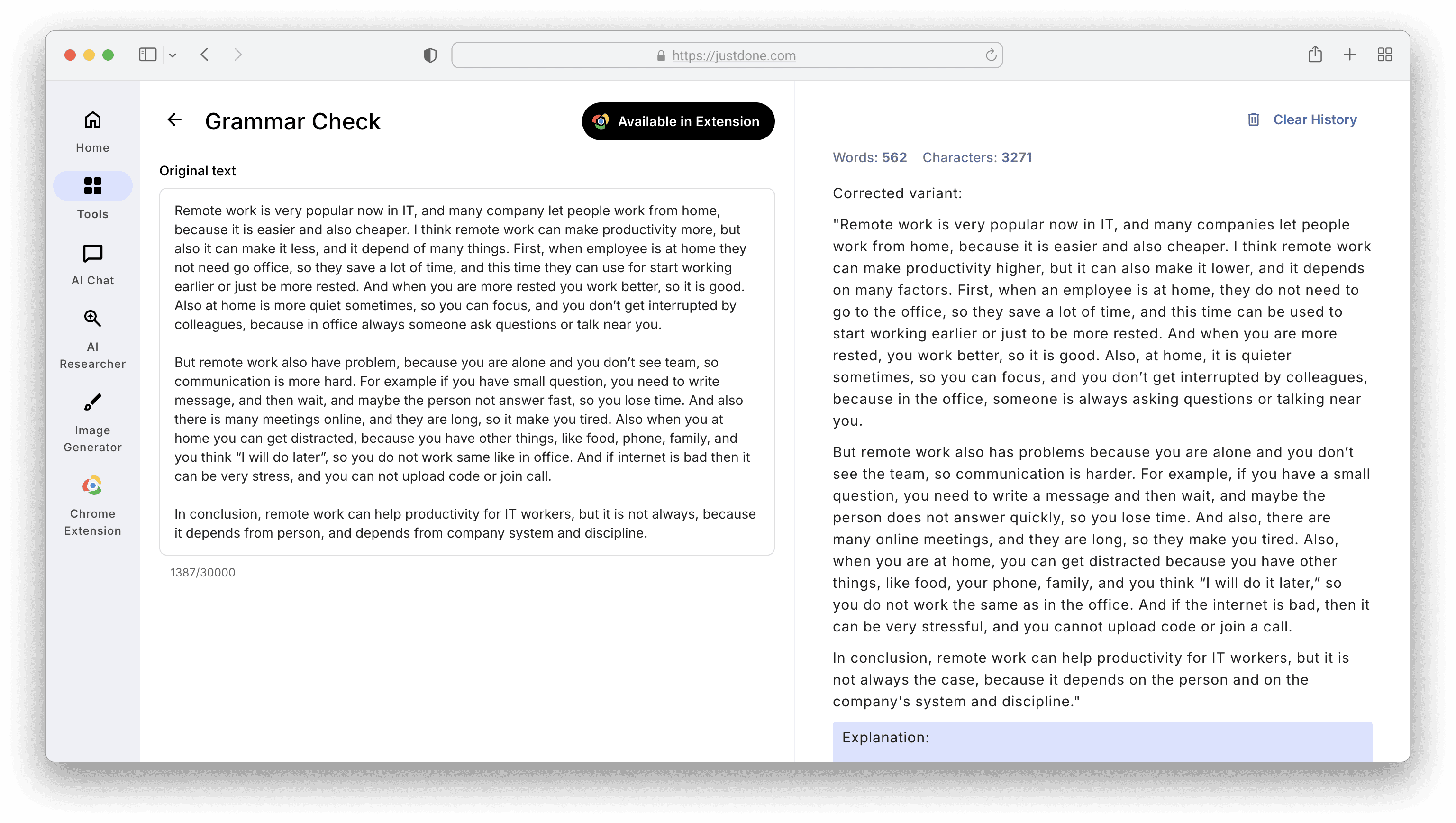
Importantly, grammar checker explains what corrections it does and why. Explanations are listed one by one, depending on where they were made in the text.
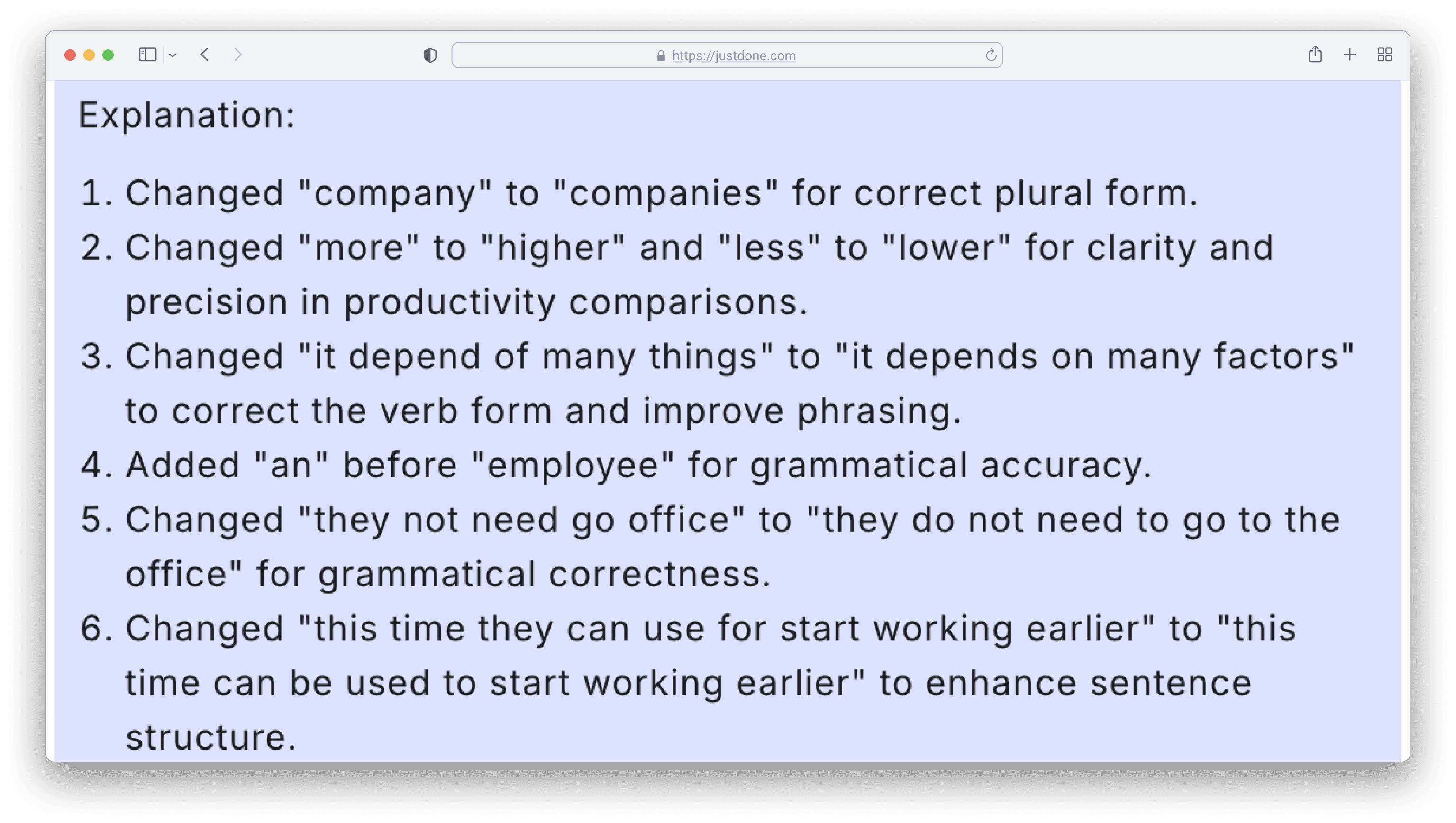
Acting as grammar rules, this practice improves English writing skills among ESL learners. Over time, students start noticing patterns and internalizing them. That’s why AI can actually improve long-term skill if used as feedback.
AI helps you write direct English without “translation thinking.”
Many ESL students first “write” the sentence in their native language in their head and then translate. That often produces stiff phrasing and unnatural word order. AI humanizer helps ESL texts sound natural by offering what I call native-like defaults or common phrases used in academic writing. This reduces the time you spend “guessing” what sounds correct.
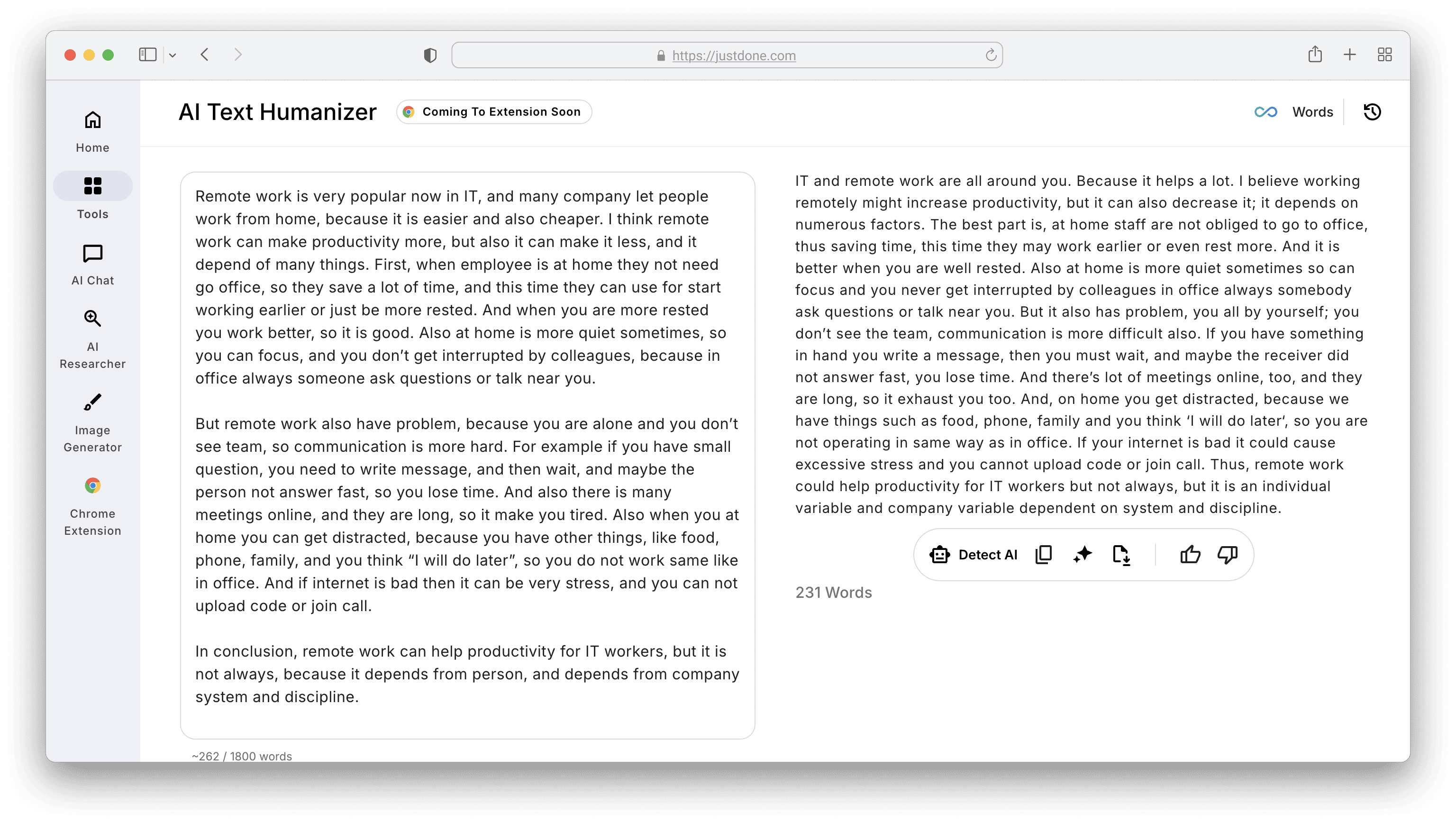
For instance, here’s how JustDone AI humanizer transforms an ESL essay into a clear and smooth English text. See how AI humanizer fixes structure, rewrites sentences, but keeps meaning unchanged.
AI improves academic tone.
A lot of ESL academic writing becomes overly formal because students associate “academic” with being complicated. If you write like “This phenomenon is of significant importance for the development of society”, think of making your message simpler, but keep it professional. AI can rewrite it into something that still sounds academic, but clearer. That’s where AI Humanizer can help too.
Select JustDone humanizing tool and Sound Human mode. Here’s what kind of output you can get:
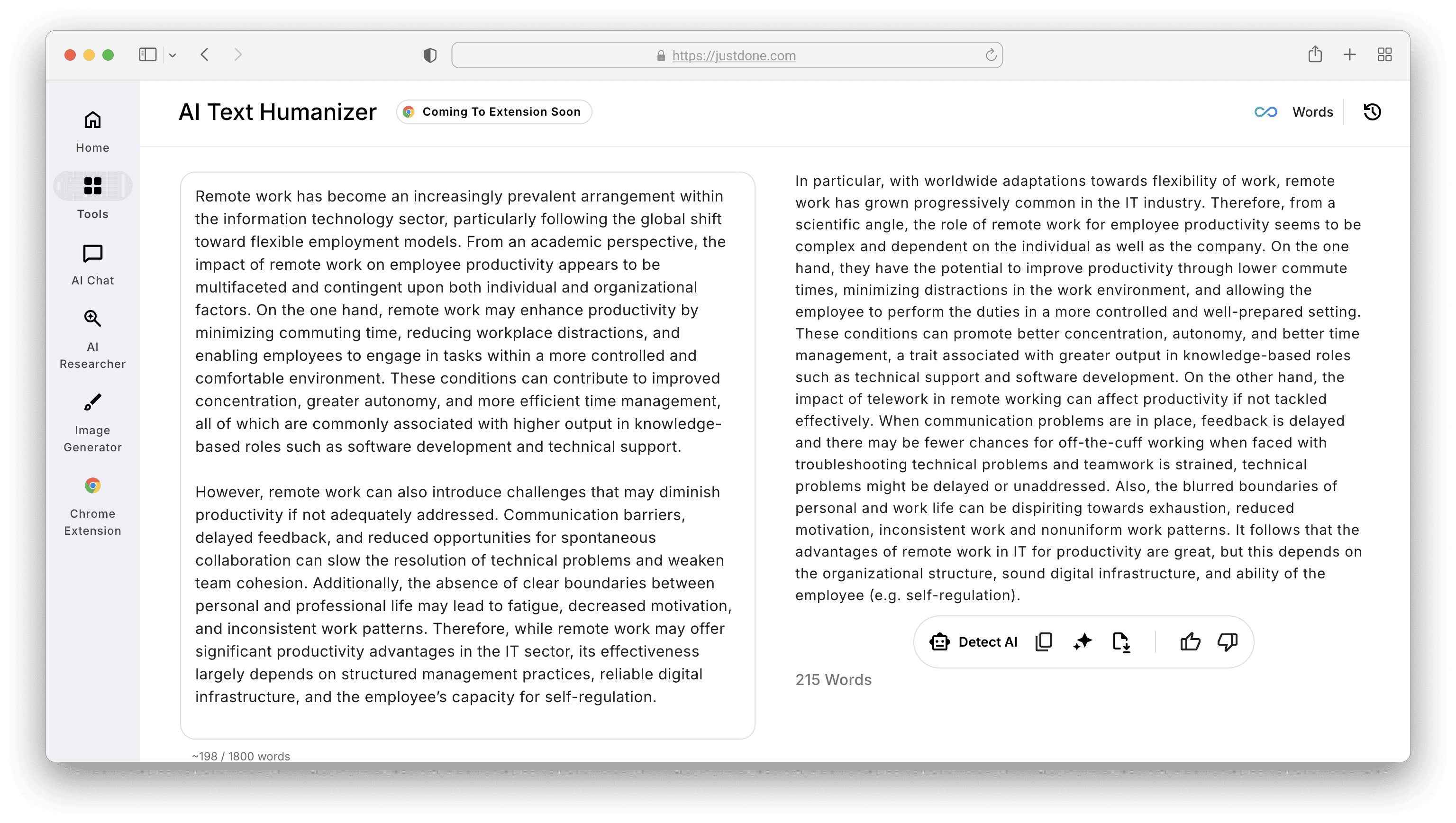
Simpler, more human, but still professional and totally academic. Learn more tips on how to humanize AI content and ESL writing in the article.
AI expands vocabulary to fit the context.
A thesaurus is dangerous for ESL students because it gives synonyms without context. AI gives vocabulary suggestions inside your real sentence. Example: “The results are good.” But AI suggests more context-aware alternatives:
- “promising”
- “significant”
- “consistent”
- “effective”
This helps you sound more academic without stuffing your paper with unnatural words. You’re not memorizing vocabulary lists. You’re learning better words in the context of your topic.
AI increases speed and confidence.
Confidence is a writing skill. When students feel uncertain, they hesitate, over-edit, and avoid writing. AI reduces that hesitation. Learners I work with often say they start writing faster, don’t get stuck on one sentence for 10 minutes, and are less scared of making mistakes. This matters because writing is not only output. It’s also learning. If you write more, you improve more.
How AI can speed up learning English
When AI gives immediate correction, it acts like constant tutoring. If you use it intentionally, you can learn fast by tracking patterns:
- Which prepositions you always get wrong
- Which sentence structures you overuse
- Which words you repeat too often
One practical method I recommend is to keep a mistake list. Every time AI corrects you, collect the pattern. Here are some of the patterns that often occur with corrections:
- “discuss about” – “discuss”
- “in the other hand” – “on the other hand”
- “make a research” – “do research”
- “information are” – “information is”
After 2-3 weeks, you write down AI corrections, you’ll notice you repeat the same mistakes. Fixing those gives you a noticeable improvement quickly.
Top ESL Academic Writing Fixes With AI Support
ESL Writing Problem | Typical ESL Sentence | What to Fix | How AI Helps (Practically) |
| Article confusion (a / the / no article) | “Student needs better structure in essay.” | Missing or incorrect articles | AI grammar checker inserts the correct article based on meaning and context |
| Direct translation from native language | “This gives possibility to understand better the topic.” | Unnatural phrasing | AI humanizer rewrites the sentence into natural academic English |
| Overly formal, stiff tone | “This phenomenon is of significant importance for society.” | Inflated, abstract language | AI rewrites into clearer academic tone without oversimplifying |
| Repetitive vocabulary | “Important”, “very important”, “big impact” | Limited word variety | AI suggests context-aware academic alternatives |
| Wrong verb–noun combinations | “Make a research”, “do a decision” | Collocation errors | AI corrects to standard academic collocations |
| Preposition errors | “Discuss about”, “different than” | Non-idiomatic prepositions | AI flags and fixes prepositions based on sentence meaning |
| Non-native sentence order | “Also this result can be explained by…” | Unnatural word order | AI reorders the sentence to sound natural in academic English |
| Generic academic filler | “It is important to note that…” | Low-information phrases | AI removes filler or replaces it with specific meaning |
| Writing anxiety and over-editing | Rewriting one paragraph for 20 minutes | Low confidence | AI provides instant feedback, reducing hesitation |
| “AI-like” academic tone | Very safe, repetitive structure | Detector false positives | AI humanizer increases variation while keeping meaning intact |
The right way to use AI as an ESL student
This is where students either win or fail with AI. What I recommend: If you use AI randomly (rewriting everything, generating full drafts, then running it through 5 tools), your paper becomes inconsistent. It’s harder to defend as your own work, and it often creates more anxiety. Instead, use AI inside a simple workflow.
Step 1: Write your basic draft first.
This is the hardest but most important step. Your first draft should reflect your thinking, not perfect language. If you try to sound academic from the start, you’ll freeze. A basic ESL draft is okay. It’s supposed to be imperfect.
Step 2: Use AI for clarity and structure.
Ask AI to revise with constraints.
Prompt example:
Rewrite this paragraph in clear academic English. Keep my meaning and argument. Fix grammar and awkward phrasing. Do NOT add new claims or citations.
This keeps the content yours.
Step 3: Use a humanizer only when needed, for natural flow
If your text still sounds stiff, you can use a humanizing tool (like JustDone AI Humanizer) to smooth rhythm and transitions. This is especially helpful for ESL students because robotic tone often happens naturally when you translate. But always review the output. Your job is to approve the final voice.
Step 4: Add evidence and interpretation
AI can make your English correct, but academic writing needs more than correctness. It needs interpretation. A simple rule: After every citation, write one sentence of meaning in your own words.
Example: “Smith (2023) found remote work increased productivity in short-term tasks.” Add: “This suggests that flexibility improves output, but only in environments with clear task definitions.”
That interpretation is your academic value. And it also makes your writing more human and less generic.
Step 5: Run originality checks early, not at the end
For ESL writers, false positives happen more often because of formal patterns, repetitive transitions, and safe wording. Checking early gives you time to revise calmly.
Where AI can go wrong for non-native speakers
AI is powerful, but it can also create new problems if you rely on it too much. What I noticed was bad with AI for ESL learners:
- AI can erase your voice
Some tools rewrite so aggressively that the text becomes neutral, generic, and “perfect.” Your professor may not call it AI, but they may feel it’s not your style. I recommend humanizing, then editing manually. Keep personal structure and wording. - AI can introduce incorrect academic phrasing
Sometimes AI produces fluent English that is conceptually wrong for your discipline. The fix is to verify terminology. If you don’t understand a sentence AI wrote, don’t keep it. - AI can hallucinate citations
This is the biggest academic risk. AI can generate sources that look real. To avoid AI hallucinations, never accept citations from AI without verification in Google Scholar, your library database, or the journal site.
Final thoughts on how AI helps ESL students
AI is not replacing academic writing. It is reducing friction in the parts of writing that ESL students find exhausting: grammar, phrasing, tone, and vocabulary. I recommend using AI as a writing coach:
- to clarify what they already mean
- to correct patterns they keep repeating
- to make their voice readable in academic English
If you’re a non-native English speaker, AI can help you write in not-perfect English, but faster, with less stress and better communication. Your thinking stays yours, AI just polishes it. And when your draft feels too stiff or robotic, tools like JustDone AI Humanizer can help you make the writing sound more natural and confident without losing the meaning.
