Key Takeaways:
- Learning how to detect AI writing starts with recognizing common patterns like repetitive structure, generic vocabulary, uniform sentence rhythm, and the lack of real personal detail.
- If you want to know how to tell if something was written by ChatGPT or another AI model, combine manual review with an AI detector like JustDone’s for a more reliable analysis.
- There is no perfect way to tell if text is AI generated. False positives and false negatives still happen, especially with edited AI content and writing from non-native English speakers.
Quick answer: AI-generated text has consistent patterns — predictable structure, specific vocabulary, uniform sentence rhythm, and an absence of genuine personal detail. These patterns are identifiable by eye and reliably caught by detection tools. But no detector is 100% accurate, and the newer models are harder to catch than older ones.
A 2026 study analyzing millions of websites found that by mid-2025, roughly 35% of newly published web pages were classified as AI-generated or AI-assisted, up from zero before ChatGPT launched in late 2022. Knowing how to tell if something is written by AI has gone from a curiosity to a practical skill.
At JustDone, AI detection tools are built and updated almost every day. Here is what you can learn about how to detect AI writing: what gives it away, where detection tools help, and where they fall short.
9 Signs of AI Writing
Knowing how to spot AI writing starts with knowing what patterns to look for. These are the most consistent tells across ChatGPT, Gemini, Claude, and other major models.
1. Generic, Formulaic Structure
AI models are trained to produce "complete" responses. The result is a predictable architecture: broad introduction, three to five evenly sized sections, summarizing conclusion. Every time. Human writing is messier — arguments interrupt each other, points appear out of order, some sections run long while others are a single line.
If the structure of a piece feels like a well-organized outline brought to life, that regularity is worth noting.
2. Overused AI Vocabulary
Certain words appear in AI output at a frequency no human writer naturally produces. The list you are probably already familiar with:
- in order to
- whether you're a student, professional, or creator
- ever-evolving world
- rapidly changing environment
- unlock new possibilities
- enhance productivity
- maximize efficiency
- streamline workflows
- bridge the gap
- empower users
- elevate your writing, etc.
A single appearance means nothing. Three or more in a short piece is a meaningful signal.
3. Excessive Em Dashes
The em dash — especially, used like this — has become one of the most reliable AI tells. ChatGPT in particular uses it at a rate that no human writer naturally matches. If almost every paragraph contains one, that frequency is itself the signal.
4. Perfect Grammar Without Rhythm
AI text is grammatically flawless. That sounds like a positive until you realize that human writing is not. We use fragments, informal phrasing, and sentences that technically break rules but read naturally. Writing that is too correct, too clean, and missing the small irregularities that characterize how people actually write can be a red flag.
5. Uniform Sentence Length
Read five consecutive sentences and estimate their word count. If they are all in the same range (say 15 to 25 words each), that uniformity is a sign of machine generation. Human writers mix short punches with longer, winding sentences. AI produces a steady, even rhythm throughout.
6. No Personal Anecdotes or Specific Details
How to tell if text is AI generated often comes down to one question: is there anything in this piece that only a person who lived it could have written? Specific memories, named experiences, observations from a particular moment — these are things AI cannot fabricate convincingly. AI writing replaces them with generic claims, abstract examples, and universal statements that apply to everyone and therefore feel relevant to no one.
7. Hallucinated Facts and Citations
AI models generate plausible-sounding information that is sometimes entirely invented. Fake citations, slightly wrong statistics, events attributed to the wrong date or person. These errors are small enough to pass quickly and specific enough to sound credible. Searching a single claim from any AI-assisted piece is the fastest accuracy check available.
8. Forced Positivity and Corporate Tone
AI models default to an optimistic, solution-oriented register. Problems are "challenges." Everything has an upside. The tone is consistently warm, balanced, and inoffensive because training data rewards content that avoids offending anyone. Human writers have opinions. They express frustration, skepticism, and contradiction. AI writing almost never does.
9. Suspicious Speed of Production
This one is contextual rather than textual, but worth including. If a piece of writing appeared very quickly, especially on a complex topic, that speed is a signal worth combining with the other signs. Not proof, but part of the pattern.
How to Detect AI Writing With JustDone
Reading for patterns manually works for short pieces. For longer documents, or when you need a reliable result quickly, an AI detector gives you something systematic that eye-reading cannot.
Here is how to detect AI writing using a tool:
- AI detector analyzes your text for the same statistical signals — perplexity (how predictable the word choices are) and burstiness (how uniform the sentence rhythm is).
- After that, it returns a probability score.
- The better tools also give you sentence-level results, showing you not just whether the document is flagged but which specific sentences drove the score and why.
JustDone's AI Detector works this way. You paste your text, run the scan, and see a sentence-by-sentence breakdown of what is reading as AI-generated. If you are a student checking your own work before submission, this shows you exactly what your professor's institutional tool will find and gives you time to fix it while you still can.
The output of the AI checker from JustDone looks like this:
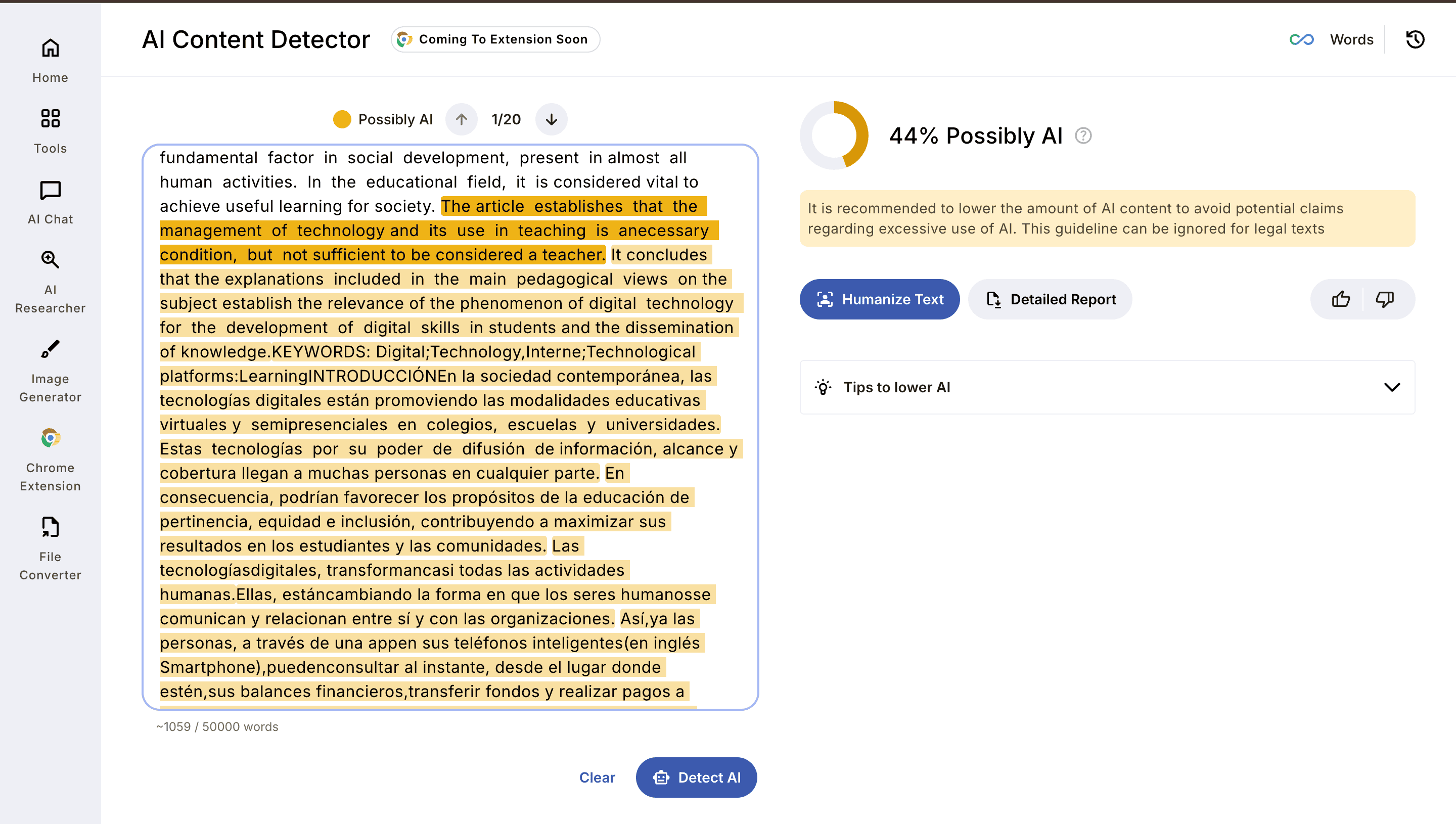
The detector is also useful for verifying content you are reading rather than writing. A product review, a piece of advice, an article someone shared — paste it in and see what comes back.
How to Tell If Something Was Written by ChatGPT Specifically
ChatGPT is the most widely used AI writing tool, and how to tell if something was written by ChatGPT has some specific markers beyond the general signs above.
Older ChatGPT versions (GPT-4o and earlier) had particularly strong tells:
- Opening responses with "Certainly!" or "Absolutely!" before answering anything
- Defaulting to heavy bullet-list structure even when prose would serve better
- Closing with "I hope this helps!" or a variation of it
- Including disclaimers like "As an AI language model, I cannot..."
- Maintaining an unfailingly helpful, neutral tone that never takes a side
GPT-5 is significantly harder to identify than GPT-4o. The vocabulary is more varied, the sentence rhythm is less uniform, and the most obvious verbal tics appear less frequently. The patterns are still there, but they are just smaller and require more careful reading to catch.
If you are trying to determine how to tell if someone used ChatGPT on a specific piece, the most reliable approach is combining a manual read for the signs above with a run through an AI detector. Neither alone is sufficient. Together, they give you a much clearer picture.
There Is No Way to Detect AI Writing with 100% Accuracy
This is the part most detection guides skip: how to tell if something is written by AI is not a solved problem. No tool gets it right every time. No human reader gets it right every time.
False positives happen. Formal academic writing, technical documentation, and content written by non-native English speakers all share characteristics with AI output — consistent tone, structured argumentation, and uniform vocabulary. That’s why they can be flagged incorrectly.
The Stanford study that found AI detectors misclassified 61% of essays by non-native English speakers is the most cited example of how significant this problem is.
False negatives happen too. Heavily edited AI content, content that has been run through a humanizer, and output from the newest model generations all pass detection at rates that make any single scan an incomplete picture.
At JustDone, the team works continuously to improve our AI Detector's accuracy and reduce false positives. Detection is not a static problem. As models improve, detection methods have to improve alongside them. The current version reflects our best understanding of where AI writing patterns appear in 2026, but they update the model regularly as new AI releases shift what those patterns look like.
The honest framing is: AI detection gives you a probability, not a verdict. A high score means look more carefully, not that you have proof. A clean score means the same thing if something else already felt off.
What If You Want AI Text to Pass as Human?
If you are using AI to help with your writing and need the output to sound genuinely human — for a class submission, a job application, or any context where detection matters — the process has two parts.
First, prompt more carefully. Specific human scenarios, banned vocabulary lists, and sentence variation rules all reduce AI patterns at the generation stage.
Second, verify and humanize what you have. JustDone's AI Humanizer rewrites flagged sections at a structural level — addressing the sentence rhythm and phrase predictability that detectors measure, not just changing individual words. The result is text that reads naturally rather than text that merely looks different.
The combination of better prompting and structural humanization is the most reliable path from AI-assisted draft to submission-ready work.
Frequently Asked Questions
Is there a way to detect AI written text?
Yes. Both manual pattern recognition and AI detection tools can identify AI-generated writing with meaningful accuracy. No method is 100% reliable — both false positives and false negatives occur — but the combination of reading for specific signs and running text through a detector gives a reliable working assessment.
Can AI writers be detected?
Generally yes, though accuracy varies by model and how much the text has been edited. Unedited AI output from older models is caught reliably. Heavily edited output from newer models like GPT-5 is harder to detect. The patterns are still there — they are smaller and require more careful analysis.
Is there a 100% accurate AI detector?
No. Every AI detector produces probability scores rather than certainties. False positives and false negatives are documented across all major tools. Treat detection results as signals for further review rather than definitive conclusions.
What are common signs of AI writing?
Generic structure, overused vocabulary (moreover, delve, robust, tapestry), uniform sentence length, absence of personal anecdotes or specific details, hallucinated facts, excessive em dashes, and a consistently positive corporate tone.
What words are overused by AI?
The most commonly flagged: moreover, furthermore, delve, tapestry, landscape, crucial, leverage, utilize, robust, seamless, it is worth noting, in today's fast-paced world, navigating the complexities, fostering, groundbreaking.
What does AI writing look like?
Structurally complete, grammatically perfect, tonally consistent, and somehow empty. It covers the topic thoroughly without saying anything that surprises you. Every paragraph is balanced, every transition is smooth, and there is no evidence that a specific person with specific experiences wrote it.
How do I know if a text is AI generated?
Read for the nine signs above. Search one specific factual claim to check for hallucinations. Run the text through an AI detector for a systematic analysis. No single check is conclusive — use them in combination.
How to tell if someone used ChatGPT?
Look for the specific ChatGPT markers: bullet-heavy structure, "Certainly!" or "Absolutely!" openers, "I hope this helps!" closers, AI disclaimers, and an unfailingly helpful neutral tone. Then run the text through JustDone's AI Detector for a sentence-level breakdown.
How to tell the difference between AI and real writing?
Real writing has friction — irregular sentence rhythm, specific personal detail, occasional imperfection, and moments where the author's actual perspective comes through. AI writing is smooth, complete, and generic in a way that becomes recognizable once you are looking for it.
What are the red flags of AI writing?
Overused formal vocabulary, em dash frequency, absence of specific personal examples, hallucinated or unverifiable facts, uniformly positive tone, and structural completeness that feels more like a template being filled in than an argument being developed.
