Key takeaways:
- Start with a research question and outline before you write anything. AI works best at planning, so a strong outline prevents wasted drafting and keeps your argument clear.
- Use AI for drafting and revision, but keep sources and citations under your control. Let AI help with clarity and structure, but verify every source in Google Scholar and build a citation map as you write.
- Treat originality checks as a revision step in the workflow. Run plagiarism and AI checks early, fix flagged sections with specificity and interpretation, then re-check before submission.
AI can make academic writing faster and less stressful. But it is possible only if you use it as a structured workflow instead of jumping between random tools. The most common student mistake isn’t using AI. It’s using AI with no system: drafting in ChatGPT, fixing grammar in Grammarly, paraphrasing somewhere else, checking plagiarism in a separate tab, then overthinking if you did everything right before submission.
This guide gives you a realistic process you can follow for any assignment. You’ll learn how to go from topic to submission, how to structure your paper, how to find reliable sources without hallucinations, how to handle citations, and how to check originality without getting trapped in AI detection anxiety.
Why academic writing feels hard even with AI
Students rarely struggle because they’re bad writers. They struggle because academic writing demands several skills at once, and most of those skills are not taught clearly.
The first problem is workflow fragmentation. A typical student writes in Google Docs, generates ideas in ChatGPT, fixes grammar in Grammarly, rewrites in QuillBot, checks plagiarism somewhere else, and then runs AI detection in a separate tool. Each switch introduces friction, and each tool changes the text in slightly different ways. That’s how students end up with writing that feels inconsistent and unnatural.
The second problem is structure. When you’re working with a big amount of material, it’s hard to see the argument. You start collecting sources, quoting things, and writing paragraphs, but the paper has no backbone.
The third problem is citations. Formatting rules, such as APA 7 or MLA, are simple in theory, but in real life, they become a time sink, especially when you have many sources and are trying to avoid mistakes.
Then there’s the real fear: policies and detection. Some instructors allow AI with disclosure, others don’t. Some students are writing in a non-native language, which makes their writing more formal and repetitive, and ironically, more likely to be flagged by AI detector, even when it’s human-written. Add hallucinated citations from AI into the mix, and the process becomes stressful fast.
The solution isn’t another tool. It’s a workflow that helps you keep writing in control.
Step by step academic writing workflow with AI
I propose to try this 7-step workflow that will help you implement AI for the academic space.
Step 1. Choose a topic and research question that can be proven
Most bad papers begin with a vague topic. “Social media,” “Climate change,” “Artificial intelligence.” These are not paper topics, but more like entire fields. Your job is to narrow the topic into a question that can be answered using evidence.
Before you write anything, ask yourself three questions:
- What exactly am I trying to explain or evaluate
- What debate or tension exists in this topic
- What kind of evidence can I realistically cite within my deadline
A good research question sounds specific, testable, and grounded in academic discussion. For example, “How does social media use affect attention and learning outcomes among first-year university students” is far more workable than “Is social media bad.”
If you want AI support here, use it like a brainstorming assistant rather than a decision maker. You’re not asking it to pick your topic. You’re asking it to generate options that you can evaluate.
Copy and paste this prompt into JustDone or your AI chat tool:
I’m writing a university paper about: [broad topic].
    Give me 5 researchable questions that are narrow enough for a [word count] paper.
    For each question, suggest 3 keywords I can use to find academic sources in Google Scholar.
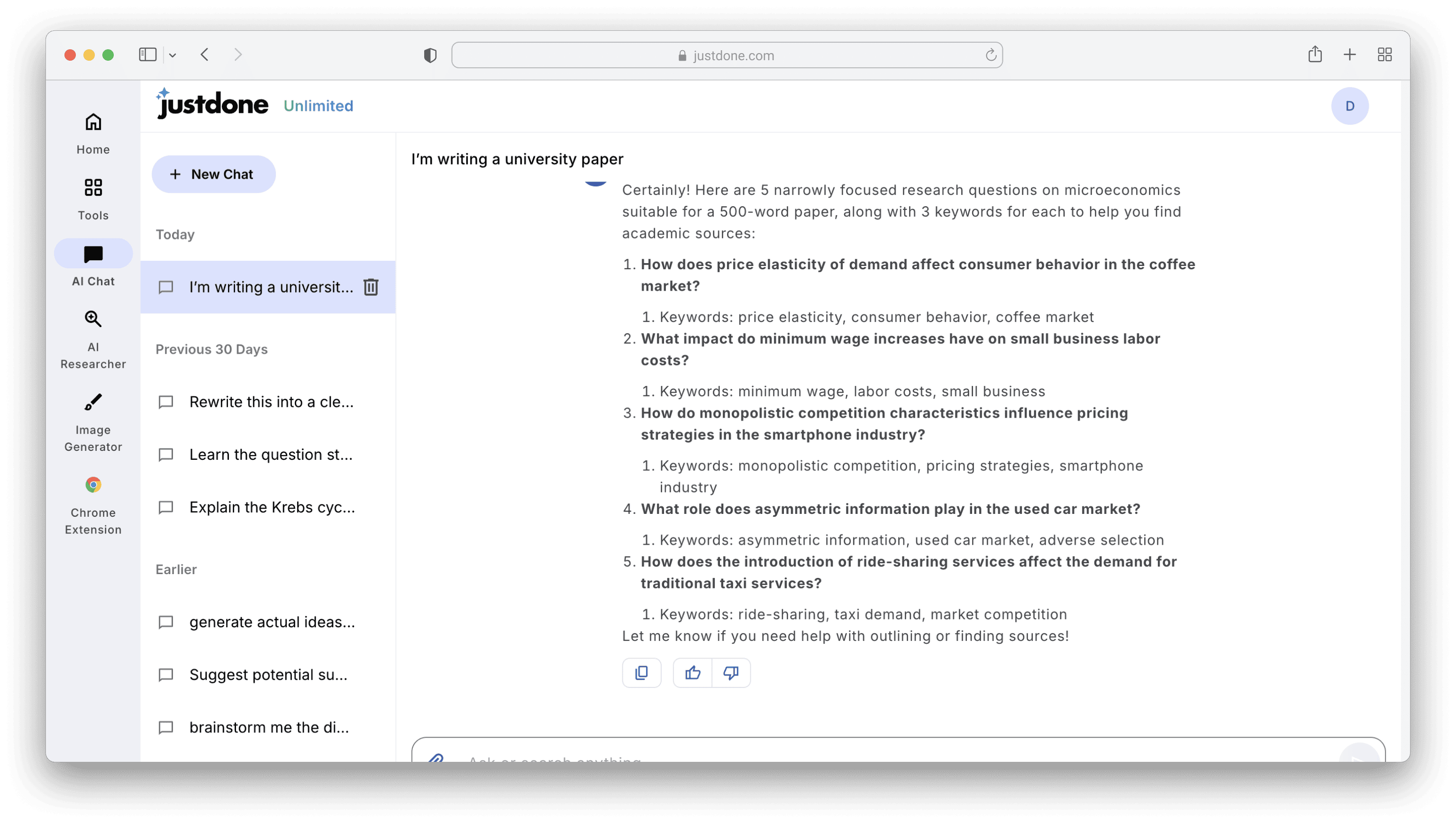
I used this prompt for a research paper in Microeconomics.
Once you pick a question, don’t move on until you can imagine what your evidence will look like. If you can’t imagine what kinds of sources you’ll cite, you’re still too broad.
Step 2. Build the outline before writing
If Step 1 gives your paper direction, Step 2 gives it structure. Outlining is the fastest way to write faster, because it prevents you from writing paragraphs you’ll delete later.
At minimum, your outline should answer one thing: what does each section contribute to your argument. Also, your outline will look different depending on the assignment type.
An academic essay usually needs a thesis, a few argument sections supported by evidence, at least one counterargument, and a conclusion that shows what your argument means.
A research paper adds a stronger background section, a clearer research question, and a discussion section where you interpret findings and explain limitations.
A literature review should not be a list of summaries. It needs themes. It should show what studies agree on, where they disagree, and what gaps exist.
If you want AI to help, the prompt matters. The prompt “give me an outline” won’t work well with AI chats. Ask for headings, logic, and word count distribution. This ways, your draft doesn’t become unbalanced.
Use this prompt:
Create an outline for a [essay / research paper / literature review] on: [research question].
    Total length: [word count].
    Include section headings and a target word count per section.
    For each body section, specify what kind of evidence I should cite.
    Include a counterargument section when appropriate.
That’s how Outline for a Microeconomics research paper from the previous prompt may look with the help of JustDone AI chat.
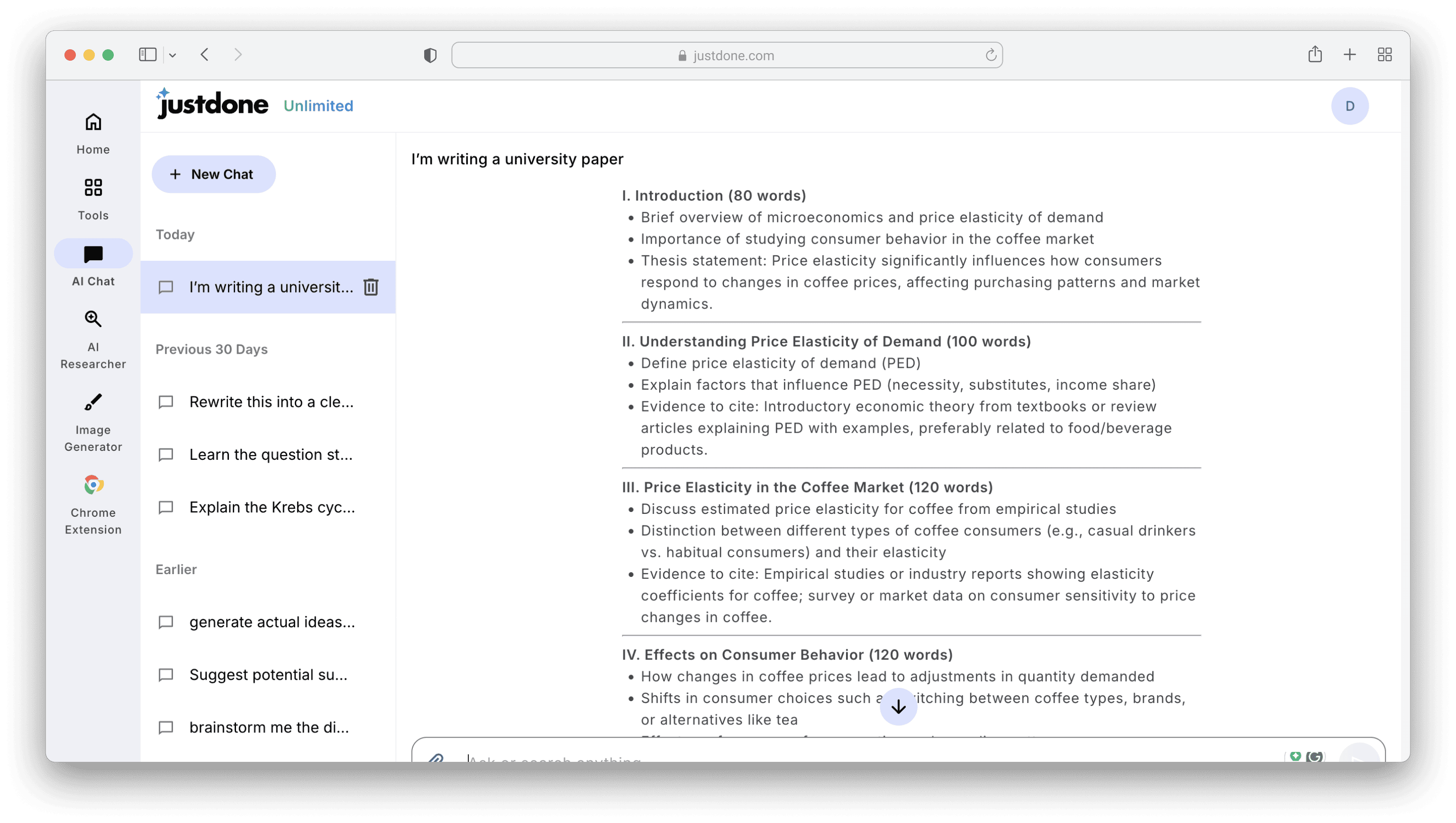 The goal is to reach a moment where you look at your outline and think, “If I fill these sections with evidence, I’ll have a complete paper.” That’s when you’re ready to draft.
Step 3. Find reliable sources without hallucinations
This is where AI can mislead students the most. AI can suggest sources that sound real, and sometimes it will even format them like APA. But confidence is not accuracy. If your paper includes a fake source, your credibility collapses.
The safest rule is simple: AI can help you search for ideas, but you verify sources in Scholar or your university database.
When AI suggests a reference, run a quick five-step check:
- Search the exact title in Google Scholar
- Second, confirm the author and year match
- Third, check whether it’s published in a real journal or by a credible academic publisher
- Fourth, look for a DOI if it’s a journal article
- Fifth, read at least the abstract to confirm it actually supports your point.
Here’s how I customized search filters for a Microeconomics research paper.
 If any of those steps fail, don’t fix the citation. Replace the source.
If your instructor requires recent sources, don’t rely on AI memory. Use Scholar filters. Use the “since” filter and combine it with specific keywords. A huge time saver is to use search phrases like “systematic review,” “meta-analysis,” “longitudinal study,” or “randomized controlled trial” because they quickly lead you to research-heavy papers.
You’ll also save time if you collect sources with structure. Instead of bookmarking everything, collect sources by claim. When you find a paper, write down what part of your argument it supports and what exact finding you’ll cite. This prevents the “I have 12 PDFs and no idea what to do with them” problem.
Step 4. Draft with an academic tone that still sounds human
Here’s what most students don’t realize: academic writing isn’t “formal.” It’s precise. Many AI drafts sound academic because they’re formal, but they fail because they’re vague.
If your writing feels robotic, it’s usually because you’re missing three things:
- Specificity
- Interpretation
- Voice.
Specificity means you name the real variable, group, or mechanism. You don’t say “technology impacts society.” You should say what technology, what society, and what impact.
Interpretation means you explain what the evidence means in your argument. Citation that you use serves to prove something and explain why it matters.
Academic writing voice should not be casual. It means being clear about your stance. Good academic work often includes phrases like “This suggests that,” “A key limitation is,” or “These findings indicate.”
If you are an ESL student, you may overcompensate by writing too stiffly. That’s normal. A good way to fix this is to write simpler first, then revise for academic style. You’ll end up clearer and more natural.
A practical revision trick is to remove generic sentences that could appear in any paper. If a sentence could fit inside an essay on any topic, it probably doesn’t belong. Replace it with a sentence that includes your topic-specific detail.
Also, if your text feels too robotic, you could be flagged as AI-generated. You can revise it with AI humanizer and reduce AI score. JustDone humanizing tool will make your text sound human and keep your meaning and evidence. Here’s how it works with the Microeconomics research paper.
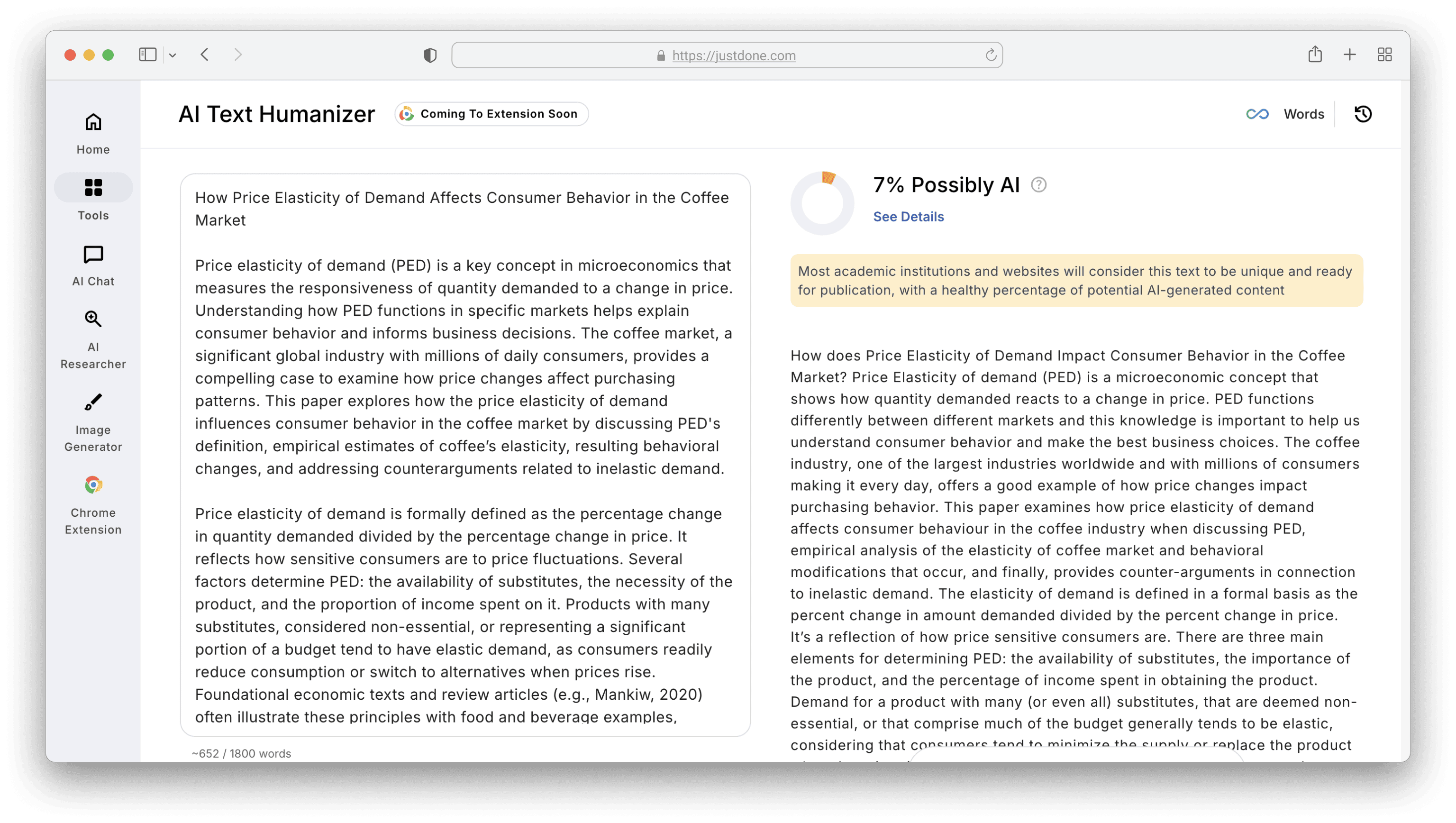
Then read the result and edit it again yourself. The final polish should always be human.
Step 5. Format citations correctly and prevent reference list chaos
Citation mistakes are one of the fastest ways to lose points, even when your argument is good. Most mistakes happen for predictable reasons: missing authors, incorrect year, inconsistent in-text formatting, or a reference list that doesn’t match in-text citations.
The easiest way to prevent this is to create a “citation map” while you draft. It’s not complicated. After you finish a section, ask:
- What is the main claim here
- What source proves it
- Where is that source cited
When you do this paragraph by paragraph, your reference list becomes clean automatically. You stop guessing. You stop scrambling. And you stop accidentally citing a paper you didn’t use.
If you’re using APA, the most common errors are wrong in-text formats, missing retrieval details for websites, and incorrect capitalization in titles. If you’re using MLA, the most common errors are missing container information and inconsistent formatting.
AI can generate citations, but you should still verify them. The best workflow is to generate the citation quickly, then cross-check against the actual source details.
Step 6. Check originality and fix issues without panic
Originality checking is where students often confuse two different things: plagiarism detection and AI detection.
Plagiarism checking looks for similarity to existing text, which can include quotations, references, common phrases, and correctly cited material. A similarity score is not automatically bad. What matters is what is highlighted and whether citations are correct.
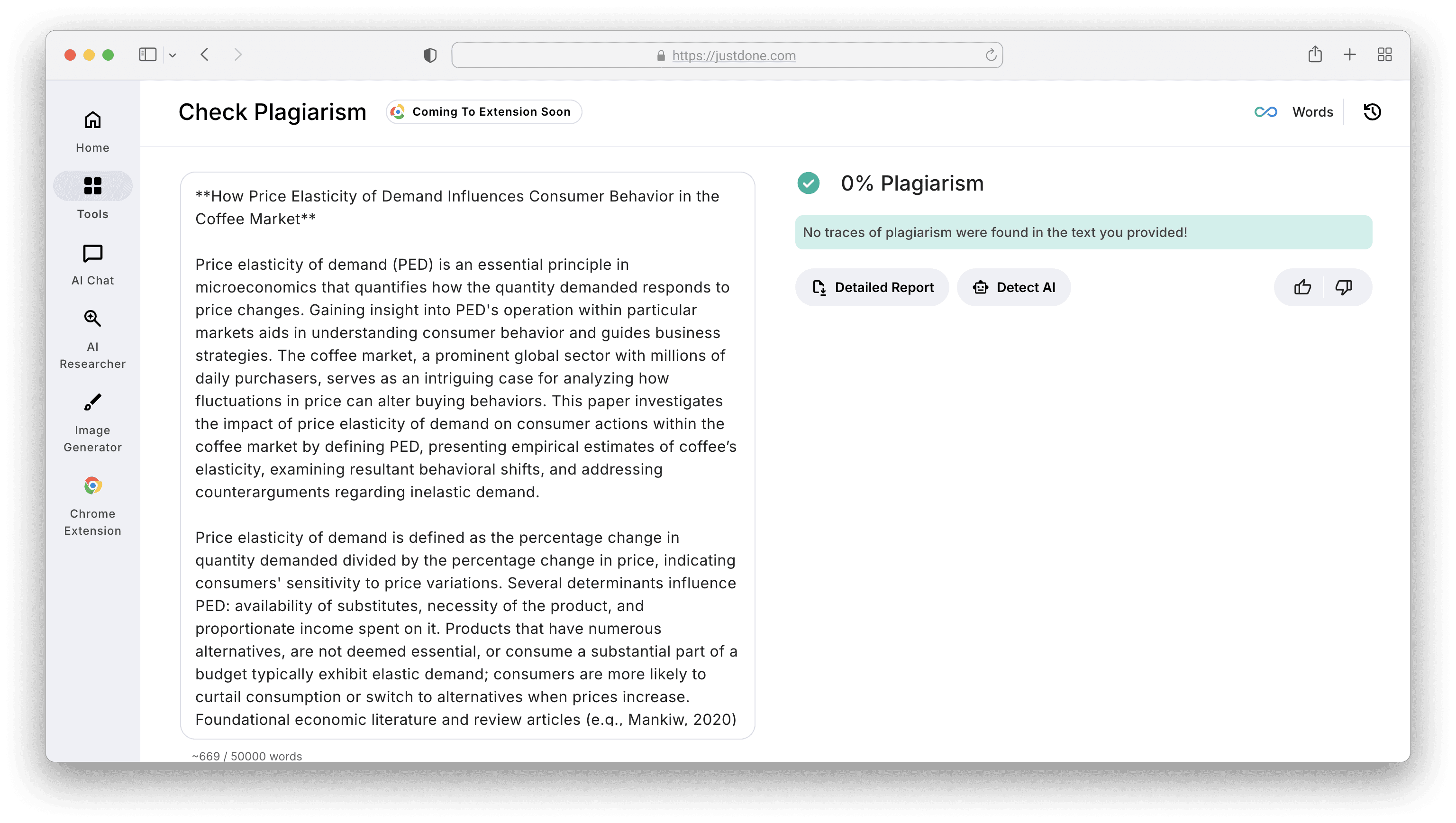
Here’s how JustDone Plagiarism checker presents its report:
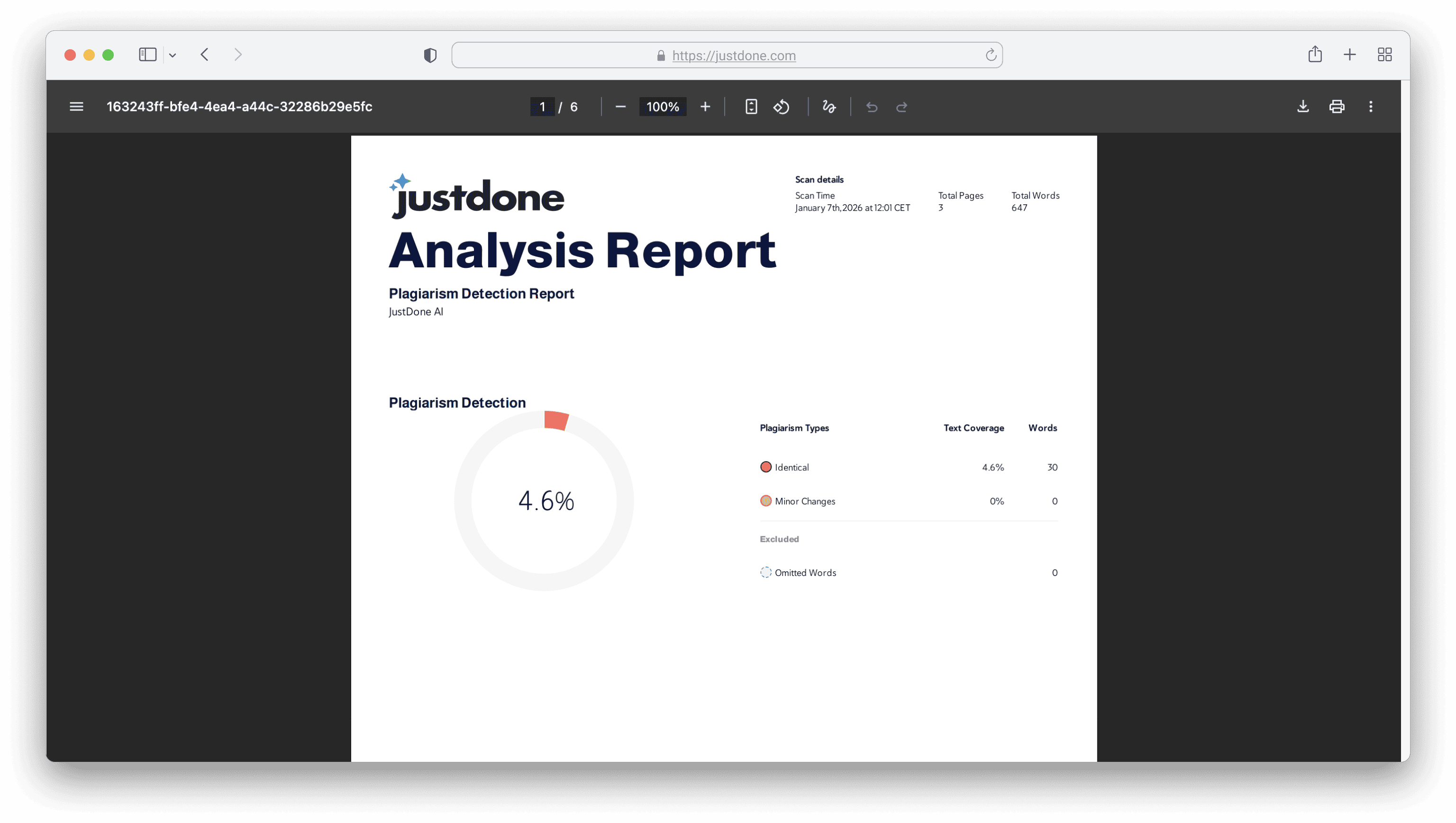 If your task is 0% plagiarism, click Remove Plagiarism button. The flagged text will be paraphrased and the score will lower.
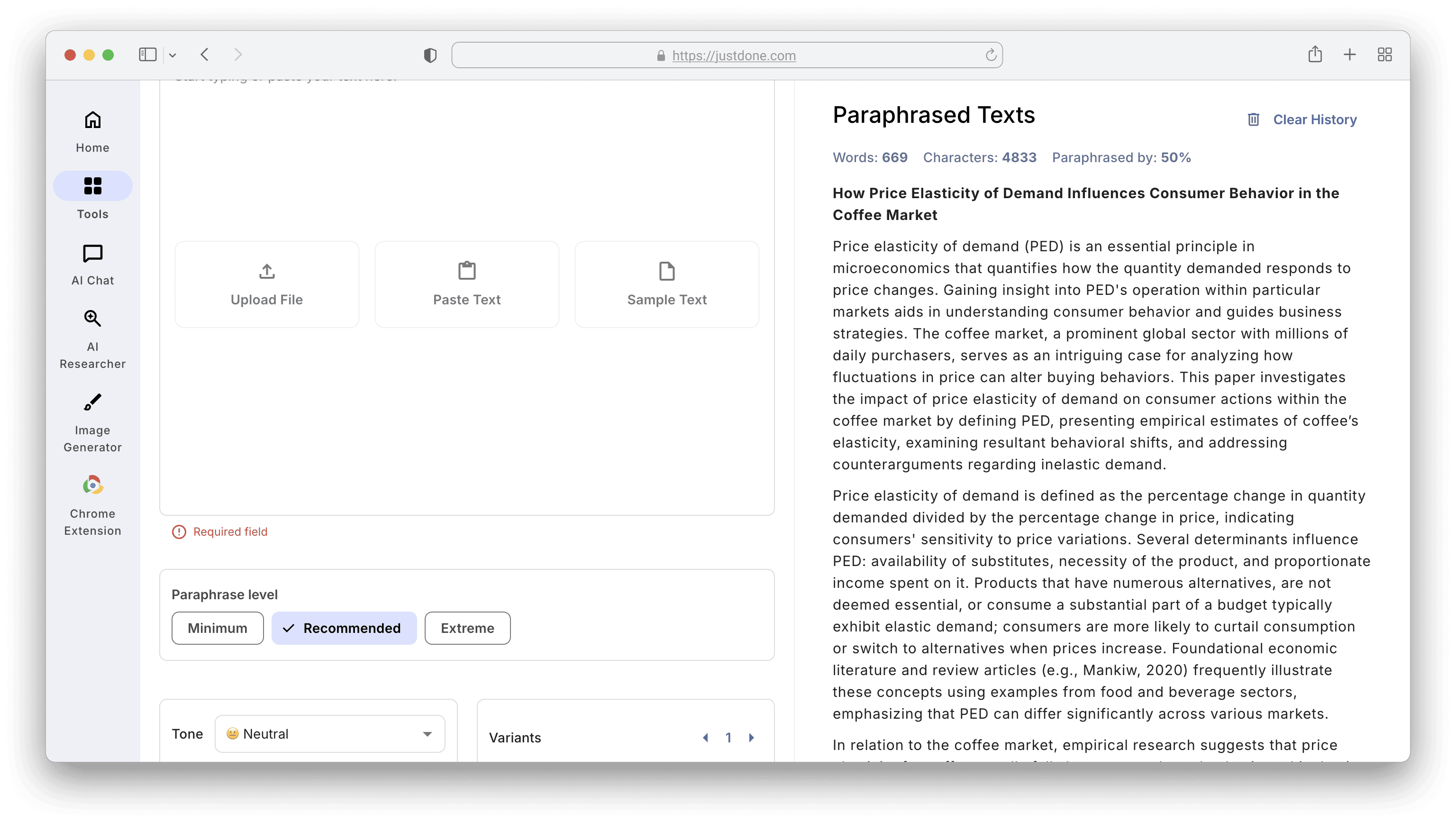 The result is here:
 AI detection tries to estimate whether writing patterns resemble machine-generated text. These tools are not perfect, and false positives happen, especially with formal tone and ESL writing.
If a section is flagged as AI-like, don’t rewrite the entire paper. Fix the patterns that detectors usually react to.
The fastest improvements come from adding topic-specific detail, removing generic transitions, varying sentence rhythm, and inserting your own interpretation after citations. Another common fix is to rewrite introduction and conclusion sections, because AI tends to produce very generic framing in those areas.
After you revise, re-check. The goal is not a magical “0 percent AI” score. The goal is a paper that is specific, evidence-based, and clearly written in your voice.
Step 7. Use a final submission checklist that prevents last-minute mistakes
Before you upload, do a final pass that protects you from predictable problems.
Ask yourself:
- Does the introduction clearly state the thesis or question?
- Does every paragraph contribute to the argument?
- Does every major claim have evidence?
- Are sources verifiable and recent enough?
- Do citations match the reference list?
Also, it is important to check for similarity issues, revise generic paragraphs, and proofread for clarity and tone. And if your course requires it, add an AI disclosure statement.
If your university has strict rules, it’s also smart to keep a version history. Save drafts and keep all your notes. If you ever need to explain your writing process, that documentation matters.
Ethical AI use in university assignments
University AI policies are changing quickly, and students often live in a gray zone. Some professors allow AI for editing, some allow it with disclosure, and some forbid it completely.
The safest approach is to treat AI as support for learning and revision, not as a replacement for your thinking. If your instructor requires disclosure, don’t guess. Write a clear statement that explains how you used AI and what you did yourself.
Here is a copy-paste AI disclosure statement you can adapt:
I used AI tools to support the writing process, including outlining, improving clarity and grammar, and formatting citations. I verified sources independently and revised the text to ensure accuracy, originality, and compliance with course requirements.
If your instructor forbids AI entirely, follow that policy. If the policy is unclear, ask. It’s always better than risking a misunderstanding.
Best tool stack for academic writing with AI
If you’re trying to get through an assignment without opening ten tabs, the best approach is simple. Use one tool to build your outline and draft, one reliable way to find sources, and one place to handle citations and originality checks. The fewer “jumps” you make, the cleaner your writing becomes.
JustDone works best when you want one workspace for outlining, rewriting, citations, and originality review. If your university policy allows research tools that access the web, Perplexity or Microsoft Copilot can help you locate sources quickly. But you should still verify every academic reference in Google Scholar or your university library database.
The strongest rule to follow is this: AI is excellent for drafting and revision, but your paper should always include verified sources, your reasoning, and your final edits.
A minimal stack usually includes an AI writing assistant, Google Scholar or your university database, a citation helper, and a plagiarism checker. An advanced stack might add a research assistant tool for source discovery, AI detector, plus a dedicated editing tool for academic tone.
Just remember, more tools don’t automatically mean better output. More tools often mean more inconsistency.
Conclusion
Academic writing with AI becomes simple when you stop treating it like a hack and start treating it like a workflow. The real goal isn’t to “sound human” for a detector. The goal is to write a clear, evidence-based paper that shows your thinking and meets academic standards.
Start with a researchable question. Build your outline before you draft. Verify every source. Write with specificity. Map your citations as you go. Review originality and revise thoughtfully. Then submit with confidence.
If you want to keep everything in one place – outlining, rewriting, citations, and originality checks – JustDone is the best choice for the academic workflow. It can reduce the stress of switching between tools greatly.
Frequently asked questions
Can students use AI for academic writing?
In many courses, yes, especially for outlining and revision. But you should always follow your instructor’s policy and disclose AI use when required.
How do I avoid fake sources from AI?
Never rely on AI citations without verifying them in Google Scholar or your library database. If you can’t find the source, replace it.
What is the best workflow for ESL students?
Outline first, write simply, then revise for academic tone. Avoid over-formal filler phrases and add your own interpretation after citations.
How can I write a literature review faster with AI?
Use AI to extract themes and compare papers, but verify sources and read key sections. Your value is synthesis, not summary.
What should I do if my professor forbids AI?
Follow the policy strictly. If it’s unclear, ask your instructor what is allowed. Don’t risk penalties.
How do I check originality without Turnitin?
You can use plagiarism checkers and AI-pattern reviews as a self-check, but treat them as guidance. Your strongest protection is evidence, citations, and clear personal reasoning.
