
An AI detector learns what AI writing looks like from the models that exist when it's trained. But new models keep coming. So what happens to a detector a year later?
We ran that experiment on ourselves. We took one of our own detector versions, trained about a year ago, and tested it on every model from OpenAI, Anthropic and Google, both the ones released before it was trained and the ones released after.
The result was clear: for every vendor and every model size, the models released after training were harder to catch. The detector didn't break, but it fell behind. That's why detectors can't be trained once and left alone. They need to be retrained as new models arrive.
The experiment
- One detector version, trained about a year ago and not updated since.
- Same prompts for every model, built from about 4,000 human-written texts.
- Same measure: the share of AI-written texts the detector caught, with a 95% confidence interval.
For each vendor, we then compared a model released before the detector was trained with the newest model released after it.
To keep it fair, we only compared models of the same size: largest models with largest, mid-size with mid-size, smallest with smallest. A newer model can also be a bigger or smaller one, and size alone changes how a model writes. A change counts as real only when the two confidence intervals don't overlap.
What we found
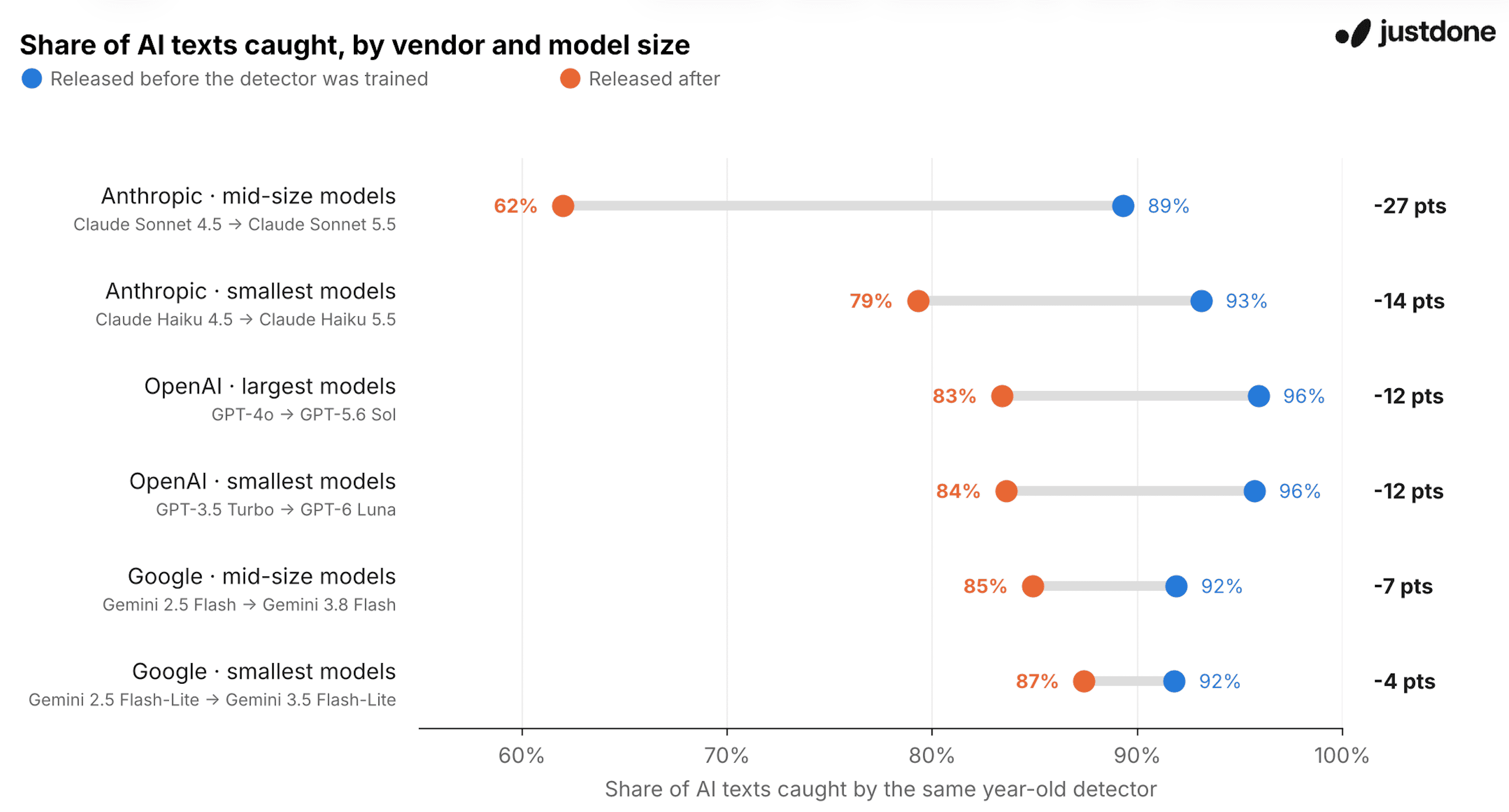
On models it had seen during training, the year-old detector caught 89–96% of AI-written texts. On models released after training, it caught 62–87%. The drop showed up in all six comparisons, and every one is larger than the confidence intervals.
By vendor
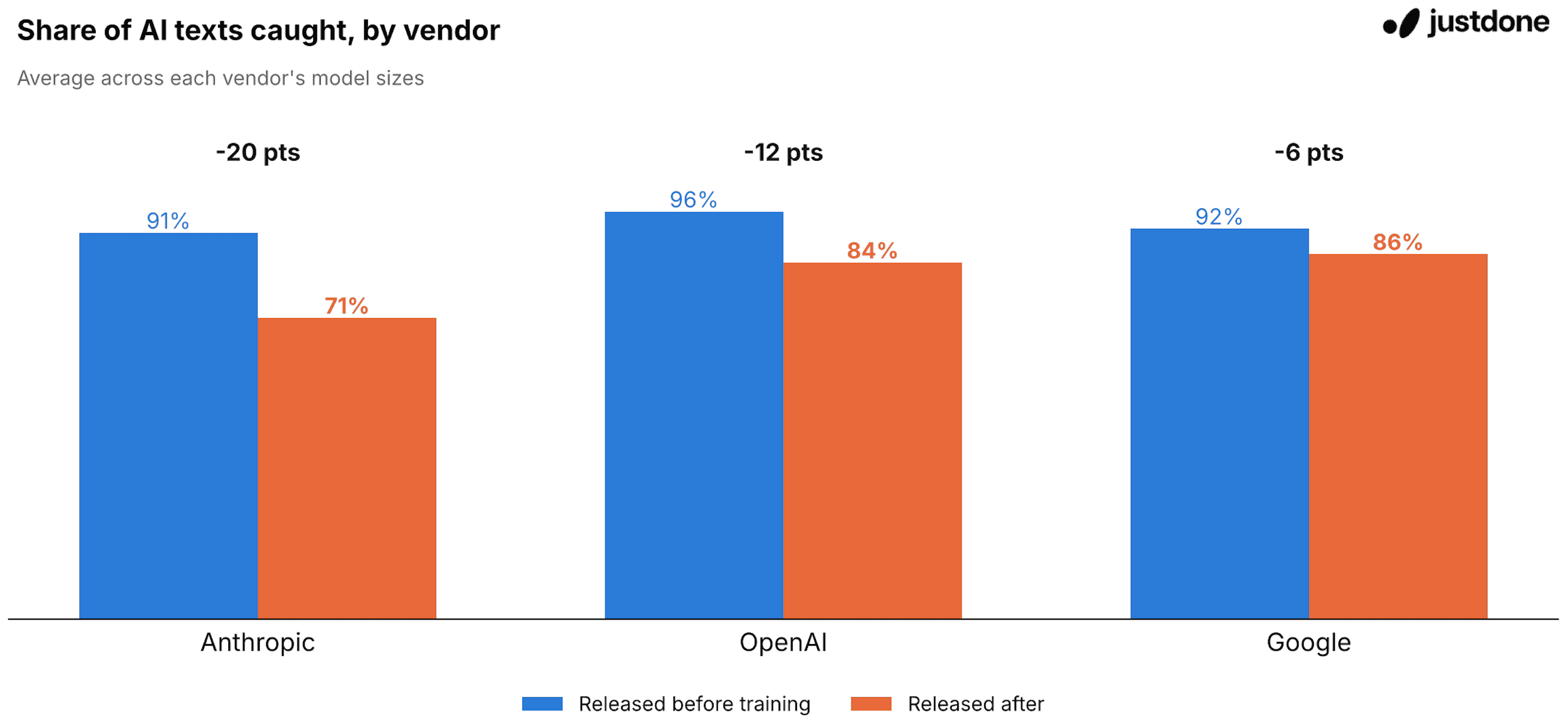
- Anthropic changed the most. Claude Sonnet 5.5 was the hardest model in our whole benchmark: the detector caught 62% of its texts, down from 89% for Sonnet 4.5.
- OpenAI moved evenly. Both its flagship and its smallest models lost about 12 points.
- Google changed the least. Its newest models were still caught 85–87% of the time.
By model size
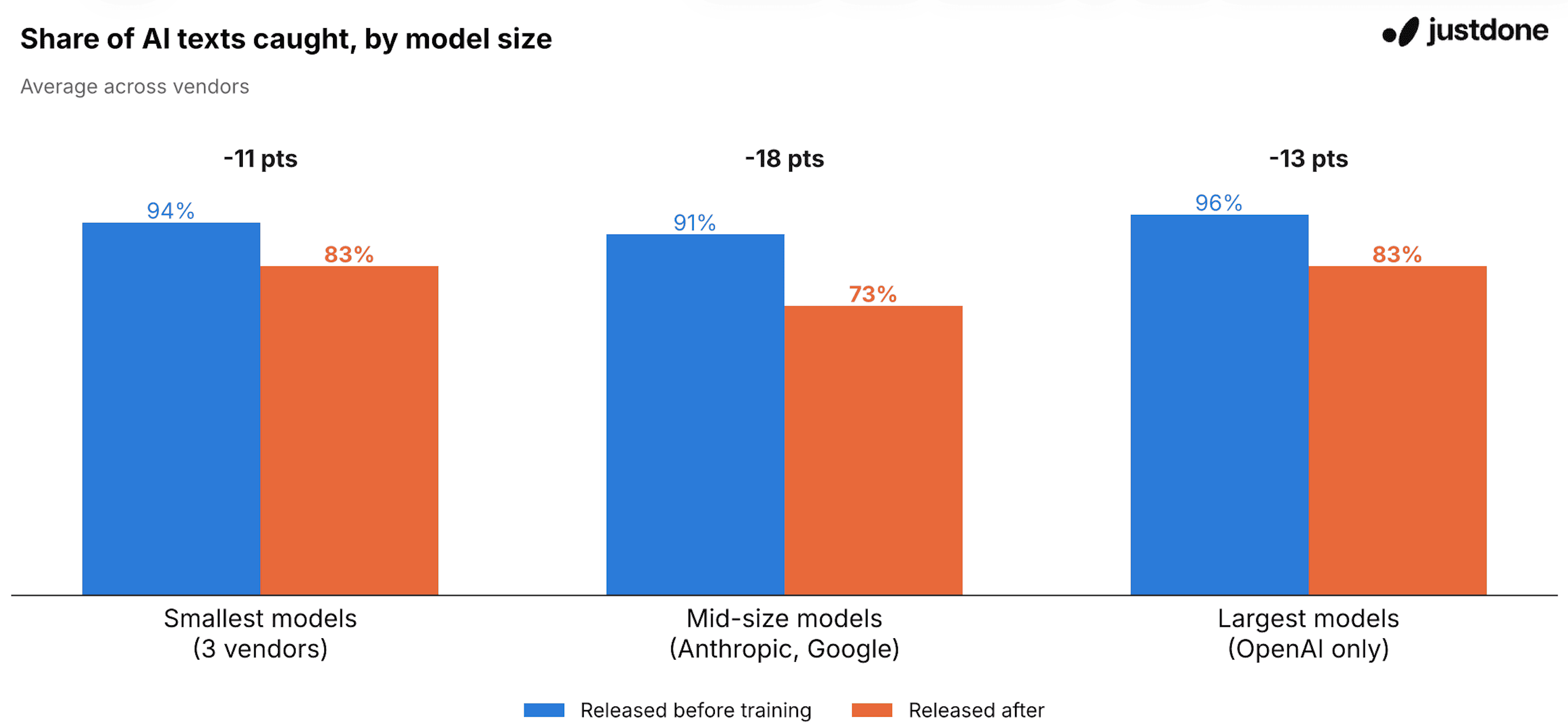
Size doesn't protect a detector either. Small, mid-size and large models all got harder to catch after training. Mid-size models moved the most, driven by Claude Sonnet 5.5.
So the detector didn't stop working. It still catches most AI-written text from every model we tested. But the further a model is from what the detector learned on, the more it misses.
Why detectors need retraining
A detector is a snapshot of AI writing at one point in time. It learns the habits of the models it was trained on: their rhythm, their favourite structures, their typical phrasing. New models don't share all of those habits:
- They're trained to sound more natural. Each generation varies its rhythm more and leans less on templates, which removes some of the signals an older detector relies on.
- Smaller models write almost like flagships now. The cheap, easy-to-spot tier is shrinking.
- Every vendor moves differently. That's why the drop ranges from 4 to 27 points.
None of this is fixed by tuning a threshold. The detector needs to see writing from the new models. In other words, it needs to be retrained. The bigger risk is not knowing when. A detector tested once looks fine on its original test set while users have long moved on to newer models. Without regular checks, a 27-point drop can stay invisible for months.
How we keep our detector current
Our LLM drift evaluation system, which measured this drop, also tells us when and how to retrain:
- Spot the gap early. Every new model is tested within days of release, and the model behind ChatGPT is re-tested every month. A drop shows up as soon as the model does.
- Learn from the models that slipped through. Outputs from the models where detection dropped most become new training data.
- Retrain. The next detector version learns from both older and newer models.
- Re-test everything. Every new version is scored on every model in the benchmark, so we can confirm it closes the gap on new models without losing ground on old ones.
Then the cycle starts again with the next release.
The bottom line
A detector trained a year ago still works, but newer models already slip past it more often. To keep up with new LLMs, a detector has to be retrained, again and again.
