
Humanizers rewrite AI text so it reads as if a person wrote it. So what comes out: human writing, AI writing, or something else?
We looked inside our AI detector to find out. The answer: neither. To the detector, humanized text is its own kind of writing, sitting apart from both human and AI text.
How we looked inside the detector
A detector doesn't read a text the way we do. It turns every text into a long list of numbers, step by step, and texts it finds similar end up with similar numbers.
We took thousands of texts of four kinds:
- Human: written by people, including Wikipedia articles.
- AI: generated by language models, including AI-written Wikipedia-style articles.
- Mixed: human texts with AI-written parts.
- Humanized: AI texts rewritten by a humanizer.
Then we drew each text as a dot on a map, so that texts the detector sees as similar sit close together. We made two maps: one from the middle of the detector, and one from its very last step, right before it decides "AI" or "human".
Under the hood
- The detector works in 22 steps, or layers. Each layer looks at a text a bit more deeply and describes it with 768 numbers.
- Each text becomes one point. We take the numbers for the first 512 words and word pieces of a text and average them.
- We looked at two layers: layer 11, halfway through, and layer 22, the last one, which the final AI-or-human decision is based on.
- 768 numbers are too many to draw, so we squeeze them onto a flat map with a standard tool called UMAP. It keeps similar texts close together. Where a group sits on the map is a rough guide, and its size means nothing.
- The score runs from 0 (human) to 1 (AI). A text counts as AI at 0.5 or above.
- The texts come from the detector's training data, plus Wikipedia articles it never saw during training.
Halfway through: grouped by topic
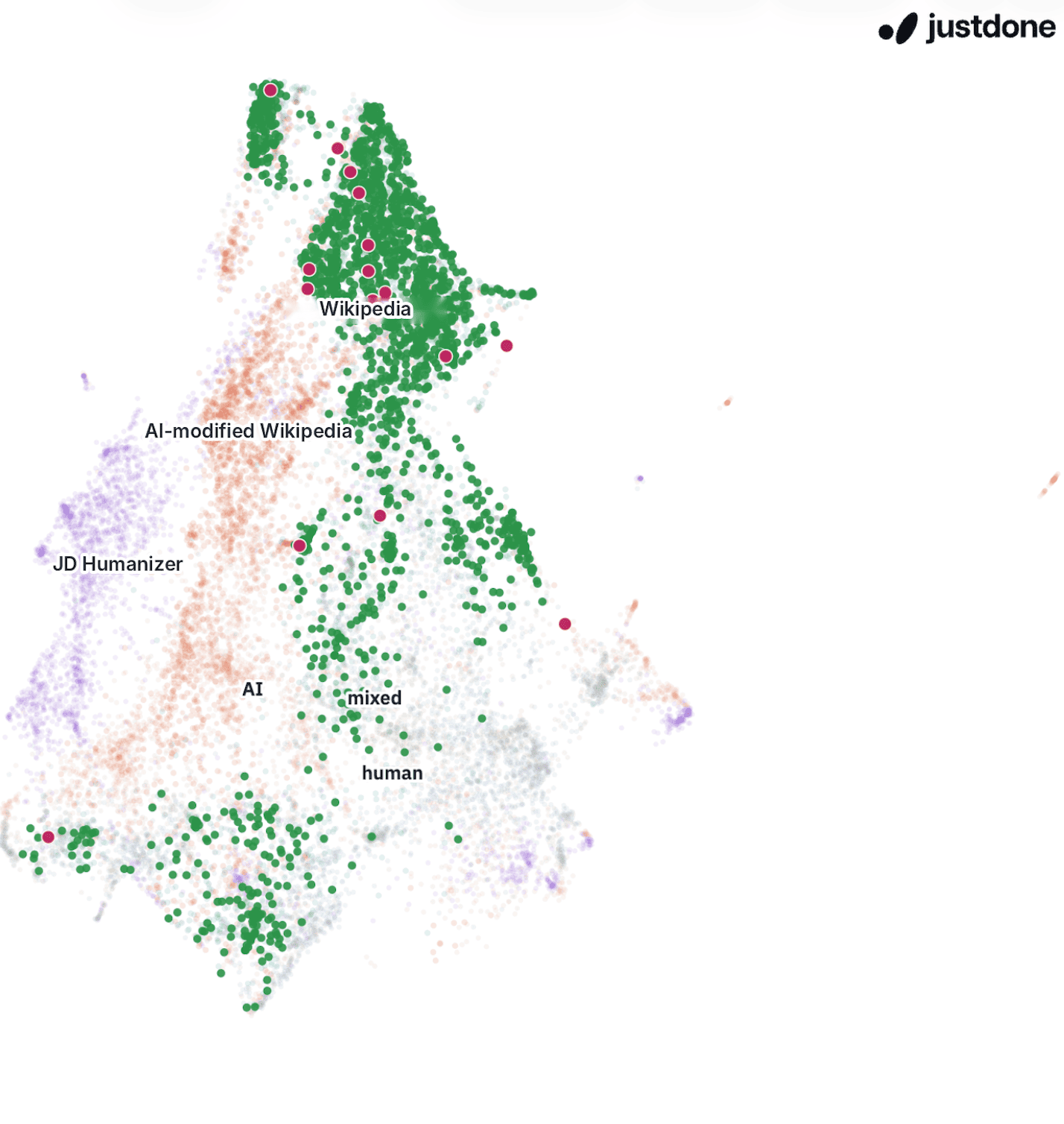
In the middle of the detector (layer 11), texts group by what they're about and what kind of text they are. Wikipedia articles sit near each other whether a person or a model wrote them, and humanized texts sit right next to the AI texts they came from.
At this stage, the detector is still working out what a text is, not who wrote it.
At the decision point: a line and an island
By the last step (layer 22), topic no longer matters. The map turns into a single line: human texts at one end, AI texts at the other, and mixed texts in between. This line is what the detector's decision reads.
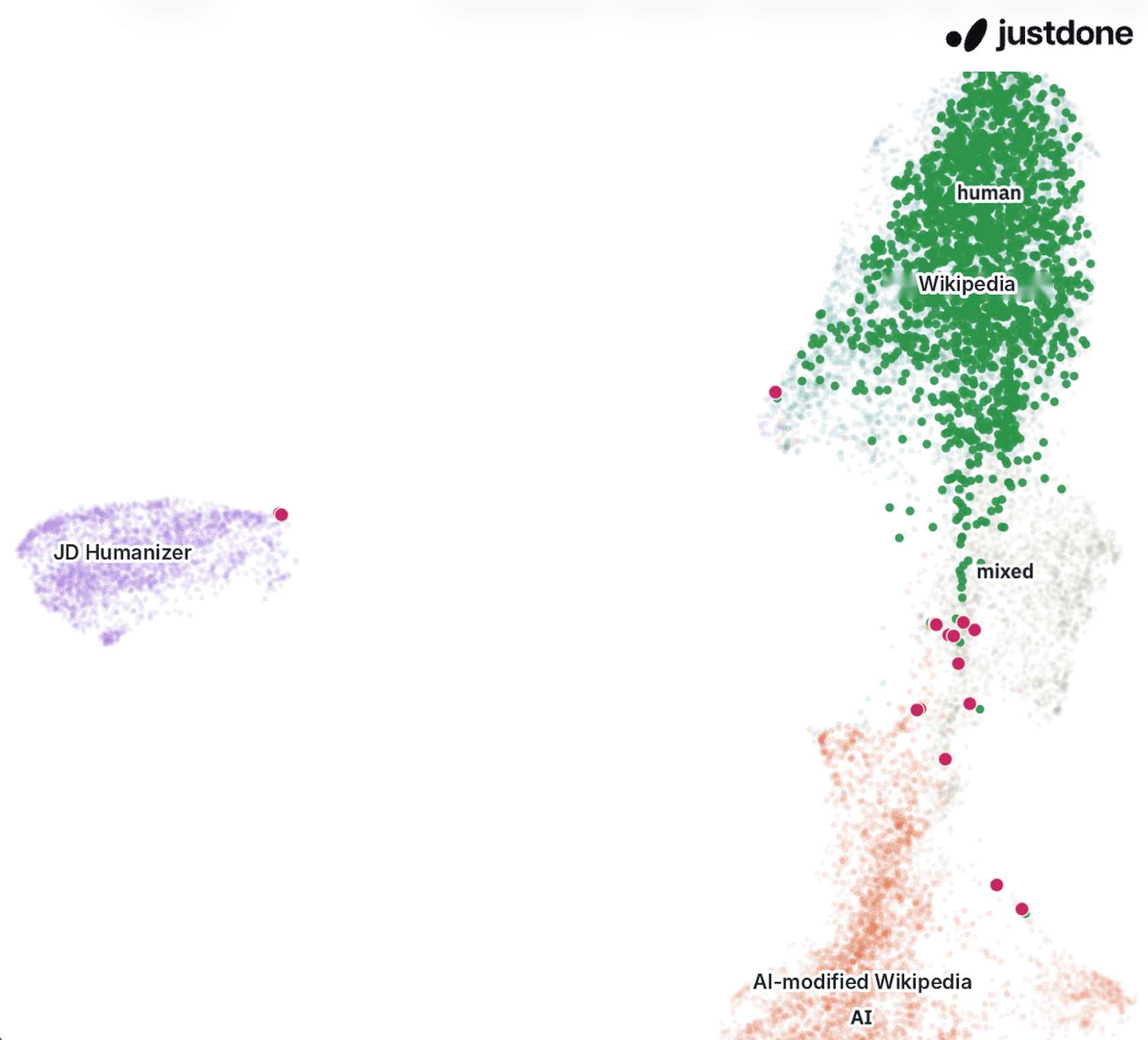
Mixed texts sit where you'd expect: partly human, partly AI, so they land in the middle.
Humanized texts don't sit on the line at all. They form a separate island, away from human writing and away from plain AI writing.
Put simply, the detector's score moves along this line: the closer a text sits to the AI end, the higher its score. Mixed texts sit in the middle, so their scores land in between. Humanized texts sit off the line, in a place where neither human nor plain AI texts are found.
So what is humanized text?
Neither human nor AI. It's a third kind of text.
The two maps show why. Halfway through the detector, humanized texts sit right next to AI texts, because their topic and structure still come from the AI draft. By the last layer, they have left the AI group, but they never reach the human one.
A humanizer changes how a text is written, not what it says. And that rewriting leaves a style of its own, one the detector recognizes as different from both people and plain AI.
For detection, this means "human or AI?" isn't the whole question. A detector has to learn humanized writing as a group of its own, from examples of the humanizers people actually use.
The bottom line
A humanizer keeps what an AI text says but changes how it's written, and that moves it off the line between human and AI. To a detector, humanized text is a third kind of writing, and it has to be learned as one.
