
AI and human texts can look alike on the surface: similar length, similar number of sentences, similar vocabulary. So we looked one level deeper, at grammar. We broke every sentence down into its building blocks and compared how AI and people put them together.
The short answer: AI doesn't write simpler sentences, it writes more predictable ones. It leans on the same few templates, lists things in threes, and keeps related words close together. People take more detours. They stretch phrases, tuck extra details inside nouns, and sometimes leave sentences unfinished.
How we looked at it
We ran each text through two kinds of grammar analysis:
- Word links. Each word is connected to the word it depends on, like an adjective to its noun or an object to its verb. This shows how far apart linked words sit and how deeply clauses nest.
- Phrase trees. Each sentence is split into nested phrases: noun phrases (the new policy), verb phrases (is improving outcomes), prepositional phrases (in the study) and subordinate clauses (because…, while…). This shows how long phrases get and how they stack.
We ran the main analysis on English, then checked the key patterns in nine more languages: Spanish, Portuguese, French, Italian, German, Korean, Turkish, Indonesian and Chinese.
One check came first. AI and human texts in our data were about the same length and had about the same number of sentences. So the differences below come from how sentences are built, not from one group simply writing more.
Where AI and human grammar differ
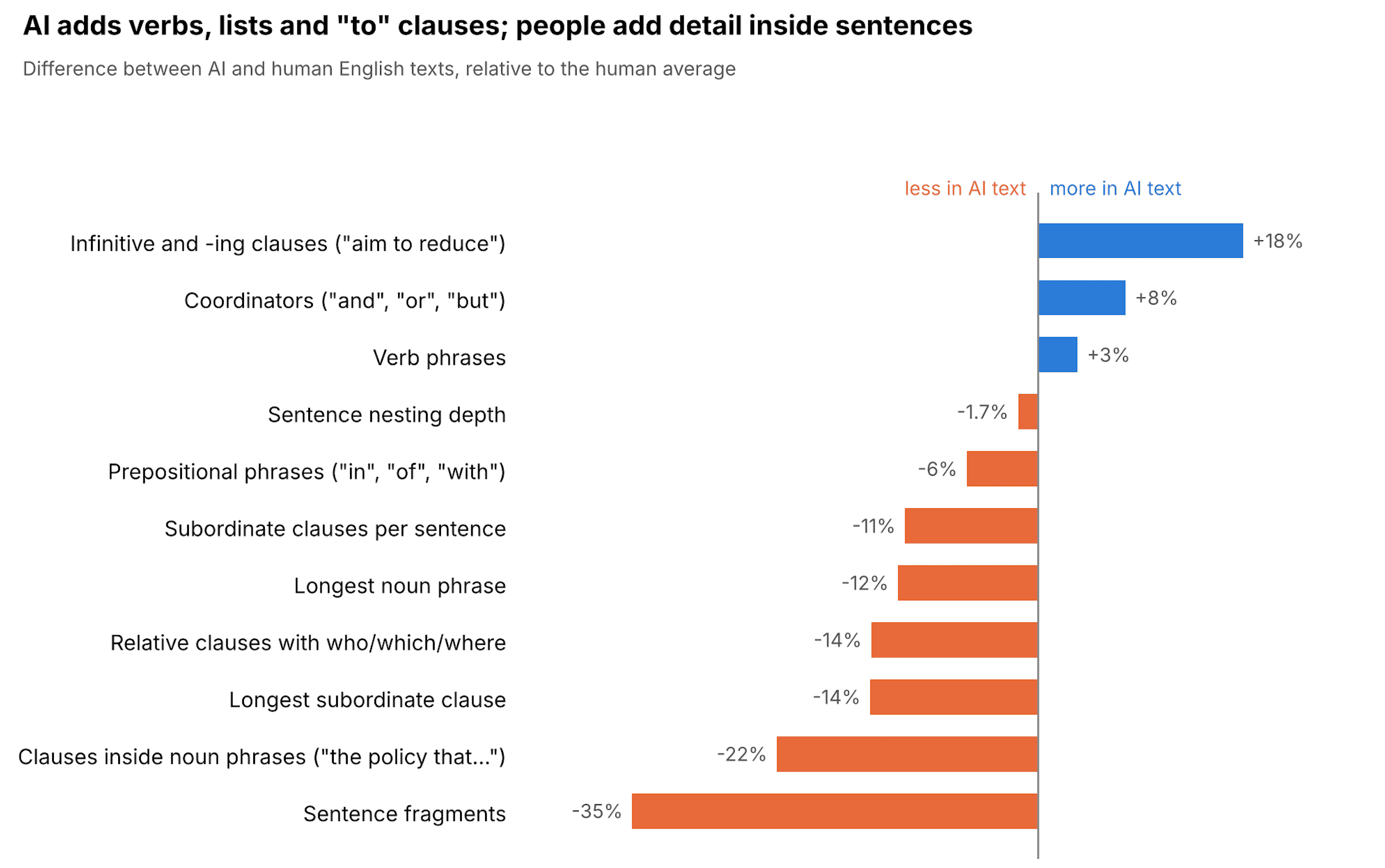
The picture splits cleanly. AI writing has more verbs, more lists and more "to" clauses. Human writing has more detail packed inside the sentence: longer phrases, more clauses hanging off nouns, and more loose ends.
AI reaches for the same templates
AI uses a small set of sentence frames again and again. Two stand out:
- "While…" and "By…" openers. While X happens, Y changes. By doing X, we achieve Y. These are the clauses AI adds most compared with people. They frame a contrast or explain a method, which gives AI text its tidy, explanatory feel.
- Verb + "to" + verb. This helps to explain… Policies aim to reduce… This encourages people to… Verbs like help, aim, encourage, allow, continue and remain show up far more in AI text. The variety of verbs used in this pattern is also lower, so the same few keep coming back.
AI lists things
AI uses "and", "or" and "but" more often, and it is more likely to list three or more items at once. X, Y and Z. Not only… but also… Lists keep sentences parallel and easy to scan, but they also make them predictable.
AI keeps related words close
In AI sentences, words that belong together sit near each other. The subject is close to its verb, and the verb close to its object. People more often stretch those links across a long aside or a nested clause. Every phrase type is shorter in AI text, and the gap is biggest at the extremes: AI's longest noun phrases and longest subordinate clauses are 12–14% shorter than people's.
People add detail inside nouns
The biggest structural gap is in how nouns get described. People attach whole clauses to nouns far more often: the policy that we discussed, the researcher who led the project. They also use more prepositional phrases: the impact of the change on students in rural areas. AI tends to describe nouns with a quick adjective instead: significant impact, global issue.
People leave sentences unfinished
Fragments are the single largest difference. People write headings, half-sentences and clipped notes; AI almost always writes complete, well-formed sentences.
The surprises
AI isn't simpler, just more compact
You might expect AI to avoid complex grammar. It doesn't. Count every subordinate link, including short "to" and "-ing" clauses, and AI actually uses slightly more of them than people. What it uses less are full clauses with their own subject and verb, which is why the chart shows fewer subordinate clauses per sentence. AI's subordinate parts are short, standard frames like while…, by… and aim to…. People's run longer and nest deeper. So AI has more pieces of complexity, but each piece is smaller.
The total amount of structure is the same
Per word, AI and human sentences carry almost exactly the same amount of grammatical structure, and phrases branch out to the same degree. AI doesn't write flatter text overall. It just spends its structure on different things: verbs and lists instead of long, detailed noun phrases.
"Which" points to people, "where" points to AI
Inside relative clauses, AI uses "which" noticeably less than people do, and "where" and "who" more. AI often stretches "where" beyond places: a situation where people feel unsafe, a context where these issues arise. AI also tends to spell its relative clauses out in full (the data that was collected), while people more often use the shortened form (the data collected last year).
Some patterns cross languages, some don't
We checked four of the patterns in nine other languages. Two held up almost everywhere, while the other two depended on the language.
| Pattern in AI text | How consistent across languages |
|---|---|
| Related words sit closer together | Most languages, especially Spanish, Portuguese, French and Italian |
| More lists ("and", "or") | Most languages, strongest in German, Chinese and Indonesian |
| Shallower sentence nesting | Often, but not in every language |
| More subordinate clauses | No clear direction: higher in some languages, lower in others |
What this means for you
For students and writers
If your writing gets mistaken for AI, look at its shape rather than its words. The patterns that read as AI are templates and tidiness:
- Vary how you open sentences instead of reaching for While… and By…
- Cut back on helps to, aims to and allows you to; say what actually happens
- Don't turn every point into a list of three
- Let nouns carry real detail: who, which one, where, from when
For educators
Polished, well-structured writing is not a sign of AI on its own. The stronger signals are repetition and predictability: the same frames, the same verbs and the same three-part lists, paragraph after paragraph. A single sentence tells you very little.
For people building detectors
Grammar adds a layer that word lists miss: templated "to" clauses, how often a text lists things, and how much detail its noun phrases carry. Test them per language, though. Some patterns carry across languages, but subordination clearly does not.
The bottom line
AI grammar isn't simpler than human grammar. It is more predictable. AI builds sentences from a small kit of reliable parts: verbs with objects, "to" clauses, while… and by… openers, and tidy lists. People improvise more. Their phrases run longer, their nouns carry more detail, and their sentences sometimes stop halfway.
If you want to tell the two apart, don't count the long words. Look for the template.
