
"Write more academically." Almost every student hears it, and almost nobody explains it. The answer is not fancier vocabulary. Academic writing is built differently: longer sentences, dense noun phrases, chains of "of", "in" and "for", and an impersonal voice. And that structure is almost the exact opposite of how AI writes an essay by default.
What we compared
We compared three groups of texts of the same length: AI-written essays, abstracts of research papers, and paragraphs from full research papers. Anything that showed up in both academic groups but not in the AI essays, we counted as a real trait of academic writing.
What academic writing actually is
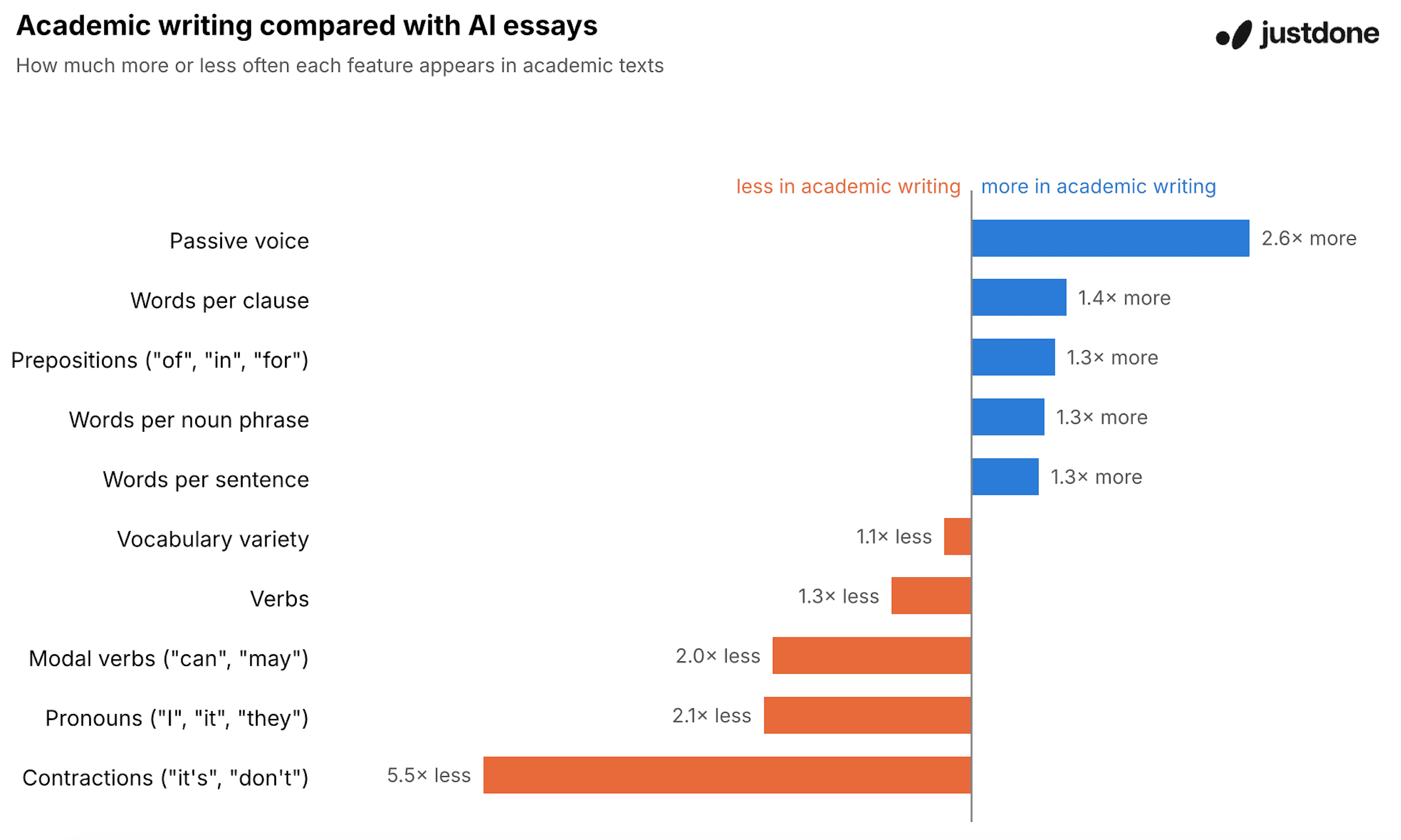
Academic writing is not a vocabulary list. It's a way of building sentences. Across both groups of academic texts, the same five traits came up again and again.
1. Longer sentences, built from fewer, bigger blocks
Academic sentences average 24–27 words; AI essays average 20. The difference is not more clauses. It is bigger ones. A clause in a research paper runs about 20 words, against under 15 in an AI essay. Academic writers pack one idea into one long, dense unit, while AI cuts the same idea into several short pieces.
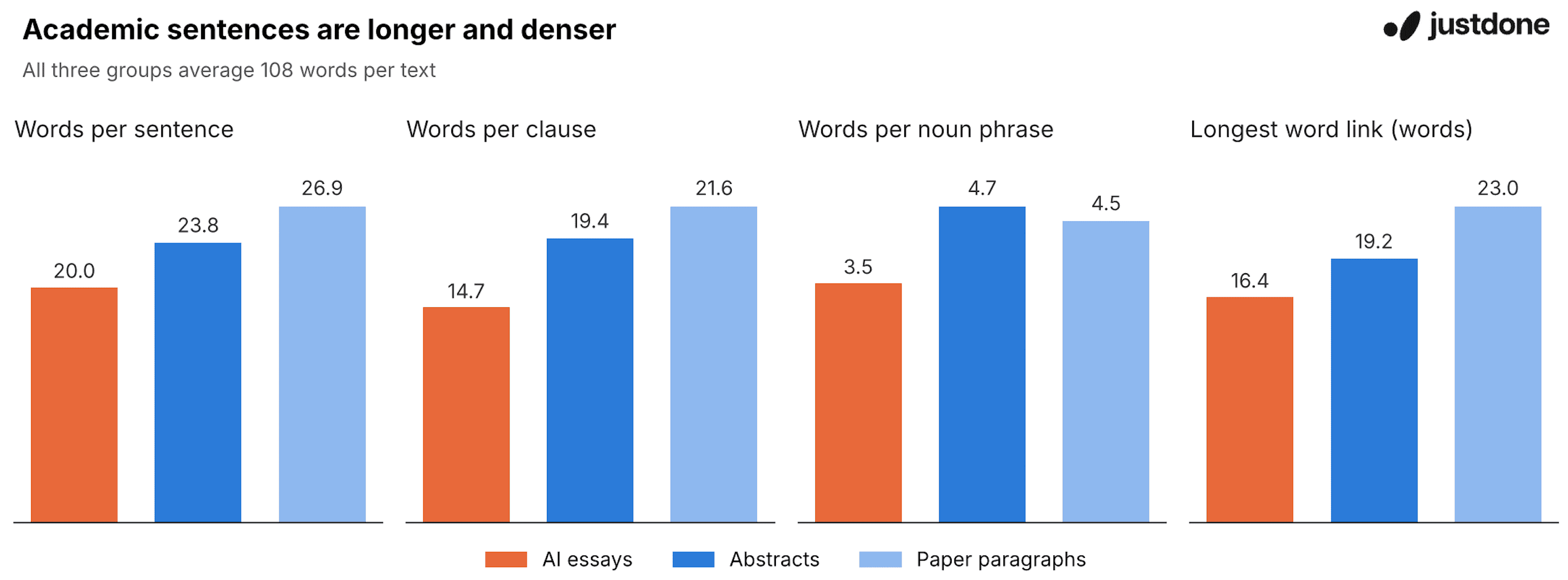
The texts are the same length, but academic writers spend those words on fewer, longer sentences. Full research papers go furthest: their longest link between two related words reaches 23 words, against 16 in AI essays.
2. Nouns do the heavy lifting
This is the core of academic style. Academic text is built around noun phrases, and those phrases are long: a quantitative formulation of this equivalence, the average abundance of the proteins. Nouns make up over 30% of the words, and roughly one noun phrase in four carries a prepositional phrase inside it. In AI essays, it's one in six. AI essays lean on verbs instead.
Here's what that difference looks like inside a sentence. We mapped how each word connects to the others: every arrow points from a word to the word that depends on it.
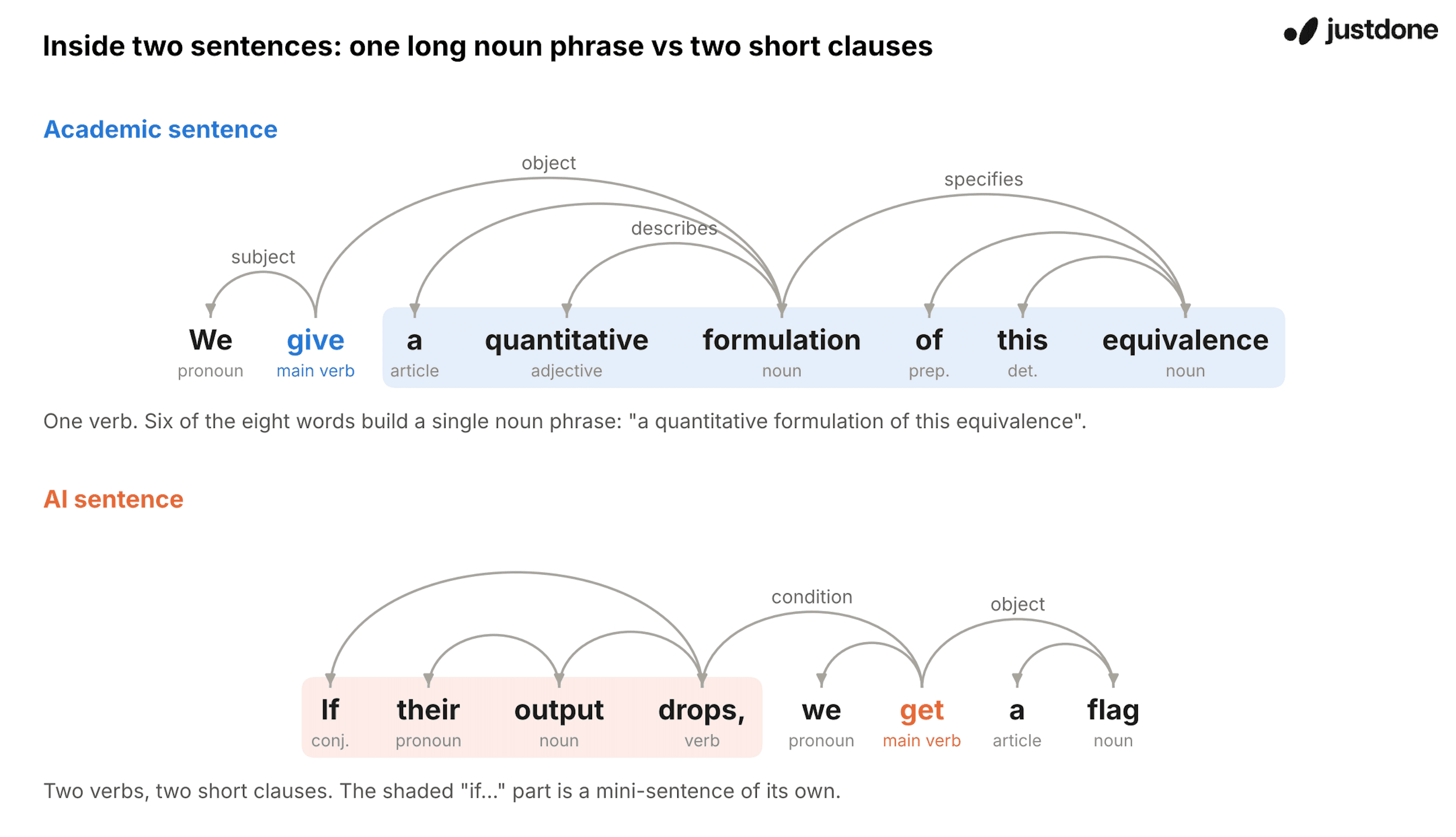
The academic sentence puts almost everything into one noun, formulation, and specifies it step by step. The AI sentence splits the same amount of words into two small clauses, each with its own verb.
3. Chains of "of", "in" and "for"
Prepositions are a third more common in academic writing. They let one noun specify another: the difference of average abundances of the proteins in the presence of uAb. Each "of" or "in" adds a layer of precision. It's also why "of", "the" and "in" are among the words that most clearly separate academic writing from AI essays.
4. Passive and impersonal
Passive voice is about 2.6 times more common in academic texts: the values were calculated, the strain was measured. In the main body of papers, "I" and "we" almost disappear. The focus stays on what was done, not on who did it.
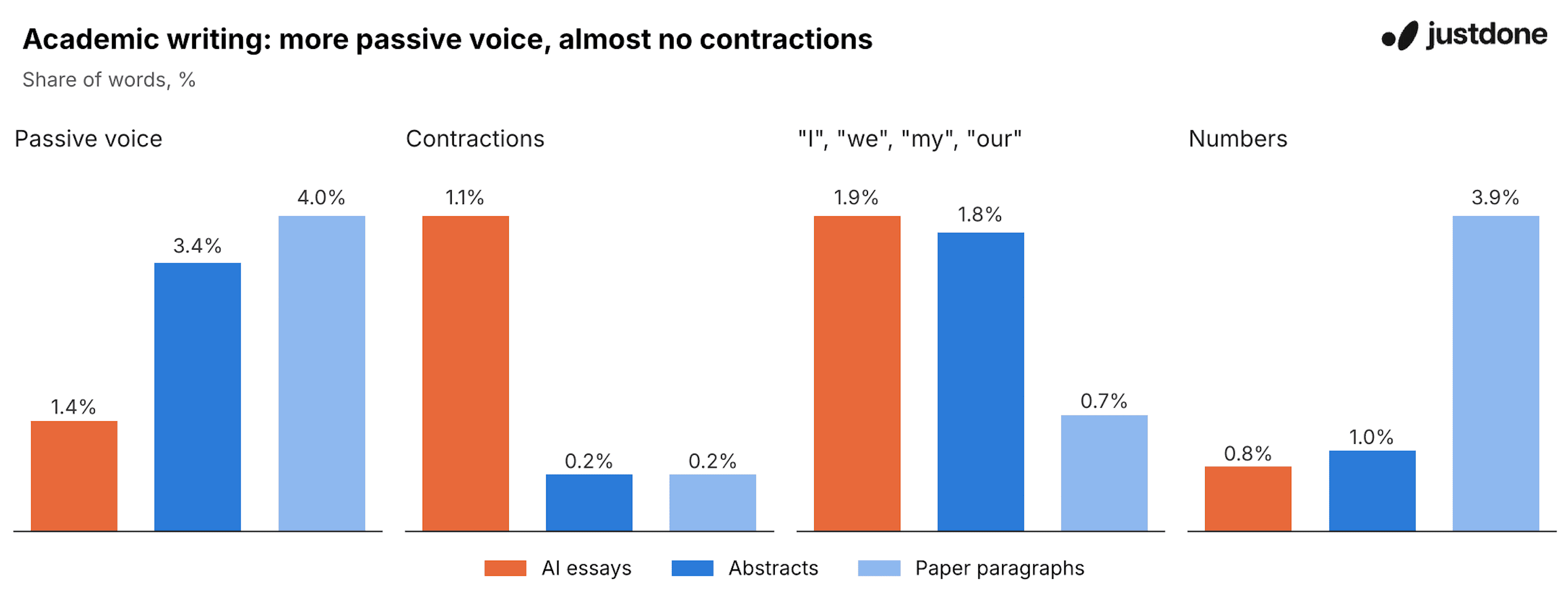
Passive voice and the absence of contractions hold in both academic genres. Two markers depend on the format, though. Abstracts use "we" almost as often as AI essays use "I" (We introduce a new class of models…), while the main body of papers is far more impersonal. And numbers belong to the main body, where results are reported: almost 4% of the words there are figures.
5. The same terms, repeated
AI essays use a wider variety of words. Academic writing does the opposite: it picks a term, such as model, method, cell or patient, and sticks with it. Repetition here is not a weakness. It keeps the meaning exact.
What academic writing avoids
Contractions like it's and don't are about five times rarer. Pronouns like I, it and they are half as common, and so are modal verbs like can and may. Everyday words that AI essays favour, like help, make, how and but, barely show up.
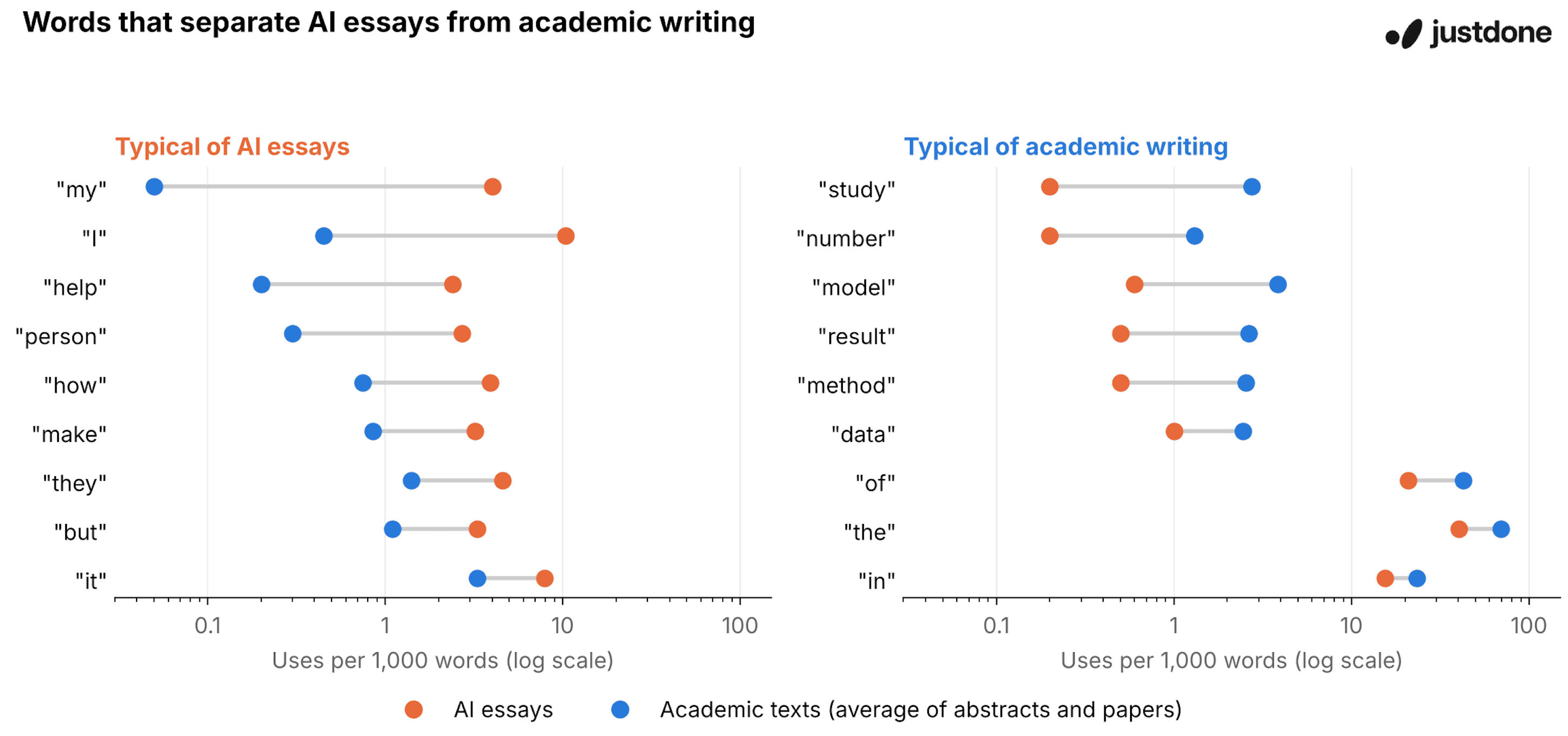
The words that separate the two styles tell the same story. AI essays write about people and what they do: I, my, person, help, make. Academic texts write about objects and outcomes: model, method, result, data, study. Even small words split clearly: academic writing uses "of" about twice as often.
A surprise: complexity isn't about subordinate clauses
You might expect academic writing to use more "because…" and "which…" clauses. It actually uses fewer than AI essays, along with fewer "and" and "but" links. Academic complexity lives inside noun phrases, not in long chains of clauses.
How to write more academically
Writing academically makes your text more precise and matches what professors and reviewers expect. It also moves it away from the default AI essay voice, which runs on verbs, pronouns, "and" and "but". Here's how to get there.
- Turn actions into noun phrases. Instead of Students use phones a lot, and this changes how they learn, write The frequent use of mobile phones affects students' learning habits.
- Specify with "of", "in" and "for". Don't stop at the results. Say the results of the second experiment in older patients.
- Use the passive where the action matters more than the actor. The samples were collected in March puts the focus on the samples, not on you.
- Pick your terms and keep them. If you call it "the model" in the first paragraph, don't switch to "the system" or "the tool" in the next one.
- Combine short sentences into one fuller one. Two or three short statements about the same idea usually belong in a single, well-built sentence.
- Drop the conversational markers. No contractions, fewer I think and it's, and fewer vague can and may.
- Add numbers and specifics. Research-paper paragraphs contain about five times more numbers than AI essays. Measured values, dates and sample sizes make a claim concrete.
