Key Takeaways:
- ChatGPT’s knowledge depends on the model’s training cutoff date, so understanding how up to date ChatGPT is matters when using it for research, assignments, or fact-based writing.
- Even with browsing enabled, ChatGPT can still generate outdated or inaccurate information. That's why tools like JustDone’s AI Fact Checker help verify claims and reduce the risk of hallucinated sources or statistics.
- Major ChatGPT updates improve what the model actually knows, while smaller updates mainly refine features and performance. It is important to check how recent ChatGPT data is before relying on it in academic work.
How up to date is ChatGPT? It depends on which model you are using and whether you have the browsing tool switched on. Let me break down exactly what that means, because the difference between getting this right and getting it wrong matters, especially when you are submitting academic work.
What Year Does ChatGPT Go Up To? The Current Cutoff
The knowledge cutoff is the date after which ChatGPT has no training data. The model was not exposed to events, articles, research papers, or any other content published after that date during training. If you ask it about something that happened after its cutoff, it will either tell you it does not know, or generate a plausible-sounding but incorrect answer.
As of 2026, the GPT-5 series models have a knowledge cutoff of August 2025. The newer GPT-5.5, released in April 2026, has a knowledge cutoff of December 2025.
Here is the current breakdown by model:
| Model | Knowledge Cutoff | Notes |
| GPT-5.5 | December 2025 | Latest release, April 2026 |
| GPT-5.4 | August 2025 | Released March 2026 |
| GPT-5.2 | August 2025 | Released December 2025 |
| GPT-4o | October 2023 | Retired from ChatGPT February 2026 |
What this means practically: if you ask the current default model about something that happened in January 2026, it likely does not know about it from training data alone. If browsing is enabled, it may find it. If not, it may guess, and guessing can bring trouble for students.
How recent is ChatGPT's data depends entirely on which model you are talking to. If you are not sure which model is active in your session, check the model selector at the top of the ChatGPT interface.
How Often Is ChatGPT Updated?
This is where a lot of people get confused, because "updated" means two different things depending on what you are asking about.
Major model releases happen roughly once or twice a year. These are the significant leaps (from GPT-4 to GPT-4o to GPT-5), where the underlying architecture and training data change substantially. Each new model generation typically comes with a newer knowledge cutoff and improved capabilities. ChatGPT's latest stable release was GPT-5.5 on April 23, 2026.
Iterative updates happen much more frequently. Sometimes, several times a month. These are smaller changes to the same underlying model: safety tuning, feature improvements, browsing capability updates, interface changes, and performance refinements. These updates do not change the knowledge cutoff. The model is not learning new information about the world. It is being adjusted in other ways.
This distinction matters for students in particular. When ChatGPT is updated, it may mean either a new model release or a minor tweak pushed. Only a major model release expands what the model actually knows about the world.
How often is ChatGPT information updated in the sense of learning about new events? Only when a new model is trained and released. It happens on the scale of months to over a year, not daily or weekly.
Is ChatGPT Up to Date with Today's News?
The answer depends on whether ChatGPT has the browsing tool or not. Without the browsing tool, ChatGPT doesn’t up to date with news. With the browsing tool, it is, but partially.
Without browsing, ChatGPT answers entirely from its training data. Ask it about a news event from last week, and it will either say it does not know, or it will generate something that sounds confident but may be completely fabricated.
ChatGPT browsing feature has the following limitations:
- Web search results depend on what has been indexed by search engines. Very recent events may not yet appear in search results.
- The model still interprets and summarizes what it finds, so it can misread or misrepresent sources.
- Browsing is available to Plus, Pro, and Team subscribers. Free users have more limited access.
Here's how browsing feature looks like in ChatGPT interface:
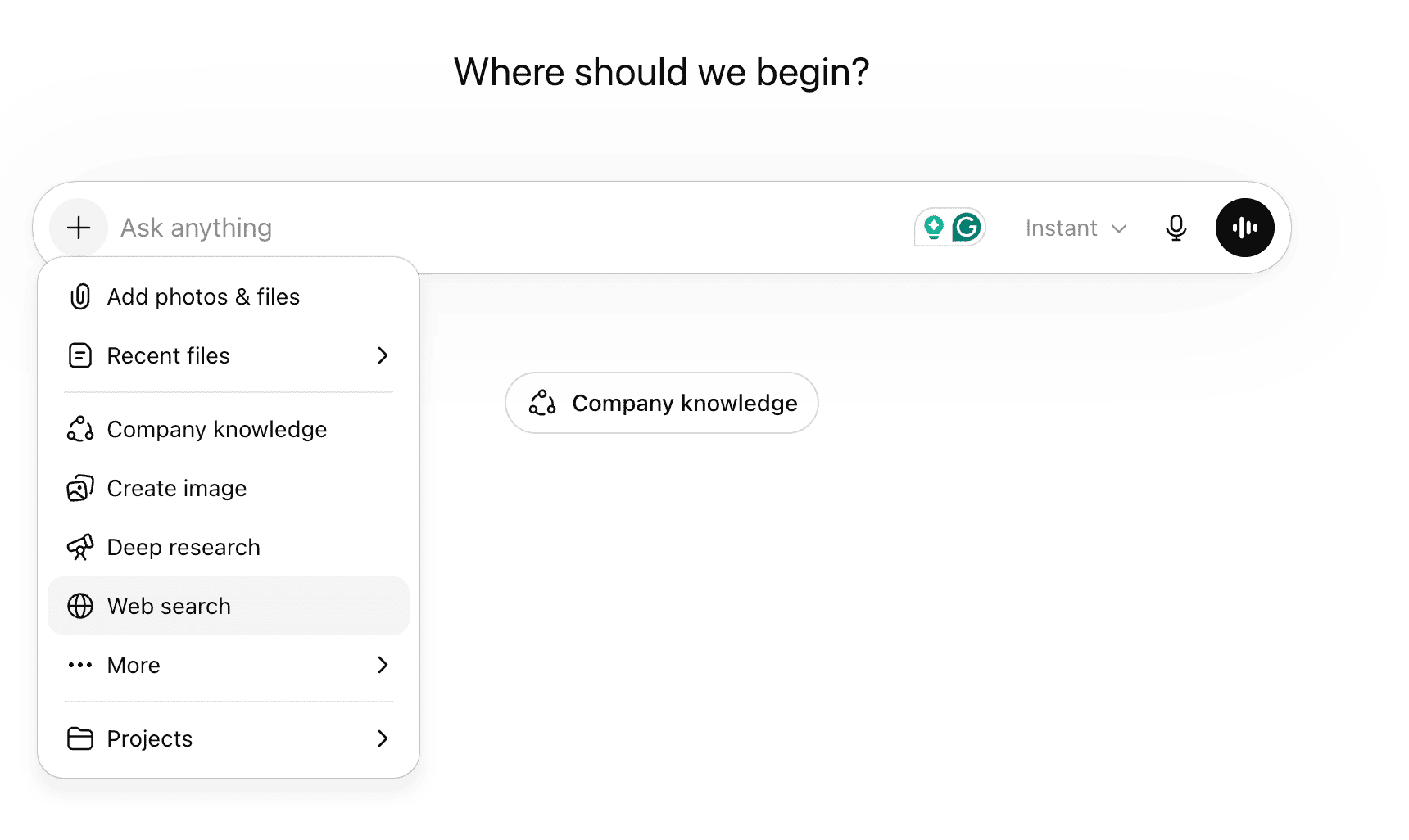 For students, the practical rule is: if ChatGPT's data update matters for your assignment, you need to verify what it tells you against primary sources. Do not cite ChatGPT directly. Use it to find directions, then verify through the actual sources it points you toward.
How to Get Current Information from ChatGPT
Here are the approaches I use when I need ChatGPT to work with recent information:
- Enable the search tool. In ChatGPT, there is a search or browsing toggle available in the message input area. Turn it on when you need current information. The model will explicitly tell you when it is drawing from search results versus training data, which helps you know when to be more skeptical.
- State the date in your prompt. Something as simple as "as of May 2026" in your prompt tells the model what time context you are working in. This helps it flag when something falls outside its training window rather than generating a confident but outdated answer.
- Verify every factual claim independently. This is non-negotiable for academic work. ChatGPT can hallucinate sources, dates, statistics, and quotes. If you are submitting work that cites specific data, find the original source yourself.
- Use JustDone's AI Fact Checker to cross-check claims before including them in submitted work. JustDone flags statements that cannot be verified against real sources, which is exactly the kind of thing that will get you in trouble with a professor who does their own checking.
- Use the reasoning modes for complex tasks. For questions that require synthesizing recent information carefully, GPT-5's Thinking or Pro modes apply more computation to the answer. They are slower but more likely to catch their own errors and flag uncertainty rather than papering over it with confident-sounding text.
Why This Matters More Than Most Students Realize
I want to be direct about something that does not get said enough: submitting ChatGPT output that contains outdated or hallucinated information is an academic integrity risk on top of a factual accuracy risk.
If you cite a study that does not exist or quote statistics ChatGPT fabricated, that looks like careless research at best and deliberate fabrication at worst. The fact that ChatGPT generated it is not a defense that most professors accept.
How old is ChatGPT data matters for your academic credibility. Knowing the cutoff date of the model you are using, checking whether browsing is enabled, and verifying factual claims before they appear in submitted work is a good practice. It means you are using AI responsibl.
The knowledge cutoff is not a bug. It is a documented limitation of how these models work. Using them well means understanding it.
Frequently Asked Questions
Is ChatGPT still using old data?
It depends on the model. The current GPT-5 series has a knowledge cutoff of August 2025, meaning anything after that date is outside the model's training data unless browsing is enabled. Older models like GPT-4o had cutoffs as early as October 2023.
How old is ChatGPT data?
For the most current models available in May 2026, training data goes up to August or December 2025 depending on the specific model version. GPT-5.5, released in April 2026, has the most recent cutoff at December 2025. How old ChatGPT data is depends entirely on which model you are using.
How often is ChatGPT information updated?
The knowledge cutoff only changes with a major new model release, which happens roughly every several months to a year. Smaller iterative updates — which happen much more frequently — adjust model behavior and features but do not expand what the model knows about the world.
Is ChatGPT trained on the latest data?
No model is trained on truly latest data. There is always a gap between when training data collection ends and when the model is released to users. For the current GPT-5 series, that gap is roughly six to nine months. With browsing enabled, the model can access more recent information, but it is pulling from web search, not its training data.
How long does it take for ChatGPT to update?
A full model retraining and release cycle takes months. OpenAI does not publish a fixed schedule, but based on the release history significant model updates have been arriving every three to six months through 2025 and into 2026. Each new release brings a newer knowledge cutoff. In between major releases, smaller updates adjust model behavior but do not change the training data cutoff.
