ZeroGPT and GPTZero are two of the most widely searched AI detectors, and their almost identical names lead many people to assume they are versions of the same product. They are not.
The confusion is understandable:
- both check whether text is AI-generated
- both show percentage-based scores
- both use similar wording, branding style and color schemes
- both appear at the top of Google for “AI detector”
But the tools were created by different teams, have different levels of accuracy, use different detection methods, and are intended for different types of users. This article clarifies the differences so you can choose the right tool and avoid depending on the wrong detector.
Why People Confuse ZeroGPT and GPTZero
The similarity of the names is the main reason for the confusion. GPTZero gained popularity first, originally created at Princeton and widely adopted in education. Shortly after its rise, ZeroGPT emerged with a similar name, similar interface, and similar positioning in the market.
Because of that:
- many users assume ZeroGPT is a version or update of GPTZero
- search results for the two tools often mix together
- teachers and content creators report accidentally using one tool when they intended to use the other
- ZeroGPT is frequently misattributed credit for GPTZero’s achievements
This similarity creates a practical problem: people assume both detectors work the same way. In reality, they behave very differently.
Key Differences Between ZeroGPT and GPTZero
The table below gives the clearest overview of why these tools are not interchangeable.
| Aspect | GPTZero | ZeroGPT |
|---|---|---|
| Who built it | Team founded at Princeton with academic roots | Anonymous commercial product team |
| Why it was created | Help educators identify AI-generated writing | Provide a broad free detector plus additional writing tools |
| Accuracy (2025 tests) | High accuracy, especially on human text; low false positives | Lower accuracy; higher false positives, especially on long or formal texts |
| False positives | Low, usually under 5 percent | High, up to 30 percent or more in independent tests |
| False negatives | Can miss some humanized or edited AI text | Often detects casual AI well but struggles with long or complex documents |
| Reporting | Sentence-level highlights and detailed explanations | Mostly a single percentage score |
| Use cases | Academic institutions, publishers, professional audits | Quick checks, casual use, creators needing extra writing tools |
| Pricing | Higher cost but more advanced features | Lower cost and ad-supported free tier |
This comparison clearly shows that although the names are similar, the tools are built for very different purposes.
GPTZero: What It Is and How It Works
GPTZero was one of the first widely used AI detectors and became dominant in schools, universities, and newsrooms. Its detection method combines behavioral metrics (such as perplexity and burstiness) with machine learning models trained to detect AI writing patterns.
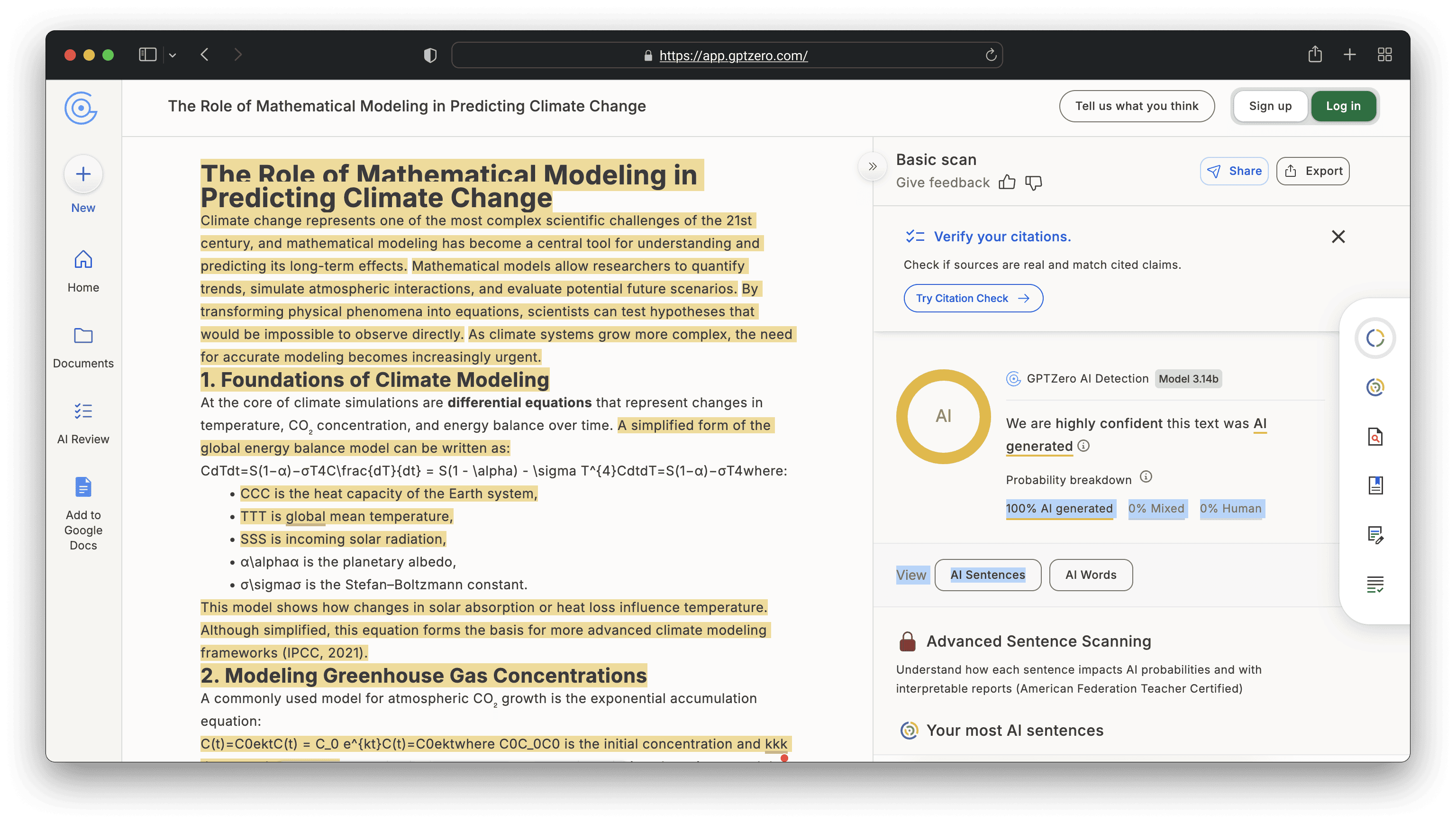
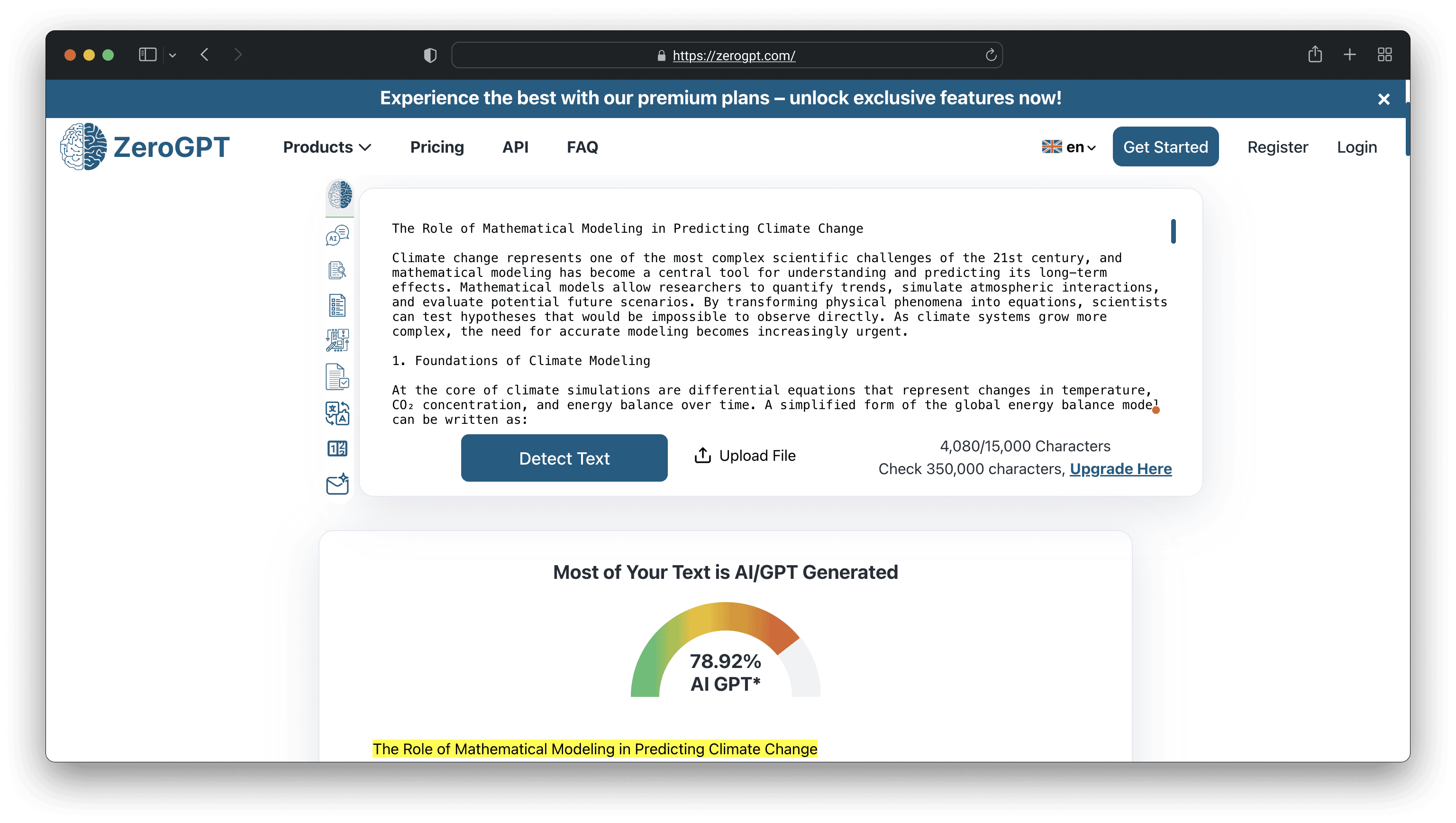
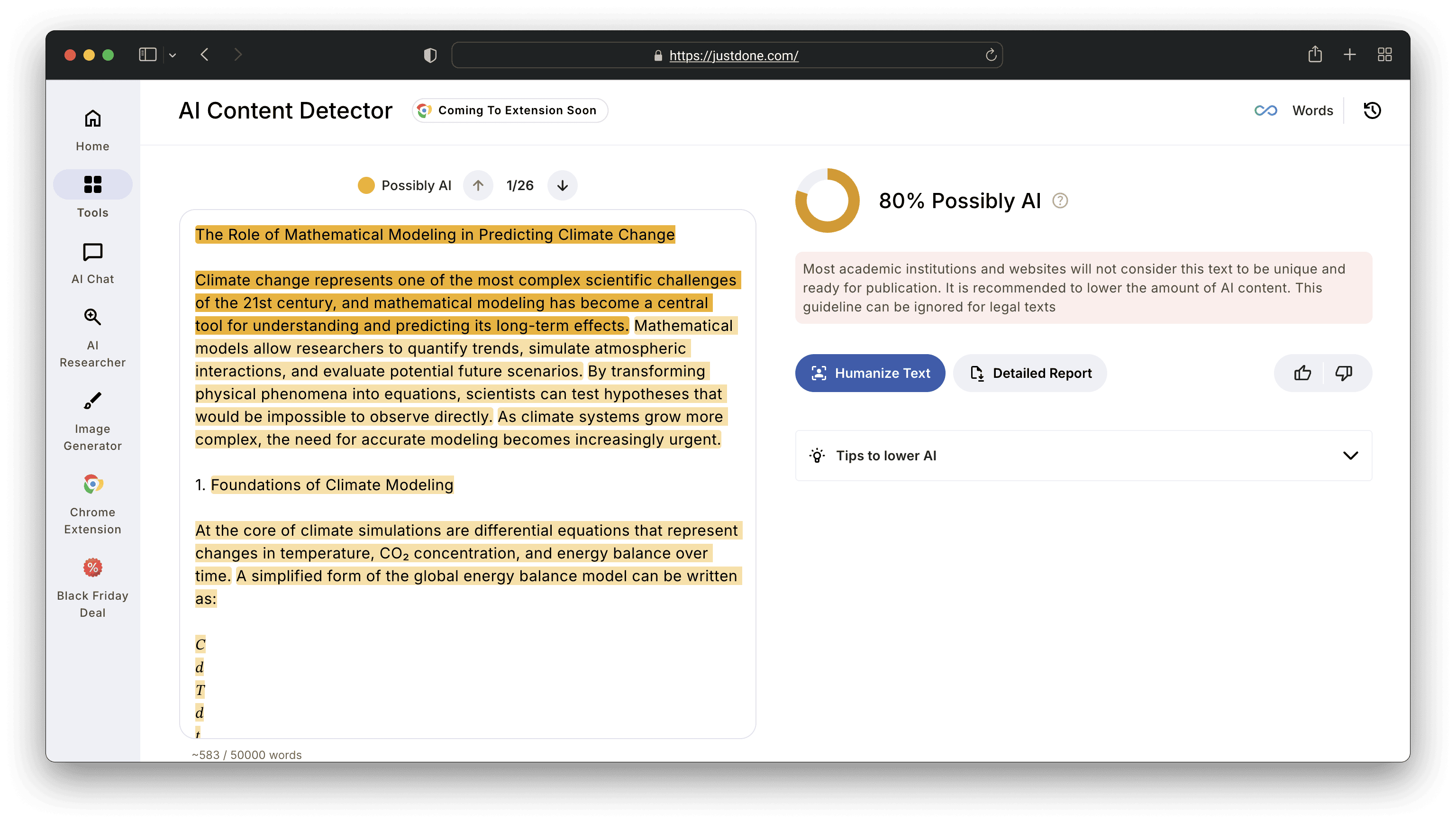
I tested both tools several times, but let's see how they perform with academic student essay about climate change with formulas, citations, and references.
GPTZero scanned the text and detected it as 100% AI-generated (however, it is not true). However, it didn't highlight the whole text, so it's not clear what to fix at first sight.
Where GPTZero performs well:
- High accuracy on long-form text
- Low false positives, which is important when evaluating student work
- Detailed reporting for academic or editorial standards
- Strong privacy posture suitable for institutions
- Consistent performance across many text types
Where GPTZero struggles:
- Can under-detect AI when text has been heavily rewritten or humanized
- Interface may feel too detailed for quick checks
- Higher pricing for full features
From the user’s perspective, GPTZero provides a detailed dashboard with highlighted sentence-level analysis. It is good for in-depth evaluation and is best for educators, editors, and researchers. However, the tool requires reading the report to understand the result.
GPTZero’s design philosophy prioritizes avoiding wrongful accusations. This is why institutions rely on it: accuracy and caution.
ZeroGPT: What It Is and How It Works
ZeroGPT arrived later but quickly gained traction because of its simple interface, strong free tier, and extra writing tools. It offers a quick detection score and additional features like a paraphraser, summarizer, grammar checker, and translation.
ZeroGPT scanned the AI-assisted student essay and showed 78,92% flagged score.
Where ZeroGPT performs well:
- Very fast, simple checks
- Good at detecting basic or typical AI-generated blog text
- A broader tool suite without switching platforms
- Lower price and an accessible free version
Where ZeroGPT struggles:
- High false positive rate on human-written content
- Difficulty with long documents or complex writing
- Less detailed reporting
- Privacy and transparency concerns due to anonymous development and ad-supported free tier
- Less transparency on the detection rationale
From the user perspective, ZeroGPT has a minimal, fast interface with one percentage score. It is good for casual creators or basic content scans. However, ads in the free version can be annoying.
Overall, the tool is useful for casual checks but not reliable enough for academic or professional verification.
Accuracy Comparison: Why Users Get Misled
A major source of confusion is that users often run the same text through both tools and get drastically different scores. This makes people think one tool must be “broken.” In reality, the algorithms behave differently.
Example pattern observed in multiple tests
- GPTZero often scores human-written text very low on AI likelihood.
- ZeroGPT often flags human text as moderately or highly AI-written.
- GPTZero can miss AI content that has been paraphrased or humanized.
- ZeroGPT can confidently identify simple AI-generated text but struggles with sophisticated writing.
This explains why someone might paste a university assignment into both tools and get:
- GPTZero: 3 percent AI
- ZeroGPT: 60 percent AI
These tools do not measure the same metrics, so their scores should not be interpreted interchangeably.
Pricing Comparison: When Cost Matters
GPTZero charges more because it offers deeper analysis, educational integrations, higher accuracy, and stronger privacy standards.
ZeroGPT is cheaper and offers more tools in a single platform, but with less accuracy and more false positives.
Choosing between them depends on your need:
- High-stakes evaluation: GPTZero
- Low-stakes quick checking: ZeroGPT
Why These Tools Should Not Be Treated as the Same
Even though the names are nearly identical, the tools differ in:
- accuracy
- methodology
- privacy standards
- intended users
- reporting depth
- likelihood of false positives
- cost
- supporting features
The confusion has caused real problems: teachers incorrectly accusing students, creators panicking over false positives, and institutions misinterpreting results.
To avoid issues, users must understand that ZeroGPT and GPTZero are not interchangeable. They are fundamentally different products.
If you want a clear, professional report, GPTZero feels more reliable. If you want a quick estimate in a few seconds, ZeroGPT feels easier.
When Alternative Detector Is a Better Option
When the goal is not simply to identify AI text but to actually improve writing quality, JustDone is a more practical tool. It includes a decent toolkit of AI detector, plagiarism checker, paraphraser, humanizer, grammar checker, and other writing tools.
This means you can correct tone, rewrite robotic sections, and verify originality without leaving the writing environment.
I ran the same AI-generated essay in JustDone as I did for ZeroGPT and GPTZero detectors. It demonstrates even more accurate result, an 80% score.
Such alternative all-in-one tools as JustDone can be most useful:
- For students needing to paraphrase and check originality in one process
- For bloggers and marketers, improving clarity and tone
- For writers reviewing both plagiarism and AI indicators in one place
- For creators who need to refine style rather than only detect AI
JustDone is not designed to replace high-stakes detectors like GPTZero, but it is a more complete writing workflow tool when the goal is to produce polished, coherent, human-like text.
Final Recommendation: Which Tool Should You Use?
As a result of my testing, I’d recommend choosing GPTZero if:
- You need the highest possible accuracy
- You want minimal false positives
- You work in academia or professional content review
- You need detailed reports and institutional-level reliability
On the flip side, choose ZeroGPT if:
- You want fast, simple checks
- You accept a higher risk of false positives
- You prefer a free or low-cost option
- You want extra tools like paraphrasing and summarization
Also, think about alternative tools and choose JustDone if:
- You want to improve or rewrite text
- You want to check both plagiarism and AI likelihood
- You need humanization or paraphrasing integrated into the same workspace
- You want a complete writing tool rather than just a detector
Summary on ZeroGPT and GPTZero Comparison
ZeroGPT and GPTZero are not the same tool, even though their names are nearly identical. GPTZero offers higher accuracy, lower false positives, and detailed reporting, while ZeroGPT provides simpler, faster checks with a broader tool suite but less reliability.
Understanding their differences prevents misinterpretation, especially in academic or professional settings where accuracy matters.
JustDone complements both by offering a writing-driven workflow that helps users actually improve and verify their text, rather than relying solely on detection scores.
F.A.Q.
Is ZeroGPT as good as Turnitin?
Not really. Turnitin is generally more reliable because it combines plagiarism databases with AI-detection capabilities. It delivers better overall accuracy (82.5% compared to 73.8%) and produces far fewer false accusations (1.3% vs. 20.5%). ZeroGPT is useful for quick checks but isn’t considered as accurate as Turnitin.
Does GPTZero give false negatives?
Yes, GPTZero can miss AI-generated text, especially if the content has been paraphrased or edited by a human. While a specificity of 0.90 is nearly acceptable, the sensitivity of 0.65 is mediocre and can result in false negatives, where AI output is incorrectly identified as human.
Do I have to pay for GPTZero?
GPTZero has a free version with limited scans. For higher volume or advanced features, you need a paid plan.
Which AI detector is most accurate?
No AI detector is fully accurate, and results can vary depending on the text. Most tools work best on unedited AI output but are less reliable with human-edited or paraphrased content. Use two different AI checkers to make sure the results are accurate.
Can GPTZero detect paraphrased AI text?
GPTZero often fails to detect paraphrased AI text. When the wording and structure are heavily edited, the patterns it looks for disappear, making AI content appear human. Try an alternative detector like JustDone as more accurate with AI paraphrasing.
