Key takeaways:
- GPTZero and Turnitin use different detection methods, so the same text can receive very different AI scores.
- Turnitin is built for institutions, while GPTZero is more accessible for individual users and educators.
- JustDone’s AI Detector produces scores closely aligned with Turnitin and helps students check and improve text before submission.
GPTZero and Turnitin are built for different purposes and different users. Turnitin is an institutional tool with a 20-year plagiarism database and AI detection bolted on. GPTZero is a dedicated AI detector anyone can access, with more transparent scoring and a free tier. Neither is definitively better. The right choice depends on whether you are an institution enforcing policy after submission or a student and educator checking work before it goes anywhere.
How Each Tool Detects AI Writing
Both tools flag AI-generated text, but they analyze it differently, produce different kinds of output, and make different tradeoffs between catching AI content and avoiding false accusations.
GPTZero's Approach
GPTZero was built from the ground up as a dedicated AI detector. It analyzes text using two core signals:
- Perplexity measures how surprising or unpredictable the language is. AI models tend to select statistically likely words at each step, producing text that is smooth and predictable. Human writers make less predictable choices — unusual phrasing, unexpected transitions, sentences that break expected patterns. Low perplexity is a strong signal of AI authorship.
- Burstiness measures variation in sentence complexity across a document. Human writing is naturally uneven — short punchy sentences followed by long complex ones, formal paragraphs next to informal asides. AI output tends to be more uniform throughout. Low burstiness is another AI signal.
GPTZero combines these signals at the sentence level and the document level, returning a probability score and highlighting individual sentences it considers likely AI-generated. This sentence-level breakdown is one of GPTZero's most useful features. It tells you not just whether the document is flagged, but where specifically the AI patterns appear.
GPTZero claims to detect text from GPT, Claude, Gemini, LLaMA, and DeepSeek, with monthly model updates to keep pace with new releases.
Turnitin's Approach
Turnitin started as a plagiarism detector in 1998 and added AI detection in 2023. Its AI detection capability is built on top of that existing infrastructure, which gives it some advantages — and some constraints.
Turnitin uses a proprietary transformer deep-learning architecture trained on a massive dataset of student writing. They have been collecting papers for over two decades, with 900 million or more archived submissions, plus AI-generated text. This means Turnitin's model has been trained on what students actually write, not just generic text, which makes it well-calibrated for academic contexts.
Turnitin returns a single overall AI percentage rather than sentence-level breakdowns in its standard view. It also produces a separate similarity report for plagiarism, which remains its primary use case for most institutions. The AI detection is an add-on feature, not the core product.
One important design choice: Turnitin's Chief Product Officer admitted the tool intentionally detects about 85% of AI content, deliberately missing 15% to maintain a false positive rate below 1%. This is a deliberate tradeoff — Turnitin prioritizes not wrongly accusing students over catching every instance of AI use.
Turnitin vs GPTZero: Benchmarking
Accuracy
- Accuracy Range: Both tools show high accuracy on unedited AI content (GPTZero: approx. 84-91.3%; Turnitin: 85-93%). However, Turnitin's model intentionally misses about 15% of AI content to maintain a lower false positive rate (FPR).
- False Positive Trade-off: Turnitin generally has a lower FPR (approx. 4% in one test) and is better at catching mixed content, while GPTZero has been tested with a higher FPR (approx. 9% in the same test).
- Edited Content: Both tools perform significantly worse on edited or heavily paraphrased AI content, with detection rates dropping to 40-60%.
- Interpreting Scores: The scores are probability signals, not calibrated percentages. A score of 0.70 means a higher likelihood of AI than 0.60, but does not equate to a 70% chance.
| Benchmark Metric | GPTZero | Turnitin |
|---|---|---|
| Detection Approach | Analyzes perplexity (unpredictability) and burstiness (sentence variation) | Proprietary transformer architecture trained on massive student writing dataset |
| Accuracy Range | ~84% to 91.3% for unedited content | ~85% to 93% for unedited content |
| False Positive Rate | Varies from 0.24% to 12% depending on study | Generally lower (~1% to 7%) due to strict calibration |
| Key Design Choice | Provides transparent sentence-level probability breakdowns | Prioritizes low false positives; intentionally misses ~15% of AI content |
| Edited AI Content | Both tools drop to 40-60% accuracy on heavily paraphrased or edited text | |
False Positives
A false positive happens when genuinely human-written text is mistakenly flagged as AI-generated. To measure this, my hands-on test used 100 writing samples – 50 human-written and 50 AI-generated. I run them through Turnitin and GPTZero to track the rate for both.
The key findings on False Positive Rates (FPR) are:
- Inconsistent GPTZero Rates: Independent tests show highly inconsistent False Positive Rates (FPR) for GPTZero, ranging from a claimed 0.24% to 10%, with some research suggesting reliance could falsely accuse up to 20% of innocent students.
- Severe Bias: Both tools demonstrate severe bias against non-native English speakers, with one study showing detectors misclassified 61.22% of TOEFL essays as AI-generated.
- Institutional Disabling: Citing FPR and bias concerns, major universities (including Yale, Northwestern, and Vanderbilt) disabled Turnitin's AI detection feature.
- Practical Takeaway: AI detection results should only serve as a signal for further review, not as the sole basis for accusation or grade penalty.
Pricing and Accessibility
GPTZero Pricing and Accessibility
- Free Plan: Accessible to anyone without a credit card; includes up to 10,000 words scanned per month, advanced detection, and writing feedback.
- Essential Plan: $15 per month for 150,000 words.
- Premium Plan: $12.99 per month for 300,000 words.
- Professional Plan: $46 per month for 500,000 words; annual billing offers approximately a 45% discount.
Turnitin Pricing and Accessibility
- Institutional Access Only: Individual users cannot purchase licenses directly; subscriptions are designed for educational institutions.
- Custom Pricing: Institutions receive quotes based on license type and student volume; typically priced around $3 per student annually plus support fees.
- Large-Scale Examples: The California State University System is projected to spend $1.1 million in 2025 on Turnitin services.
| Feature | GPTZero | Turnitin |
| Who can access | Anyone | Institutions only |
| Free tier | Yes, 10,000 words/month | No |
| Paid individual plan | From $12.99/month | Not available |
| Institutional pricing | Enterprise plans available | Custom quote only |
| AI detection accuracy | 84 to 91% | 85 to 93% |
| False positive rate | 6 to 12% depending on test | ~1 to 7% depending on test |
| Plagiarism detection | Limited | Full, with student paper repository |
| Sentence-level breakdown | Yes | Partial |
| LMS integration | Limited | Full (Canvas, Blackboard, Moodle) |
Our Experiment: How Closely Do GPTZero and JustDone Mirror Turnitin?
To give students a practical pre-submission reference point, I ran the same text through both Turnitin and JustDone's AI Detector and compared results directly.
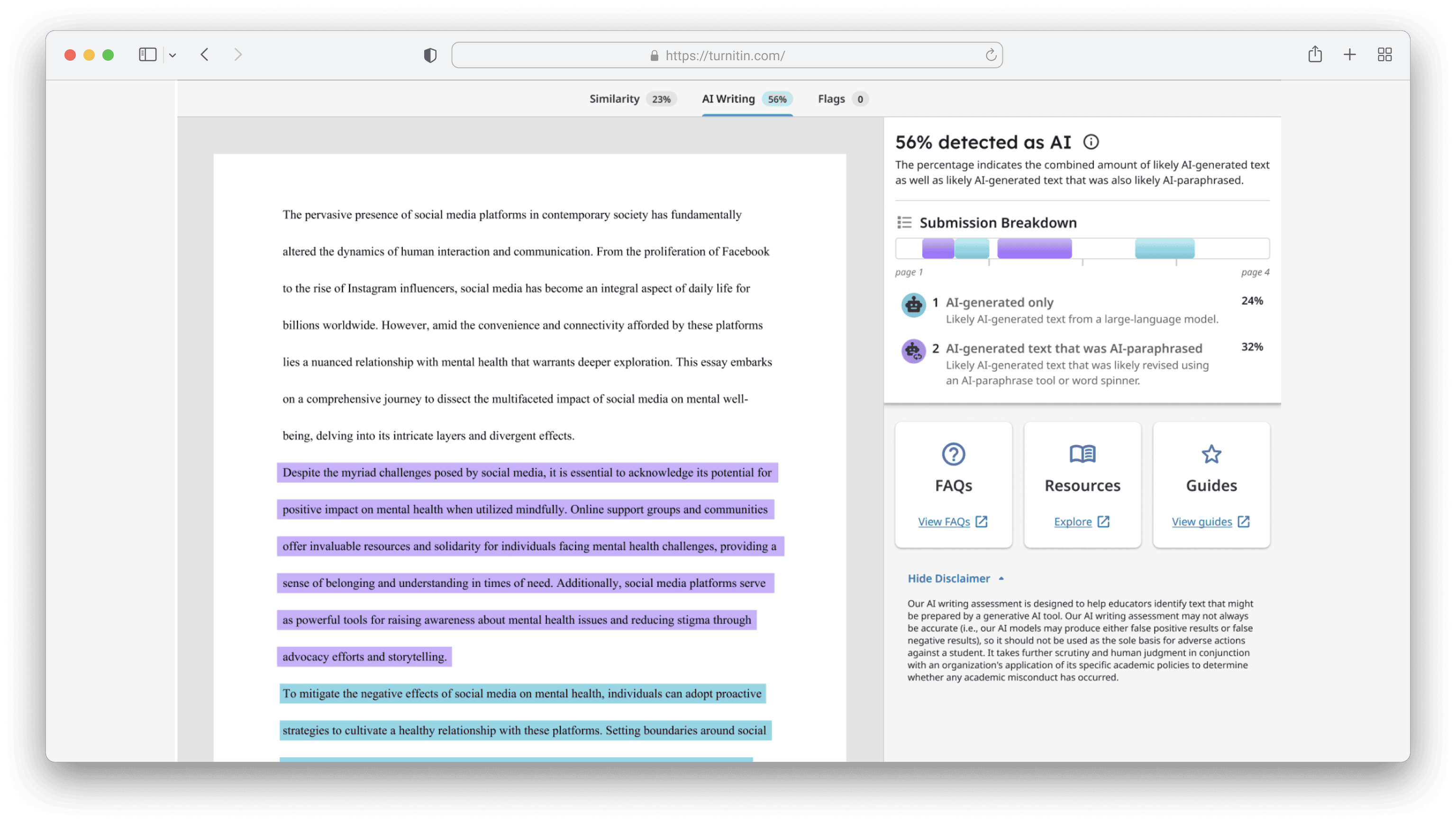
I used a document that Turnitin flagged at 56% AI-generated — a clearly elevated score with multiple highlighted sections:
I then ran the identical text through JustDone's AI Detector:
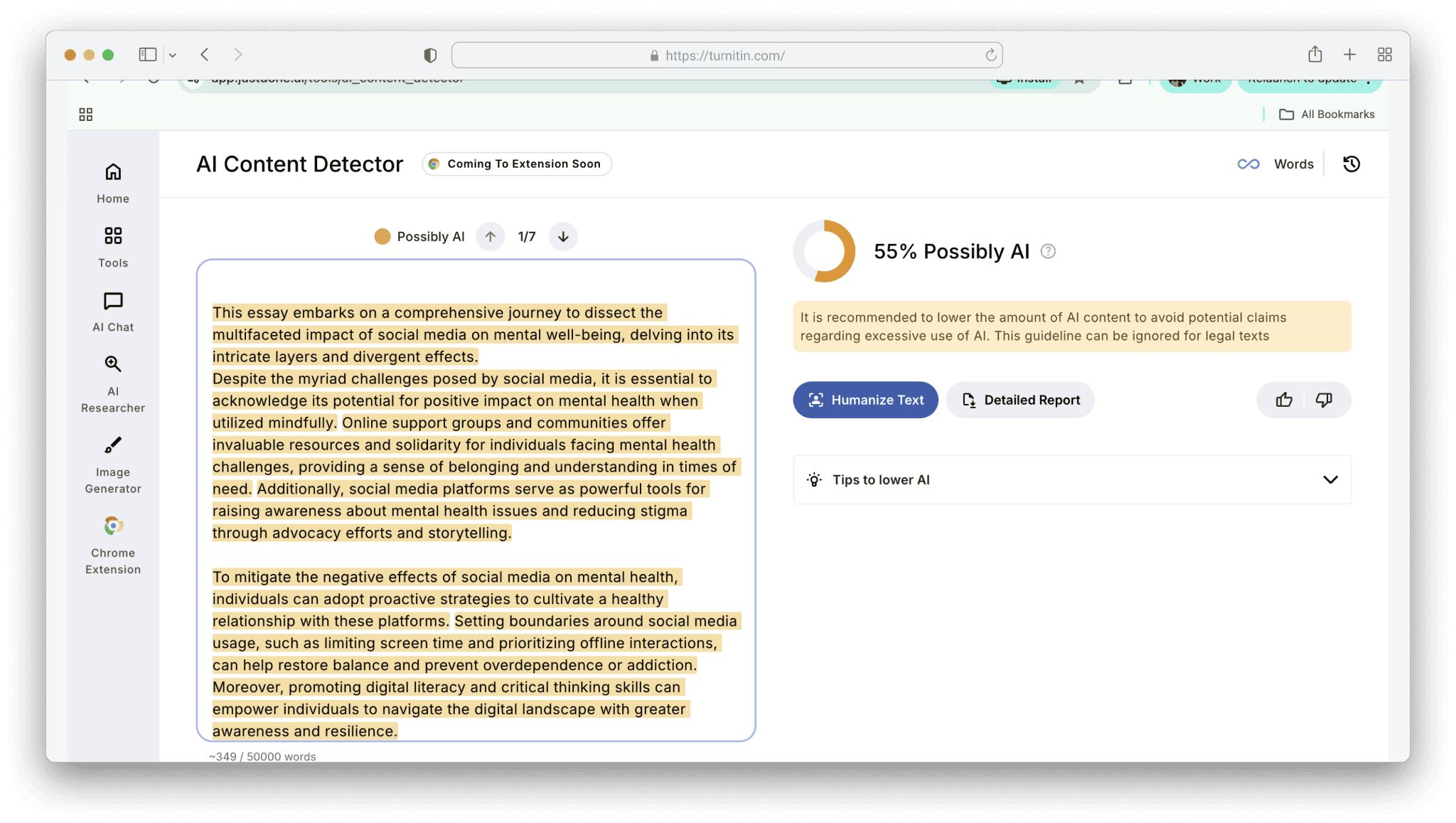
JustDone returned 55% — a one-percentage-point difference. The sentence-level breakdown highlighted the same passages Turnitin flagged, and the overall score was close enough to give students a reliable pre-submission picture of what Turnitin will show.
This matters because students cannot access Turnitin before submitting. JustDone's AI Detector functions as a practical proxy. You see approximately what your professor will see, before it goes anywhere, with enough time to address what's flagged.
I ran the same text through GPTZero and got a 100% AI score, which was very different from Turnitin’s result.
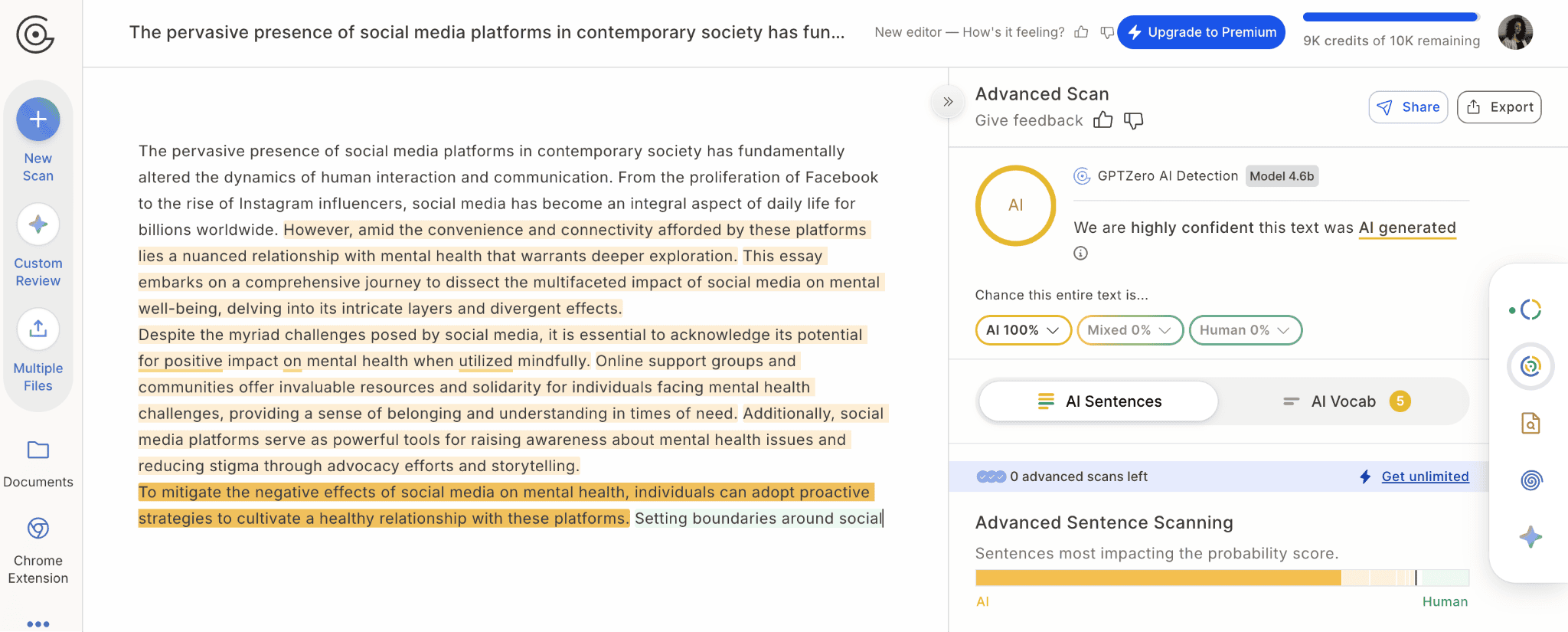
This shows that detection results can vary significantly between tools. If your college uses Turnitin, GPTZero scores alone may not give you a reliable picture of how your text will be detected.
Is Turnitin Better Than GPTZero for Different Users?
These are tools for different audiences, not direct substitutes.
For universities and educational institutions
Turnitin is the standard, and that institutional status is itself part of its value. Its integration with Canvas, Blackboard, and Moodle, its two-decade archive of student submissions, and its combined plagiarism and AI detection make it the most comprehensive integrity tool available. If you are running an institution, Turnitin's plagiarism detection alone justifies the cost. The AI detection is a useful addition, not the reason to buy it.
For individual educators and teachers
GPTZero is the practical choice. It is accessible without institutional procurement, free at useful word volumes, and provides more transparent sentence-level output that helps explain findings to students rather than just flagging a number.
For students checking their own work
Neither Turnitin nor GPTZero is ideal here. Turnitin is not available to most students directly. GPTZero is accessible but produces results that don't always match what Turnitin will show — meaning a clean GPTZero result does not guarantee a clean Turnitin submission.
JustDone's AI Detector is built specifically for this use case. It produces AI scores that are closely comparable to Turnitin's output on the same text, shows sentence-level detail explaining which sections drove the score and why, and includes a built-in AI Humanizer to fix flagged sections before submission. You are not just getting a number — you are getting a path to addressing what the number means.
Check Before You Submit With a Tool That's Built for It
The problem with both GPTZero and Turnitin for students is the same: you get the result after something has already happened. GPTZero gives you a score but no direct path to fixing what it flagged. Turnitin gives you the institutional result after you have already submitted.
JustDone's AI Detector gives you the pre-submission check that actually matters. Here is what makes it different:
- Sentence-level detection. You see exactly which sentences drove the AI score and why — not just an overall percentage. You know what to work on.
- Scores comparable to Turnitin. In direct testing on the same text, JustDone's AI Detector and Turnitin returned scores within one percentage point of each other. The result you see on JustDone is close to the result your professor will see.
- Built-in humanizer. When sentences are flagged, the AI Humanizer rewrites them at a structural level — addressing the sentence rhythm and phrase predictability that detectors actually measure, not just swapping vocabulary.
- One workflow. Detect, humanize the flagged sections, and verify again — all without switching tools or tabs. The check takes minutes. The alternative is finding out what Turnitin shows after you have already submitted.
If your work uses AI in any part of the writing process, even for brainstorming or grammar corrections, running it through JustDone's AI Detector before submission is the most practical safeguard available to students who do not have direct access to Turnitin.
Frequently Asked Questions
Is GPTZero better than Turnitin for AI detection?
GPTZero is more accessible and provides more transparent sentence-level output. Turnitin is more deeply integrated into academic systems and has a larger training dataset of student writing. GPTZero has a higher false positive rate in most independent tests. Turnitin deliberately misses some AI content to keep false positives low. Neither is universally better — they are optimized for different users.
Can GPTZero replace Turnitin?
Not for institutions. Turnitin includes plagiarism detection against a 900 million paper student archive that GPTZero does not have access to. For individual educators and students who need quick AI checks, GPTZero covers that use case. For formal institutional submission checking, Turnitin is still the standard.
Does a clean GPTZero result mean Turnitin will be clean too?
Not reliably. The two tools use different models, different training data, and different detection thresholds. A low score on GPTZero does not guarantee a low score on Turnitin. If your submission goes to Turnitin, checking it against a tool that closely mirrors Turnitin's scoring — like JustDone's AI Detector — is more predictive than a GPTZero result.
What is the false positive rate for GPTZero and Turnitin?
False positive rates vary significantly across studies and text types. Independent tests have found GPTZero's false positive rate ranging from under 1% in controlled benchmarks to 9 to 12% in real-world academic text tests. Turnitin's rate is generally lower, around 1 to 7%, because it is deliberately calibrated to reduce false positives even at the cost of missing some AI content. Both tools show dramatically higher false positive rates on formal academic writing and non-native English speaker text.
Is Turnitin better than GPT Zero for students?
Neither is ideal. Turnitin is not available to most students directly. GPTZero is accessible but, as our gpt zero vs Turnitin experiment showed, produces results that can differ from what Turnitin will show by as much as 44 percentage points. A clean GPTZero result does not guarantee a clean Turnitin submission.
Is Turnitin accurate for detecting ChatGPT?
Turnitin's AI detection was specifically trained on student writing combined with AI output, and it performs well on unedited ChatGPT text. Accuracy drops significantly on edited or paraphrased content. The tool intentionally operates at 85% detection sensitivity rather than maximum sensitivity, to keep false positives manageable.
Can students access Turnitin directly?
Generally no. Turnitin is sold to educational institutions, not to individual users. Students who want a pre-submission AI check comparable to what Turnitin will show can use JustDone's AI Detector, which produces scores closely aligned with Turnitin's output on the same text.
